


The droid that outlived its app
A graphing calculator, an ESP32, and a toy nobody can play with - until now...
Hasbro's Smart R2-D2 was sold in 2016 with an Android app that controlled it over Bluetooth. Modern phones will not install it, so the toy has lost a lot of its playability - until now!
Nothing is wrong with the robot. It still advertises itself over Bluetooth LE to anything that knows how to ask. What died was the software, and with it every one of these toys still sitting in a cupboard.
This project puts a Casio FX-9750 graphing calculator in charge of it, through the same 2.5 mm serial port and the same four-component interface circuit as every other build in this family of projects by the author. It then adds DroidX, a block-coding web page served by the ESP32 itself, so a phone or tablet can drive the droid with no app, no install, and no internet connection.
Not just a phone app
Restore phone control of your Hasbro Smart R2D2 The Casio remains a teaching tool connecting to R2D2 AT THE SAME TIME as the ESP32 serves an app to your phone, tablet or laptop webbrowser.
The calculator sends the commands. The ESP32 translates them into Bluetooth. The droid moves. And the calculator screen shows what the droid is actually doing, read back from the robot rather than assumed.
The calculator is the interesting control surface, but it is not the only one. Because the ESP32 has WiFi, it can run as its own access point and serve a page. A phone will not find the Hasbro R2D2 droid in its Bluetooth list, but it will find the ESP32 in its WiFi list. Join it, open a browser, and the controller appears.
DroidX is that page: snap blocks together into a sequence, press Run, and watch the droid execute it while the calculator mirrors each step. There is no app to install, no store, no account, and no internet connection anywhere in the chain.
[ Phone / tablet browser ]  --WiFi WebSocket-->  [ ESP32 ]  --serial-->  [ Casio screen ]
        DroidX block UI                              |
                                                     +--Bluetooth LE-->  [ droid ]
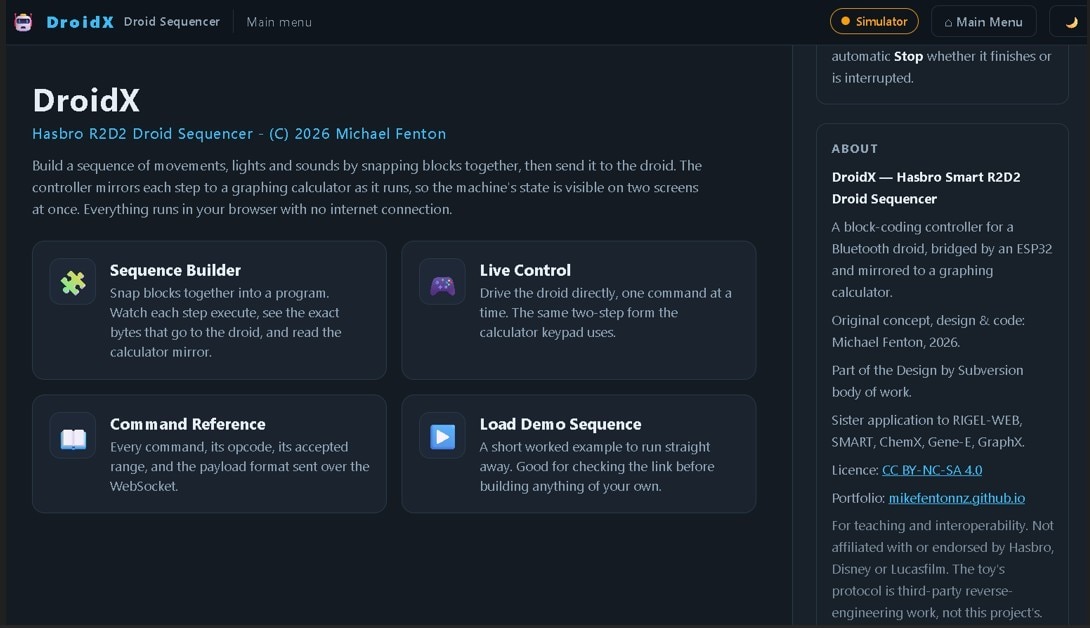
Not just a toy controller
This is an extension of my 2008 research, which carried classroom validation and student feedback, now with a modern facelift and cross-platform compatibility. Learners can record heart rate, temperature, sound level, and other readings using sensors they build themselves, for cents or a few dollars.
The simplest build is a Casio FX-9750 or FX-9860 graphing calculator, a microcontroller costing a few dollars, and a cross-over cable. Sensor readings arrive at a set interval and land in the calculator's own lists, where the graphing and statistics tools students already know are waiting for them.
For a few dollars more, the Casio can log data from remote sensors wirelessly and serve a web page with data to smart devices including phones, tablets, and laptops.
The calculator needs no modification or firmware change. It does not need to know what is on the other end of the cross-over cable.
https://mikefentonnz.github.io/projects/casio-calculator-r2d2-droidx.html
https://www.youtube.com/watch?v=7bs8HlcWaaY
All open source, low cost, for educational purposes only. And fun!