element14 Community
element14 Community
    Register Log In
  • Site
  • Search
  • Log In Register
  • Community Hub
    Community Hub
    • What's New on element14
    • Feedback and Support
    • Benefits of Membership
    • Personal Blogs
    • Members Area
    • Achievement Levels
  • Learn
    Learn
    • Ask an Expert
    • eBooks
    • element14 presents
    • Learning Center
    • Tech Spotlight
    • STEM Academy
    • Webinars, Training and Events
    • Learning Groups
  • Technologies
    Technologies
    • 3D Printing
    • FPGA
    • Industrial Automation
    • Internet of Things
    • Power & Energy
    • Sensors
    • Technology Groups
  • Challenges & Projects
    Challenges & Projects
    • Design Challenges
    • element14 presents Projects
    • Project14
    • Arduino Projects
    • Raspberry Pi Projects
    • Project Groups
  • Products
    Products
    • Arduino
    • Avnet & Tria Boards Community
    • Dev Tools
    • Manufacturers
    • Multicomp Pro
    • Product Groups
    • Raspberry Pi
    • RoadTests & Reviews
  • About Us
  • Store
    Store
    • Visit Your Store
    • Choose another store...
      • Europe
      •  Austria (German)
      •  Belgium (Dutch, French)
      •  Bulgaria (Bulgarian)
      •  Czech Republic (Czech)
      •  Denmark (Danish)
      •  Estonia (Estonian)
      •  Finland (Finnish)
      •  France (French)
      •  Germany (German)
      •  Hungary (Hungarian)
      •  Ireland
      •  Israel
      •  Italy (Italian)
      •  Latvia (Latvian)
      •  
      •  Lithuania (Lithuanian)
      •  Netherlands (Dutch)
      •  Norway (Norwegian)
      •  Poland (Polish)
      •  Portugal (Portuguese)
      •  Romania (Romanian)
      •  Russia (Russian)
      •  Slovakia (Slovak)
      •  Slovenia (Slovenian)
      •  Spain (Spanish)
      •  Sweden (Swedish)
      •  Switzerland(German, French)
      •  Turkey (Turkish)
      •  United Kingdom
      • Asia Pacific
      •  Australia
      •  China
      •  Hong Kong
      •  India
      • Japan
      •  Korea (Korean)
      •  Malaysia
      •  New Zealand
      •  Philippines
      •  Singapore
      •  Taiwan
      •  Thailand (Thai)
      • Vietnam
      • Americas
      •  Brazil (Portuguese)
      •  Canada
      •  Mexico (Spanish)
      •  United States
      Can't find the country/region you're looking for? Visit our export site or find a local distributor.
  • Translate
  • Profile
  • Settings
STEM Academy
  • Learn
  • Learning Center
  • STEM Academy
  • More
  • Cancel
STEM Academy
Blog Raspberry Pi - 90,000 above the Earth
  • Blog
  • Forum
  • Documents
  • Events
  • Polls
  • Files
  • Members
  • Mentions
  • Sub-Groups
  • Tags
  • More
  • Cancel
  • New
Join STEM Academy to participate - click to join for free!
  • Share
  • More
  • Cancel
Group Actions
  • Group RSS
  • More
  • Cancel
Engagement
  • Author Author: mikedavis
  • Date Created: 9 May 2015 2:35 AM Date Created
  • Views 1269 views
  • Likes 3 likes
  • Comments 10 comments
  • stem space
Related
Recommended

Raspberry Pi - 90,000 above the Earth

mikedavis
mikedavis
9 May 2015

My college recently received a grant from NASA that allows us to pursue high altitude balloon projects.  I have written about this before, and asked about some potential ideas for experiments and sensors.


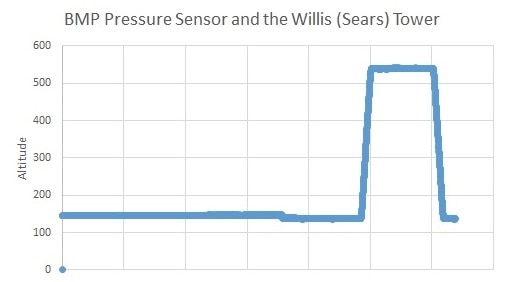
Today, in Lexington, IL we launched a balloon with some payloads on it.  This was our first launch, so our payload consisted of a pair of Raspberry Pi cameras, and an Arduino with the BMP Pressure/Temperature/Altitude Sensor.  Prior to the launch I tested the BMP sensor by taking it for a ride to the top of the Sears Tower. 
 

image

The sensor worked.  The shape of the curve is what I would expect, though the actual altitude values surprised me.  I am going to have to look in to how that is calculated.  At any rate, the circuit worked, and one of my students built in a red light / green light system to let us know if things are working.  After one test, everything looked great.


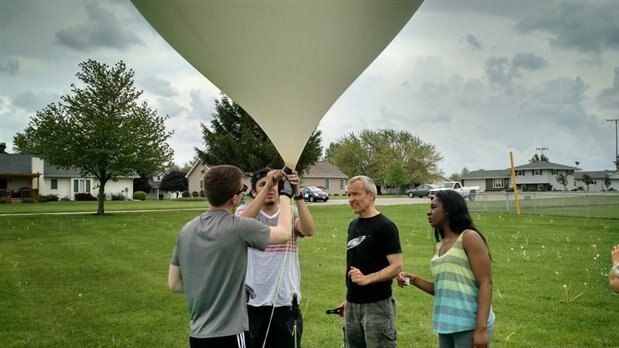
A storm was brewing in Lexington, so we had to hustle to get our balloon out in front of it.  We used a 1600g balloon with about 14 pounds of lift for roughly 8 pounds of payload.  (The FAA limits us to 12 pounds overall.) 
 

image


The sky behind us was getting pretty dark. 


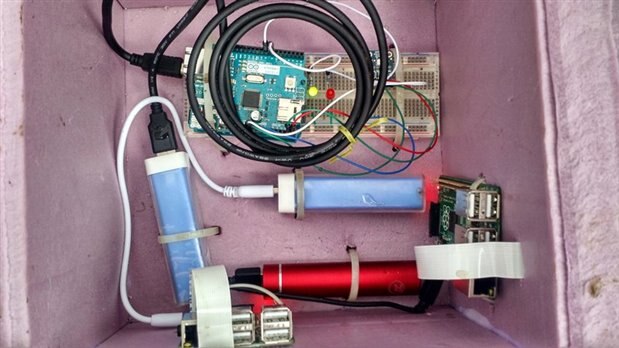
Our materials were packed into a foam box, held in place with cable ties.
 

image

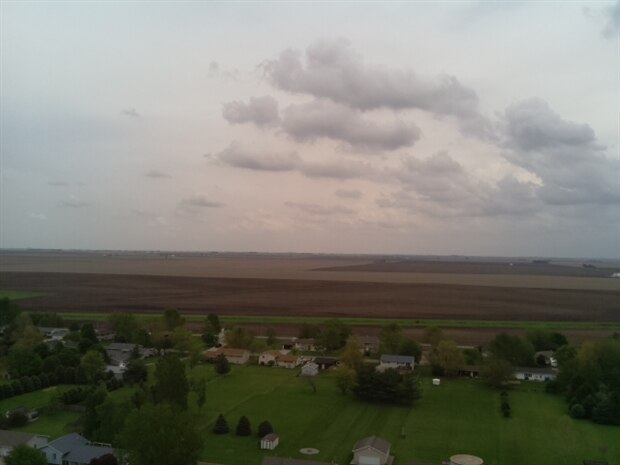
Once we did the pre-flight check, and we were convinced everything was working, we let the balloon fly.  The pictures below are just a few of the more than 2000 that our two Pi Cameras took at 10 second intervals. 
 

image

image

image


The balloon burst at an altitude of about 90,000.  In later pictures I can see the turbulence with a brief free fall before our parachute deployed.  Shortly after that, both cameras failed.  I think it might have something to do with the fact that the cameras were on the outside of the payload box, and it descended through a storm.  When it landed, both RPis were still on, but the cameras weren't taking pictures.


This was a tremendously fun project.  I have about six more planned over the summer, and we have more experiments to do.  We have some things to revise, but this was a great start.  Any guidance or suggestions from the community would be most welcome!

  • Sign in to reply

Top Comments

  • mikedavis
    mikedavis over 10 years ago in reply to mcb1 +2
    We see a real advantage to using RPis and Arduinos as our data loggers in experiments like this. They are inexpensive, and low power. So every time we fly, we will probably have at least one camera as…
  • dragonstyne
    dragonstyne over 10 years ago +1
    Outstanding! Congratulations to you and your team. perhaps, you could enclose the cameras and place a tube coaling around the apertures to protect them and limit optical distortion. [][][]Steve
  • mcb1
    mcb1 over 10 years ago +1
    mikedavis Nice work. There is some interest here, and I know someone who has some Raspberry Pi's that he might be able to donate for the cause. Your sensor may require to be calibrated aginst the barometric…
Parents
  • DAB
    DAB over 10 years ago

    Very cool post.


    Given the RPi sensitivity to light, I was curious if it would work at that latitude given the increase in radiation levels.


    If you are concerned about lightning, wrap the inside or outside with aluminum foil or copper screen so you make your own faraday cage.


    DAB

    • Cancel
    • Vote Up +1 Vote Down
    • Sign in to reply
    • More
    • Cancel
Comment
  • DAB
    DAB over 10 years ago

    Very cool post.


    Given the RPi sensitivity to light, I was curious if it would work at that latitude given the increase in radiation levels.


    If you are concerned about lightning, wrap the inside or outside with aluminum foil or copper screen so you make your own faraday cage.


    DAB

    • Cancel
    • Vote Up +1 Vote Down
    • Sign in to reply
    • More
    • Cancel
Children
  • mikedavis
    mikedavis over 10 years ago in reply to DAB

    Thanks, I forgot about that.  It was inside a foam box, but we may need to do some additional shielding.

    • Cancel
    • Vote Up +1 Vote Down
    • Sign in to reply
    • More
    • Cancel
element14 Community

element14 is the first online community specifically for engineers. Connect with your peers and get expert answers to your questions.

  • Members
  • Learn
  • Technologies
  • Challenges & Projects
  • Products
  • Store
  • About Us
  • Feedback & Support
  • FAQs
  • Terms of Use
  • Privacy Policy
  • Legal and Copyright Notices
  • Sitemap
  • Cookies

An Avnet Company © 2025 Premier Farnell Limited. All Rights Reserved.

Premier Farnell Ltd, registered in England and Wales (no 00876412), registered office: Farnell House, Forge Lane, Leeds LS12 2NE.

ICP 备案号 10220084.

Follow element14

  • X
  • Facebook
  • linkedin
  • YouTube