element14 Community
element14 Community
    Register Log In
  • Site
  • Search
  • Log In Register
  • Community Hub
    Community Hub
    • What's New on element14
    • Feedback and Support
    • Benefits of Membership
    • Personal Blogs
    • Members Area
    • Achievement Levels
  • Learn
    Learn
    • Ask an Expert
    • eBooks
    • element14 presents
    • Learning Center
    • Tech Spotlight
    • STEM Academy
    • Webinars, Training and Events
    • Learning Groups
  • Technologies
    Technologies
    • 3D Printing
    • FPGA
    • Industrial Automation
    • Internet of Things
    • Power & Energy
    • Sensors
    • Technology Groups
  • Challenges & Projects
    Challenges & Projects
    • Design Challenges
    • element14 presents Projects
    • Project14
    • Arduino Projects
    • Raspberry Pi Projects
    • Project Groups
  • Products
    Products
    • Arduino
    • Avnet & Tria Boards Community
    • Dev Tools
    • Manufacturers
    • Multicomp Pro
    • Product Groups
    • Raspberry Pi
    • RoadTests & Reviews
  • About Us
  • Store
    Store
    • Visit Your Store
    • Choose another store...
      • Europe
      •  Austria (German)
      •  Belgium (Dutch, French)
      •  Bulgaria (Bulgarian)
      •  Czech Republic (Czech)
      •  Denmark (Danish)
      •  Estonia (Estonian)
      •  Finland (Finnish)
      •  France (French)
      •  Germany (German)
      •  Hungary (Hungarian)
      •  Ireland
      •  Israel
      •  Italy (Italian)
      •  Latvia (Latvian)
      •  
      •  Lithuania (Lithuanian)
      •  Netherlands (Dutch)
      •  Norway (Norwegian)
      •  Poland (Polish)
      •  Portugal (Portuguese)
      •  Romania (Romanian)
      •  Russia (Russian)
      •  Slovakia (Slovak)
      •  Slovenia (Slovenian)
      •  Spain (Spanish)
      •  Sweden (Swedish)
      •  Switzerland(German, French)
      •  Turkey (Turkish)
      •  United Kingdom
      • Asia Pacific
      •  Australia
      •  China
      •  Hong Kong
      •  India
      • Japan
      •  Korea (Korean)
      •  Malaysia
      •  New Zealand
      •  Philippines
      •  Singapore
      •  Taiwan
      •  Thailand (Thai)
      • Vietnam
      • Americas
      •  Brazil (Portuguese)
      •  Canada
      •  Mexico (Spanish)
      •  United States
      Can't find the country/region you're looking for? Visit our export site or find a local distributor.
  • Translate
  • Profile
  • Settings
STEM Academy
  • Learn
  • Learning Center
  • STEM Academy
  • More
  • Cancel
STEM Academy
Blog Simple Science Experiment with the Raspberry Pi
  • Blog
  • Forum
  • Documents
  • Events
  • Polls
  • Files
  • Members
  • Mentions
  • Sub-Groups
  • Tags
  • More
  • Cancel
  • New
Join STEM Academy to participate - click to join for free!
  • Share
  • More
  • Cancel
Group Actions
  • Group RSS
  • More
  • Cancel
Engagement
  • Author Author: mikedavis
  • Date Created: 2 Sep 2014 6:13 PM Date Created
  • Views 2478 views
  • Likes 1 like
  • Comments 8 comments
  • science
  • temperature
  • raspberrypi
  • probe
  • fair
  • sensor
  • stem space
Related
Recommended

Simple Science Experiment with the Raspberry Pi

mikedavis
mikedavis
2 Sep 2014

Since I got my first Raspberry Pi, I have been struggling to find a simple science experiment that I could do around the house.  I wanted to do something interesting, that used something I was familiar with.  It also had to involve temperature since that was the only probe I owned at the time.


I have a glass beaker mug that I got from a conference.  I don't remember the conference, but that was a highly coveted piece of swag from the exhibition floor, and I felt that I was luck to have it.  As cool as it looks, it is the worst mug I own.  Drinking coffee from that mug is like a drinking contest; it cools down so fast!  So I decided to see what coffee mug acts as the best insulator.


This has all of the core components of a classic science fair project.

  • Observation:  My coffee gets cold too quickly in this mug.
  • Hypothesis:  I bet other mugs might be better.
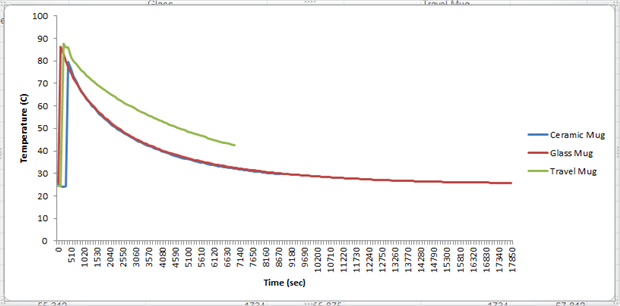
  • Experiment:  I can measure the temperature of water as it cools down over a long period of time using a temperature probe.
    • Heat 300mL of water (the beaker mug has graduation marks, so it isn't totally worthless) for 2 minutes in the microwave.
    • Pour the hot water into the mug of choice.
    • Stick in the temperature probe.
    • Watch the temperature drop as it cools down.
  • Conclusion:  None yet, but my travel mug seems to be doing the best.
 

image

I am a little surprised by this.  I thought my ceramic mugs were better than my glass mug.  According to this, there is little to no difference.


I also leads me to other questions:

  • Are there other better ceramic mugs in my house.
  • Will a lid help?
  • What about a travel mug without a lid?
  • What is the optimal drinking temperature - the best mug should be there the longest?


It took most of Labor Day to collect this data, and I did most of it while I was doing other things.  I have posted on the temperature probe before.  Again, because the RPi is a dedicated computer, I can dedicate it to watching temperatures for a long time, and do some calculations with it.


I wish I were young enough to enter it in the Science Fair!

  • Sign in to reply

Top Comments

  • jw0752
    jw0752 over 11 years ago +1
    This is a very good experiment and a good science application of the temperature probe and the Raspberry Pi. You can't however go back and use it as a school science experiment. Fortunately, now you have…
  • shabaz
    shabaz over 11 years ago +1
    These kinds of experiments are always the most fun,since one learns a lot not just about the desired experiment itself, but also about the methods used to perform the tests, like what probes are good,…
  • michaelwylie
    michaelwylie over 11 years ago +1
    I think you should try to determine the heat transfer coefficients for each of the materials.
Parents
  • jw0752
    jw0752 over 11 years ago

    This is a very good experiment and a good science application of the temperature probe and the Raspberry Pi. You can't however go back and use it as a school science experiment. Fortunately, now you have Element 14 to do the experiment for. I want to see the result for a styrofoam cup.

    John

    • Cancel
    • Vote Up +1 Vote Down
    • Sign in to reply
    • More
    • Cancel
Comment
  • jw0752
    jw0752 over 11 years ago

    This is a very good experiment and a good science application of the temperature probe and the Raspberry Pi. You can't however go back and use it as a school science experiment. Fortunately, now you have Element 14 to do the experiment for. I want to see the result for a styrofoam cup.

    John

    • Cancel
    • Vote Up +1 Vote Down
    • Sign in to reply
    • More
    • Cancel
Children
  • mikedavis
    mikedavis over 11 years ago in reply to jw0752

    I plan to do a styrofoam cup (with and without lid).  I also want to do a single paper (Starbucks) cup, and a pair of nested cups.  I don't know if more cups leads to better insulation, but this is a good way to find out.

    • Cancel
    • Vote Up 0 Vote Down
    • Sign in to reply
    • More
    • Cancel
element14 Community

element14 is the first online community specifically for engineers. Connect with your peers and get expert answers to your questions.

  • Members
  • Learn
  • Technologies
  • Challenges & Projects
  • Products
  • Store
  • About Us
  • Feedback & Support
  • FAQs
  • Terms of Use
  • Privacy Policy
  • Legal and Copyright Notices
  • Sitemap
  • Cookies

An Avnet Company © 2025 Premier Farnell Limited. All Rights Reserved.

Premier Farnell Ltd, registered in England and Wales (no 00876412), registered office: Farnell House, Forge Lane, Leeds LS12 2NE.

ICP 备案号 10220084.

Follow element14

  • X
  • Facebook
  • linkedin
  • YouTube