element14 Community
element14 Community
    Register Log In
  • Site
  • Search
  • Log In Register
  • Community Hub
    Community Hub
    • What's New on element14
    • Feedback and Support
    • Benefits of Membership
    • Personal Blogs
    • Members Area
    • Achievement Levels
  • Learn
    Learn
    • Ask an Expert
    • eBooks
    • element14 presents
    • Learning Center
    • Tech Spotlight
    • STEM Academy
    • Webinars, Training and Events
    • Learning Groups
  • Technologies
    Technologies
    • 3D Printing
    • FPGA
    • Industrial Automation
    • Internet of Things
    • Power & Energy
    • Sensors
    • Technology Groups
  • Challenges & Projects
    Challenges & Projects
    • Design Challenges
    • element14 presents Projects
    • Project14
    • Arduino Projects
    • Raspberry Pi Projects
    • Project Groups
  • Products
    Products
    • Arduino
    • Avnet & Tria Boards Community
    • Dev Tools
    • Manufacturers
    • Multicomp Pro
    • Product Groups
    • Raspberry Pi
    • RoadTests & Reviews
  • About Us
  • Store
    Store
    • Visit Your Store
    • Choose another store...
      • Europe
      •  Austria (German)
      •  Belgium (Dutch, French)
      •  Bulgaria (Bulgarian)
      •  Czech Republic (Czech)
      •  Denmark (Danish)
      •  Estonia (Estonian)
      •  Finland (Finnish)
      •  France (French)
      •  Germany (German)
      •  Hungary (Hungarian)
      •  Ireland
      •  Israel
      •  Italy (Italian)
      •  Latvia (Latvian)
      •  
      •  Lithuania (Lithuanian)
      •  Netherlands (Dutch)
      •  Norway (Norwegian)
      •  Poland (Polish)
      •  Portugal (Portuguese)
      •  Romania (Romanian)
      •  Russia (Russian)
      •  Slovakia (Slovak)
      •  Slovenia (Slovenian)
      •  Spain (Spanish)
      •  Sweden (Swedish)
      •  Switzerland(German, French)
      •  Turkey (Turkish)
      •  United Kingdom
      • Asia Pacific
      •  Australia
      •  China
      •  Hong Kong
      •  India
      • Japan
      •  Korea (Korean)
      •  Malaysia
      •  New Zealand
      •  Philippines
      •  Singapore
      •  Taiwan
      •  Thailand (Thai)
      • Vietnam
      • Americas
      •  Brazil (Portuguese)
      •  Canada
      •  Mexico (Spanish)
      •  United States
      Can't find the country/region you're looking for? Visit our export site or find a local distributor.
  • Translate
  • Profile
  • Settings
STEM Projects
  • Learn
  • Learning Center
  • STEM Academy
  • STEM Projects
  • More
  • Cancel
STEM Projects
Blog Shedule & Homework Robot - Sound System's Hardware (part #2)
  • Blog
  • Forum
  • Documents
  • Events
  • Polls
  • Files
  • Members
  • Mentions
  • Sub-Groups
  • Tags
  • More
  • Cancel
  • New
Join STEM Projects to participate - click to join for free!
  • Share
  • More
  • Cancel
Group Actions
  • Group RSS
  • More
  • Cancel
Engagement
  • Author Author: yuritikhonov
  • Date Created: 14 May 2015 7:59 AM Date Created
  • Views 924 views
  • Likes 2 likes
  • Comments 7 comments
  • schedule_bot
  • teachers_pet
  • robot
  • matlab
  • teachers pet robotics design challenge
  • arduino
Related
Recommended

Shedule & Homework Robot - Sound System's Hardware (part #2)

yuritikhonov
yuritikhonov
14 May 2015

Good day comrade!


Today we'll talk about the audio hardware of my robot. Generally speaking, my sound system will consist of two parts:

  • melody generator;
  • speech generator.


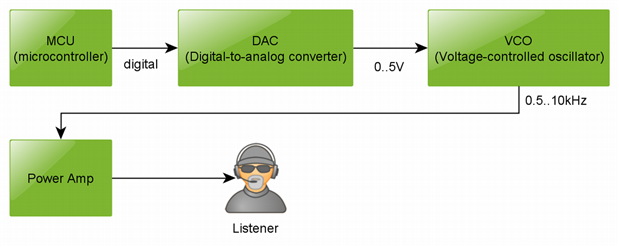
The latter will be discussed in a future article, but today (and next week), our attention will be focused on the melody generator. So here's what I came up with:
image

The circuit operates as follows:

  • digital code of note comes from the MCU to the DAC;
  • DAC converts the note into an analog signal U = 0..5V;
  • analog signal U is fed to VCO, which converts it into frequency f = 0.5..10kHz;
  • frequency signal f from VCO is supplied with the power amplifier;
  • signal from the power amplifier enters the loudspeaker from which the sound is coming.


Pretty simple!

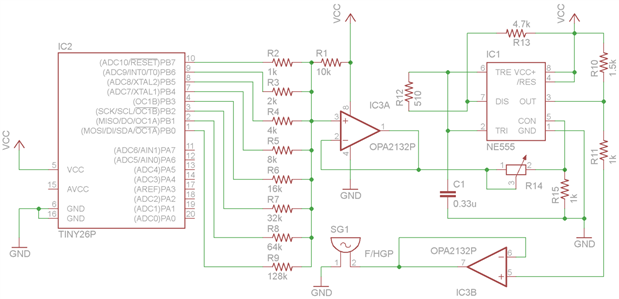
Circuitry of our "sound card" is very simple and clear:
image

Let's look at the purpose of each part:

  • IC2 - microcontroller generating digital codes;
  • R1-R10 and IC3A - improvised DAC;
  • IC1, R10-R13 and C1 - a simple VCO, built on classic 555 timer;
  • R14-R15 - frequency control (for fine tuning);
  • IC3B - power amplifier (U = const, I - enhanced);
  • SG1 - piezo speaker.


I’d like to explain one thing: DAC in this scheme is performed on the base  of  voltage divider, but you may have noticed that the scheme additionally uses Op-Amp IC3A. Why is it needed? Everything is very simple! In this case IC3A is used as a buffer stage to avoid the influence of signals from outside on the DAC.


Well, we’ve got the scheme, it's time to put it into practice! To begin with, I had to walk to the store and buy all the necessary electronic components:

image

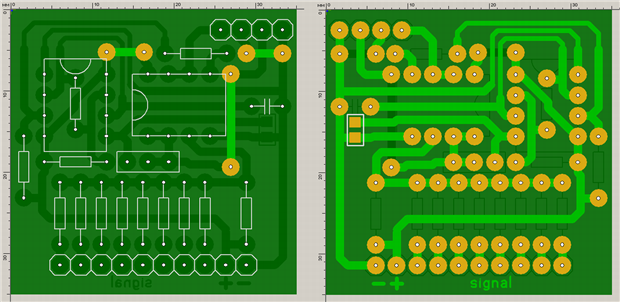
Then came the hour of manufacturing PCB. The board is very simple, and I decided to draw it in not less simple program Sprint Layout:
image

Finally, I made the PCB. Traditionally, for this purpose, I used an iron and a laser printer:

image

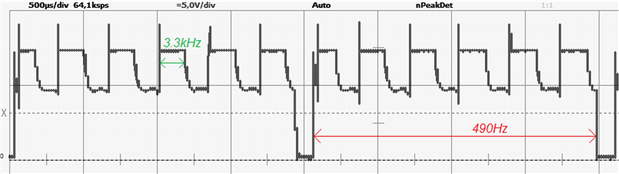
And now it's time to test! The scheme worked at once, but an important drawback of piezo speaker was detected: these speakers have their own oscillation frequency (in my case 3.3kHz) and in case of applying to the speaker of a less frequency (e.g. 490Hz), the frequencies are summed:
image

In general, this does not prevent the system to work, but if I get a chance, I will get a normal speaker capable of reproducing clear sound.


Finally, I offer you a short video showing the work of my "sound card":

You don't have permission to edit metadata of this video.
Edit media
x
image
Upload Preview
image


Next week, we will create music for our "sound card" using Matlab. See you soon!

  • Sign in to reply

Top Comments

  • dragonstyne
    dragonstyne over 10 years ago +1
    Nice job so far Yuri. [][][]Steve
  • Robert Peter Oakes
    Robert Peter Oakes over 10 years ago +1
    have you looked at using an R-2R ladder for the resistor network, it would simplify the DAC by only requiring 2 resistor values and is a common technique for making DACS See the WIKI page for more details…
  • DAB
    DAB over 10 years ago +1
    Are you going to use a real time clock chip to keep track of days and hours or just run off of the board clock? DAB
  • yuritikhonov
    yuritikhonov over 10 years ago in reply to anujaapte

    Thanks for advice! I'll try it.

    • Cancel
    • Vote Up 0 Vote Down
    • Sign in to reply
    • More
    • Cancel
  • anujaapte
    anujaapte over 10 years ago

    Here's a tutorial that may be relevant - Create your own music with Simulink and Arduino

    • Cancel
    • Vote Up +1 Vote Down
    • Sign in to reply
    • More
    • Cancel
  • yuritikhonov
    yuritikhonov over 10 years ago in reply to DAB

    Hi DAB! I'm glad to see you again!


    I'm use 555 timer (it is not a real time clock) to generate sound.


    But your Idea is a really good! I have some real time clock IC's in my collection and if I find some extra time - I'll use it in my project!

    • Cancel
    • Vote Up 0 Vote Down
    • Sign in to reply
    • More
    • Cancel
  • DAB
    DAB over 10 years ago

    Are you going to use a real time clock chip to keep track of days and hours or just run off of the board clock?


    DAB

    • Cancel
    • Vote Up +1 Vote Down
    • Sign in to reply
    • More
    • Cancel
  • yuritikhonov
    yuritikhonov over 10 years ago in reply to Robert Peter Oakes

    Yep, I know about R-2R DAC but in my case for this circuit I need a little more components (resistors). But yes! My circuit is more complex in adjustments.

    • Cancel
    • Vote Up 0 Vote Down
    • Sign in to reply
    • More
    • Cancel
>
element14 Community

element14 is the first online community specifically for engineers. Connect with your peers and get expert answers to your questions.

  • Members
  • Learn
  • Technologies
  • Challenges & Projects
  • Products
  • Store
  • About Us
  • Feedback & Support
  • FAQs
  • Terms of Use
  • Privacy Policy
  • Legal and Copyright Notices
  • Sitemap
  • Cookies

An Avnet Company © 2025 Premier Farnell Limited. All Rights Reserved.

Premier Farnell Ltd, registered in England and Wales (no 00876412), registered office: Farnell House, Forge Lane, Leeds LS12 2NE.

ICP 备案号 10220084.

Follow element14

  • X
  • Facebook
  • linkedin
  • YouTube