

.jpg)

Introduction
In industrial environments, it is imperative that digital signal processing (DSP)-intensive applications at the edge deliver efficient performance. Applications such as electric drives and motor controllers require high compute throughput and deterministic, low-latency performance for precise control. Failure to do so can cause compute-intensive DSP workloads to exhibit unpredictable or inaccurate behaviour. The result can be performance degradation, reliability concerns, and even safety risks.
Traditionally, overcoming these challenges required complex hardware design and lengthy development cycles, making it difficult to balance performance with cost and time-to-market. The AMD KriaTM K24 System-on-Modules (SOMs) and Kria KD240 drives starter kits address these challenges. The K24 SOM offers a power-, performance-, and cost-optimized platform in a compact production-ready form factor. This article explores how the K24 SOM and KD240 starter kit enable architects and engineers to create reliable, high-performance motor control and DSP solutions at the edge. The kit bridges the gap between development efficiency and industrial-grade deployment.
2. Latency and Determinism in Industrial Motion Control
Definitions
Latency is the time delay between an input signal and the corresponding system response. In industrial motion control, it is the time between an input and the corresponding motor output. Even microseconds of delay can compromise motion precision. Conversely, determinism is the ability of the system to execute consistent and predictable control loops. This eliminates jitter and ensures reliable performance under load. A deterministic system helps ensure that every operation executes within a defined time frame.
Impacts of High Latency and Low Determinism
In industrial motion control, high latency and low determinism can degrade accuracy, as latency and determinism directly influence system performance, reliability, and safety. Machines can sustain optimal operating speeds only if there is precision, a lack of which results in reduced throughput and unpredictable response time. Performance degradation can extend to inconsistent control timing. There can be greater wear, heat buildup, and vibration. The result is shortened equipment lifespan and higher maintenance costs. Traditionally, these challenges were reduced using custom ASICs, DSPs, or FPGAs, which require deep hardware expertise.
To identify the position of the moving rotor, the controller uses a sensor attached to the stator that provides the angled position of the rotor based on an agreed reference point. In short, it's reporting an angle measurement. Based on this angle, the controller tries to optimize the drive, creating the proper amount of current for every motor phase and enabling the motor to operate at maximum efficiency. Without this information, the motor would spin inefficiently, consuming a lot of current and eventually overheating, or it would spin and not efficiently produce the maximum amount of torque possible.
Solution: AMD KriaTM K24 SOM
In industrial motion control, it is critical to achieve low latency and high determinism. This is because jitter or unpredictable delays can compromise efficiency, safety, and performance. Motor control solutions based on standard microcontrollers are limited when it comes to switching frequency.
The AMD KriaTM K24 SOM, paired with the Kria KD240 drives starter kit, directly addresses issues such as low latency and high determinism by offering deterministic control loops and significantly lower latency than traditional SoCs. In fact, tests show up to twice lower latency in single-axis drives than competitive devices, with even greater benefits as the number of motor axes scales, thanks to FPGA logic that enables independent rather than time-multiplexed loops.1
The K24 SOM is equipped with built-in pulse-width modulation (PWM) capabilities. It uses programmable logic to enable continuous current measurement and real-time processing, ensuring smooth, accurate, and energy-efficient operation. By fine-tuning voltage modulation, the K24 SOM enables precise motor speed control while simultaneously reducing electromagnetic interference (EMI). Unlike traditional software-driven control loops, AMD hardware-based execution provides deterministic performance for demanding industrial drives by reducing interrupt delays and jitter. This hardware-first approach simplifies design and enhances system reliability by solving common issues associated with software routines.
The key advantages of using this solution are:
- AI-enabled intelligence – The K24 SOM collects and analyzes parameters like current, torque, and position to enable predictive maintenance, anomaly detection, and functional safety.
- Scalability for multi-motor systems – FPGA parallelism allows synchronized control of complex setups such as six-axis robotics or multiple coordinated drives.
- Flexible multiprotocol support – Compatibility with encoder/sensor standards like EnDat, BiSS, and Hiperface DSL ensures adaptability and future-proof motion control designs.
- Advanced modulation capabilities – Engineers can implement scalable, custom modulation schemes in programmable logic, spreading harmonics to reduce acoustic noise and torque ripple.
- Deterministic real-time performance – Hardware-accelerated control loops deliver sub-millisecond latency, supporting high-frequency SiC-based power electronics and ensuring consistent, reliable motor control.
3. Introducing the AMD KriaTM K24 SOM
Features and Operation
The AMD KriaTM K24 SOM is a powerful solution for next-generation electric drives and motion control applications at the edge. It is built on the AMD ZynqTM UltraScale+TM MPSoC and integrates programmable logic, dual-core Arm® Cortex®-R5F real-time processors, and high-performance cores. It integrates FPGA-based adaptive system-on-chip technology into a compact, production-ready format, designed specifically for high-performance, real-time motor control in industrial applications.
This architecture allows hardware acceleration of time-critical paths while minimizing jitter, making it ideal for compute-intensive DSP workloads. The design also supports modern power electronics, such as silicon carbide devices, by providing fast, deterministic loops at high switching frequencies. The K24 SOM is optimized for power efficiency and reliability in industrial environments, with ECC memory, thermal robustness, and extended lifecycle support (Figure 1). The K24 SOM also offers two security features: dedicated hardware built into the MPSoC and an on-board trusted platform module (TPM) device. It allows synchronization of multiple motors and offers on-board error correction and system monitoring.

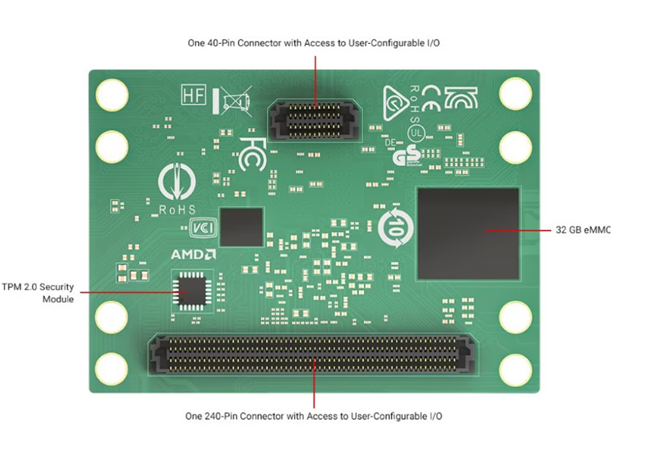
Figure 1: Picture showing the front and back sides of the AMD KriaTM K24 SOM
Some of the key benefits of the K24 SOM for motor control include:
- Security Features: AMD motor control solutions offer multiple security features, from tamper monitoring to license management.
- Multiple Industrial Networking Protocol Support: AMD solutions support multiple industrial networking protocols, delivering high design flexibility.
- Functional Safety: AMD solutions are built to support the latest functional safety standards.
- Low Latency: AMD motor control solutions deliver low latency between IT and operational tasks for high-speed performance.
- Standard Industrial Networking: Besides TSN, it can support other industrial networking standards, such as EtherCAT®, PROFINET®, EtherNet/IP®, and many more.
- Standard Fieldbus: The K24 SOM supports the CAN interface, and the KD240 drives starter kit offers a connector for the CAN 2.0 interface.
4. Getting Started with the AMD KriaTM KD240 Drives Starter Kit
The AMD KriaTM KD240 drives starter kit is the latest out-of-the-box ready development platform in the Kria portfolio. This starter kit serves as a platform for developing electric drives and other size and cost-constrained applications. The kit consists of a non-production AMD Kria K24 SOM plugged into a drives application carrier card and equipped with a passive heatsink. The K24 SOM included in the starter kit is based on the AMD ZynqTM UltraScale+TM MPSoC and paired with 2 GB of LPDDR4 memory. The starter kit is also drives-application ready because it features a three-phase inverter, quadrature encoder interface, brake control, and torque sensor interface. Beyond the drives-specific interfaces, there are host of other interfaces for general purpose developers including connectivity through Ethernet and USB ports, and flexible I/O expandability via a Pmod connector. Figure 2 shows the details of the components of the KD240 drives starter kit.
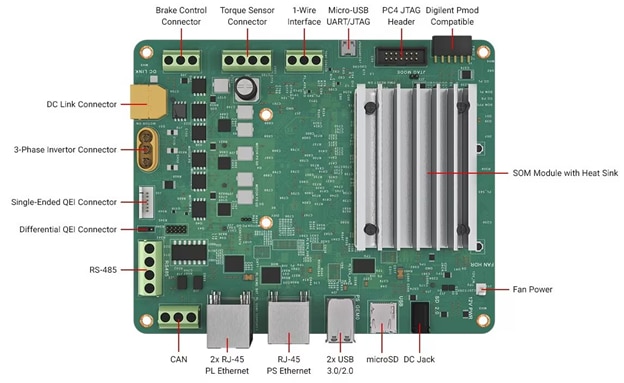
Figure 2: AMD KriaTM KD240 Drives Starter Kit
Software Support
The solution is pre-certified for industrial use, simplifying both hardware and software development requirements. It is simplified signal processing supports many design flows, including familiar design tools like MATLAB, Simulink, and languages like Python, with its extensive ecosystem and support for the PYNQ framework.
The Kria Robotics Stack (KRS), a ROS 2 superset, enhances AMD KriaTM K24 SOM by enabling hardware-accelerated robotics development. It provides optimized libraries, secure compute architectures, and seamless integration for industrial-grade robotics. With support for low latency, determinism, real-time performance, and high throughput, KRS empowers ROS 2 developers to build and deploy advanced robotic solutions faster and more efficiently on adaptive computing platforms.
Out-of-the-box Demo Information
The AMD KriaTM K24 SOM, coupled with the Kria KD240 drives starter kit, is an out-of-the-box-ready tool for developers building compute-intensive motor control applications.
It benefits from a rich ecosystem, including pre-built motor control libraries and the KD240 kit, which enables out-of-the-box validation without FPGA expertise. It leverages multiple development flows, including Python, the MATLAB® Simulink® environment, and more.
This demo highlights how quickly engineers can set up the KD240 drives starter kit and run a sensor-based Field-Oriented Control (FOC) hardware accelerated application. After flashing the provided microSD card with the latest AMD image and mounting the kit to the motor accessory plate, users simply connect Ethernet, USB-UART, motor accessory kit cables, and power. The setup requires no FPGA expertise.
Once powered, the kit boots into Ubuntu, where the FOC motor control application is installed and launched. A browser-based GUI allows engineers to remotely control and monitor motor performance, such as adjusting RPM in real time.
The entire setup from unboxing to running the FOC application takes less than an hour, showcasing the KD240 drive starter kit’s ease of use and rapid prototyping capability. Beyond this demo, engineers can explore additional accelerated applications through the Kria App Store, enabling quick evaluation and deployment across motor control and DSP use cases. With production-ready Kria SOMs available, the KD240 drivers starter kit provides a seamless path from development to deployment in both commercial and industrial environments.
5. Conclusion
Summary
Latency and determinism are critical challenges in industrial motion control. Traditional microcontroller-based systems often fall short, introducing unpredictable delays and limiting the adoption of modern high-frequency technologies like SiC. The AMD KriaTM K24 SOM and the Kria KD240 drives starter kit provide engineers with a production-ready, adaptive platform that ensures deterministic, low-latency control. By integrating programmable logic, robust security, and OTA update capability, the K24 SOM delivers long-term value for industrial edge deployments. With its out-of-the-box usability, scalability, and proven reliability, the K24 SOM allows engineers to move quickly from prototyping to deployment—achieving higher precision, safer operation, and extended equipment lifecycles.
To explore the AMD KriaTM K24 SOM and Kria KD240 drives starter kit, visit:
- AMD KriaTM KD240 Drives Starter Kit
- AMD KriaTM K24 SOM
- Boot Kria Starter Kit Linux on AMD KriaTM KD240
1Based on AMD internal analysis in August 2023, using the latency results reported by TI for a full control loop implementation on a Texas Instruments AM64xx standard SOC using a Texas Instruments benchmark vs. the latency results of a full control loop implementation using a Field Oriented Control algorithm designed by Qdesys. System configuration for the TI AM64xx SOC system: TMDS64EVM board; configuration for the Kria K24 SOM system: KD240 starter kit. The latency advantage improves up to 7x as the number of motor axes increases. Actual results will vary. (SOM-003)
AMD, and the AMD Arrow logo, Kria, UltraScale+, Zynq, and combinations thereof are trademarks of Advanced Micro Devices, Inc. Other product names used in this publication are for identification purposes only and may be trademarks of their respective owners.
About the sponsor

AMD drives innovation in high-performance and AI computing to solve the world’s most important challenges. Today, AMD technology powers billions of experiences across cloud and AI infrastructure, embedded systems, AI PCs and gaming. With a broad portfolio of AI-optimized CPUs, GPUs, networking and software, AMD delivers full-stack AI solutions that provide the performance and scalability needed for a new era of intelligent computing. Learn more at amd.com.
