

.jpg)

 Universal Serial Bus (USB) is one of the leading serial communication standards in modern electronics. It is present in domestic applications, factory floors, vehicles, and outdoor infrastructures. However, not all environments are as clean as your home or car, especially those found in factories or outdoors. In these environments, water, dust particles, and oil ingress are the main culprits of intermittent faults and premature USB failures. Standard USB connectors are not designed for use in wash-down environments, exposure to rain, or in areas with airborne particulates. The absence of a sealing cover, lightweight backshell, and exposed contacts can lead to corrosion, compromising signal integrity and leading to premature failure. L-com overcomes these challenges with its IP-rated, waterproof USB cables, designed to withstand the dust and moisture often found in manufacturing and other difficult environments. This article explains the key elements of waterproof USB cabling, best installation practices, and USB cabling solutions available from L-Com for deployment in harsh environments.
Engineering the seal: What makes a USB cable truly “waterproof”?
A waterproof USB connector requires more than a simple rubber boot or splash-resistant coating to achieve genuine environmental protection. Several critical mechanical design choices and factors determine a USB connector's waterproof rating:
- IP Rating: Waterproof USB cables are specified using an Ingress Protection (IP) rating. IP ratings are defined by the IEC 60529 standards and are represented by two-digit codes. The first digit refers to the ingress of a solid foreign object. The second digit indicates the level of protection against liquid intrusion. Common waterproof ratings for USB cables include:
- IP67: Fully dust-proof and survives being submerged in 1 meter of water for 30 minutes.
- IP68: Fully dust-proof and can remain underwater deeper than 1 meter for the duration specified by the manufacturer.
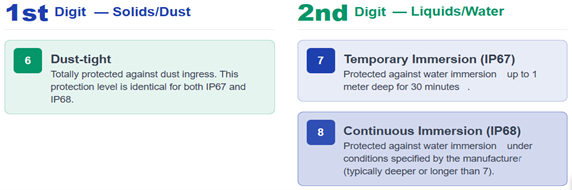
Figure 1: IP67 vs IP68 waterproof rating comparison for USB connectors
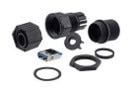
- Threaded couplings and O-ring seals provide the primary environmental seal: These create a positive, repeatable seal at the mating surface helping to achieve the IP67 rating in real-world deployments. The threaded coupling draws the two connector halves together while the elastomer O‑ring compresses to exclude water and particles at the interface.
- Rugged backshell: Molded backshells resist impact, flex, and cable side‑loads, which are common on machinery and vehicles. They also help control strain where the cable meets the connector, reducing micro‑fractures and shielding damage.
- Gold‑plated contacts and shielding: A typical 30 µin gold contact plating supports reliable mating cycles under varying vibration, humidity, and temperature conditions. Additionally, a combination of foil and braid shielding effectively resists EMI/RFI, ensuring signal integrity remains within USB specifications.
- Panel‑mount options: Bulkhead jacks with flying leads facilitate bringing a sealed USB feed‑through to the outside of an enclosure without compromising the cabinet’s ingress protection.
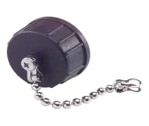
- Port covers and caps: An open, exposed receptacle breaks the sealing chain and compromises it. Port covers and caps preserve the seal when ports are unused.
Best practices for selecting and deploying waterproof USB: selection, installation, and lifecycle
Achieving reliable waterproof USB connectivity extends beyond simply selecting an IP-rated cable. It requires careful component selection, proper installation techniques, and proactive lifecycle management to ensure long-term performance in harsh environments while minimizing the total cost of ownership.
Right connector family and data rate: Selecting the correct USB connector and version is crucial for data and power transfer. For example, USB-A connectors are suitable for most computers or external hard drives. USB-B connectors are used for printers and other large peripherals. Similarly, USB-C, which has the capability of faster data transfer rates, has become a standard connector for many newer devices. In addition to different shapes and sizes, USB connectors also differ in their data transfer capabilities. USB 3.0, 3.1, and 3.2 connectors are designed for high-speed data transfer, making them ideal for transferring large files or streaming HD video, compared to slower USB 2.0 versions.
Practical cable lengths and thickness considerations: USB cable length is limited by signal timing and voltage drop (e.g., 5 m for USB 2.0, 3 m for USB 3.x, and 0.8 m for USB4). Longer runs increase resistance and delay, reducing signal and voltage. Similarly, gauge (AWG) is chosen to keep the voltage drop under 5% and deliver the required current. A thicker (lower AWG) cable can carry more current and is suitable for longer or higher power cables (e.g., 20–22 AWG for 3–5 m, 3 A USB-C cables compared to 28 AWG for short, 0.5 m data-only cables).
Maintain the integrity of the entire mating chain: IP67 protection only holds when all interfaces are properly sealed. If the enclosure features a waterproof bulkhead receptacle, the mating field cable must also be the matching IP-rated plug with a dust cap on any unused female side to maintain the system’s rating integrity.
Installation & lifecycle best practices: To ensure the long-term reliability of waterproof USB or similar sealed connectors, cables should be routed with drip loops and kept away from areas where water can pool, as IP67 ratings guarantee only temporary immersion. Proper cable management, strain-relief boots, clamps, and rugged backshells protect against vibration and side loads. During installation or servicing, connectors should be tightened only until the O-ring is uniformly compressed to prevent damage to the threads. The unused ports must be capped immediately with tethered or lanyard caps.
L‑com waterproof USB solutions: The building blocks you can mix and match
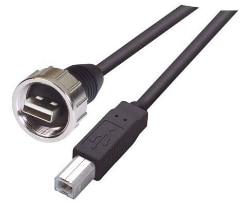
Waterproof USB cables and cable assemblies from L-com provide exceptional reliability for computing applications in harsh environments. These IP67-rated USB cable assemblies and components feature robust construction that shields against dust and water ingress, making them ideal for manufacturing environments where computers must interface with robots, CNC machines, and automated equipment in the presence of particulate contamination and moisture exposure. These waterproof USB cables enable reliable computer connections in process industries, including food, pharmaceutical, and chemical processing, where exposure to liquids and chemicals is a constant concern. L-com's waterproof USB solutions also excel in demanding environments such as construction sites, mining operations, and military applications.
L-com’s product range covers USB 2.0 and USB 3.0 standards and includes a wide variety of connector types such as Type-A, Type-B, A/B, B/A, Type-C, and Mini-B 5-position, along with specialized options like USB/FireWire combinations, shielded cables, extension cables, and field-installable connectors. To maintain complete system integrity, L-com also offers replacement gaskets, nuts, and IP67-rated port protection accessories, such as the WPCVR-USB-1394 Port Protection Cover. These components allow engineers to create a fully sealed, end-to-end USB path from panel feedthroughs to device connections, reducing maintenance costs in critical applications.
|
Product Family / Component |
Connector Types |
Key Features and Use Cases |
Typical Lengths |
|
Waterproof Cable Assemblies (General) |
Broad IP67-rated USB family: Type-A, Type-B, A/B, B/A, Mini-B, Type-C, USB 3.0 |
Utilizes rugged housings, threaded couplings, and O-rings for sealing. Designed for harsh environments; maintain IP67 seal when mated |
Various (0.3 m – 5.0 m) |
|
Type-A Extension Cable |
Panel-Mount A-Female |
Use Case: Creating a sealed pass-through port on an enclosure (e.g., kiosks, PLC cabinets). Requires a protective cap on unused female side |
0.3 m, 0.5 m, 1 m, 2 m, 3 m, 5 m |
|
Type-B/A Cable Assembly |
Panel-Mount B-Female |
Use Case: Connecting instruments, printers or diagnostic ports with a Type-B port to a host PC (Type-A). Common for instrument panels. |
0.5–5.0 m |
|
Type-B/B Cable Assembly (WPUSBBB Series) |
B-Male |
Use Case: Controller-to-device runs where both endpoints are Type-B. |
2.0 m, 5.0 m |
|
USB 3.0 IP67 Assemblies (U3A00017 Series) |
Various (e.g., IP67 B-Male |
Designed for SuperSpeed (higher data rates). Includes options for shrouded IP67 male and panel-mount female connectors for high-bandwidth peripherals (e.g., machine vision). |
1.5 m |
|
Bulkhead Jacks & Connectors |
Panel-mount A/B Jacks |
Use Case: Mounting connectors cleanly through a sealed panel or enclosure wall to maintain the IP rating. Mates directly with waterproof cable assemblies. |
10-inch lead versions available |
|
Port Protection Cover (WPCVR-USB-1394) |
Waterproof Cap (USB/FireWire Compatible) |
Use Case: Sealing and protecting unused IP67 female panel connectors. Features a rubber lanyard to prevent loss. Essential for maintaining the IP67 rating when the port is idle. |
NA |

Table 1: Comparison of L-com IP67 Waterproof USB Cable Assemblies and Accessories
Summary
In challenging environments where standard USB cables and connectors are subjected to wash-downs, rain, dust, oils, or shock and vibration, signal integrity degrades and operational risks increase. IP rated waterproof assemblies featuring threaded collars and O-ring seals, robust backshells, and reliable contacts, significantly reduce corrosion and intermittent faults without sacrificing USB interoperability. With a comprehensive portfolio and proven durability, L-com’s waterproof USB solutions are the ultimate building blocks for industrial connectivity that you can mix and match to meet any application requirement.
Secure and Reliable Industrial Connectivity Starts with L-com
|
|
|
|
|
|
|



ABOUT THE SPONSOR
L-Com offer a wide range of high-performance, UL-rated solutions across many key industries, including electronics, medical, industrial automation, military, and telecom. For more information, click here.
