

.jpg)

Power reliability across diverse, high-stakes environments
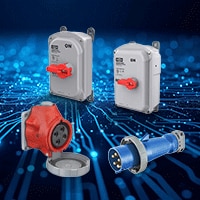 Industrial and institutional infrastructure, such as high-speed factory floors, washdown-intensive food processing plants, and life-critical healthcare environments, relies on safe, reliable, and uninterrupted electrical power at the point of use.
Manufacturing systems use automated machinery and robotics that operate continuously in environments with constant vibration, high current loads, and particulate contamination. Food processing facilities require equipment that withstands frequent high-pressure washdowns, chemical exposure, and strict hygiene protocols, which challenge standard electrical interfaces. Healthcare environments depend on electrically reliable systems for diagnostic imaging, mobile medical equipment, and sterilization processes, where power failure or electrical noise can directly affect patient safety.
As automation, electrification, and 24/7 operation expand across all three sectors, electrical power systems are under increasing stress. High currents, frequent connection cycles, environmental exposure, and stringent safety regulations place unprecedented demands on power entry connectors and disconnect devices. These critical interfaces must address challenges like load-break safety, environmental ingress protection, mechanical durability, maintenance isolation, and regulatory compliance.
This convergence of demands has elevated the importance of rugged, switch‑rated, and environmentally sealed power solutions that can perform consistently across diverse operating conditions. In this article, we explore how modern power entry architectures address shared failure modes across manufacturing, food processing, and healthcare and how solutions such as Hubbell Advantage Series Switch‑Rated IEC Pin & Sleeve Devices and Circuit‑Lock® Disconnect Switches (HBLDS Series) help engineers design safer, more resilient power systems for multi‑industry applications.
Environmental challenges across industrial and critical environments
Manufacturing, food processing, and healthcare environments are among the harshest operating conditions for electrical hardware. The power entry connectors present on factory floors, processing areas, and clinical settings are continuously subjected to the following challenges:
- Vibration and shock: Heavy machinery, processing equipment, and mobile medical systems generate continuous micro‑vibrations that can loosen poorly designed connectors and locking hardware. Over time, this can increase contact resistance, generate heat, and ultimately lead to connector failure.
- Contaminants and ingress: Dust, metal shavings, food particulates, moisture, and chemical disinfectants generated by operations can enter connectors and degrade contacts if sealing is inadequate or the ingress protection (IP) rating is insufficient. This increases the risk of short circuits or arc faults.
- Thermal stress: Industrial, processing, and medical equipment frequently operate at high duty cycles, drawing significant current over long periods. This continuous load generates significant heat at the contact interface. If connectors are not designed to handle these temperature rises, housing materials may degrade, and contact resistance can increase, potentially leading to overheating or contact welding.
- Accidental disconnects: In dynamic environments, cables are often damaged when mobile equipment such as forklifts, portable imaging skids, or diagnostic carts moves before being disconnected from the power source.
Together, these conditions can lead to several failure modes, including damage to power cords, mobile equipment, and wall receptacles. Such failures often result in unexpected operational downtime, sanitation or maintenance requirements, and pose significant safety risks to personnel and patients.
Engineering out failure modes: Standards that matter
To maintain reliable performance under these circumstances, industrial connectors and disconnect switches must be engineered with rugged housing, corrosion-resistant contacts, secure locking mechanisms, and high ingress protection (IP) ratings. These connectors should also conform to internationally recognized standards that define safety, environmental protection, and electrical compatibility requirements for industrial connectors. Some of these standards are:
- UL 2682 – Switch-rated connector standard: This standard certifies connectors that can safely interrupt electrical current during connection or disconnection under load. Switch-rated devices approved under UL 2682 combine plug-and-receptacle functionality with switching performance, making them a compliant disconnecting means for both motor circuits and branch circuits. This prevents dangerous arcing, reduces contact pitting, and improves operational safety.
- IEC 60309 – Industrial plug and socket standard: It defines globally recognized specifications for industrial plugs, sockets, and couplers. The standard uses keyed geometries and color-coding based on voltage and frequency, ensuring safe, reliable mating while preventing mismatches between electrical systems. This is particularly important in manufacturing facilities where equipment may operate across varying voltage levels.
- UL 508 / IEC 60947‑4‑1 – Industrial control and motor switching standard: These standards govern industrial control equipment such as motor controllers and disconnect switches, defining requirements for safe switching, isolation, and endurance under electrical load. Compliance ensures devices are suitable for use as disconnecting means in motor circuits, providing predictable performance, fault protection, and operational safety in industrial power systems.
- IP69K – High-pressure washdown protection: The IP69K rating defines the highest level of ingress protection for connectors exposed to high-pressure and high-temperature washdowns. Devices meeting this standard are tested with water jets at roughly 80–100 bar and up to 80 °C from multiple angles, ensuring connectors remain dust-tight and watertight even in aggressive sanitation environments.
- NEMA 4X(UL4X) / NEMA12 ratings: These North American environmental protection ratings ensure connectors are resistant to corrosion, dust ingress, and hose-directed water exposure. When combined with IP ratings, they provide comprehensive protection against contaminants, chemicals, and moisture typically found in industrial environments.
|
Standard / Requirement |
Definition |
Industrial benefit |
|
Rugged mechanical design |
Durable housing, corrosion-resistant contacts, and secure locking mechanisms. |
Ensures long service life in vibration, dust, and chemically exposed environments. |
|
UL 2682 |
Switch-rated connectors certified to safely connect or disconnect under electrical load. |
Prevents arcing and enables use as a compliant disconnect for motor and branch circuits. |
|
IEC 60309 |
International standard for industrial plugs and sockets with keyed, color-coded configurations. |
Prevents mismating and ensures safe connections across different voltage systems. |
|
UL 508 / IEC 60947‑4‑1 |
Standards governing industrial control equipment and motor disconnect devices. |
Ensures safe switching, isolation, and compliance for motor circuit disconnect applications. |
|
IP69K |
Highest ingress protection rating against dust and high-pressure hot water jets. |
Enables reliable operation in washdown and sanitation environments. |
|
NEMA 4X / NEMA 12 |
North American enclosure ratings for corrosion resistance, dust protection, and water exposure. |
Protects connectors from moisture, chemicals, and industrial contaminants. |
Table 1: Key Industrial Connector Standards for Safety, Washdown Protection, and Reliable Power Connections
Ruggedizing the Factory Floor: Solving the Load Break Dilemma with Hubbell Advantage and Circuit-Lock® HBLDS
The Hubbell Advantage Series switch-rated IEC pin-and-sleeve connectors provide safe and reliable load-break operation at the point of use. Designed for manufacturing, food and beverage, and healthcare settings, these devices combine strong electrical switching with advanced environmental protection.
Advantage connectors, available in 30A, 60A, and 100 A ratings, are UL 2682 switch rated and approved as disconnecting means for both motor and branch circuits. They make and break under load, serving as a line-of-sight disconnect without a separate switch. With short-circuit current ratings up to 100 kA SCCR and horsepower ratings up to 40 HP, they support demanding motor-driven applications while reducing hardware and installation complexity. Durable housing, UL Type 4X/12 and IP69K sealing, and a spring-loaded cover ensure long-term reliability in harsh environments by protecting against dust, oils, chemicals, and high temperature washdowns.

Figure 1: Features and Benefits of Advantage Series Switch-Rated IEC Pin and Sleeve Devices
In applications where a dedicated, enclosure-based disconnect is required, Hubbell Circuit-Lock® HBLDS motor disconnect switches provide a robust solution for local motor isolation and servicing. The HBLDS family is available in industrial-grade, unfused, three-pole configurations, including models such as the HBLDS30P (30 A, 600 V AC) and HBLDS60 (60 A, 600 V AC). These switches are listed to UL 508 and UL 60947-4-1A as manual motor controllers and are suitable for use as motor disconnects in accordance with NEC 430.102(B) requirements.
Designed for harsh industrial and washdown environments, HBLDS disconnects feature UV-stabilized, non-metallic enclosures and a rounded, sloped-top geometry that supports hygienic design by shedding dirt and debris. Protection ratings include IP69K and NEMA Type 4X/12, ensuring resistance to water ingress, corrosion, and contaminants. NSF certification further qualifies these devices for hygiene-critical applications, making them well-suited for food processing environments and other sanitation-intensive installations.
Operational safety is enhanced through a highly visible red handle that can be padlocked in the OFF position to support OSHA lockout/tagout (LOTO) procedures. Permanently laser-marked ratings ensure long-term legibility, even under repeated washdowns. Select HBLDS models also incorporate inTOUCH® technology, providing installation-free LED phase indication via six integral LEDs for clear, secondary visual confirmation of make/break status across three-phase (Y or Delta) systems.
Together, the Advantage Series switch-rated IEC pin-and-sleeve devices and Circuit-Lock® HBLDS motor disconnect switches offer two complementary approaches to load-break design: one that integrates connection and switching at the point of use, and another that provides a durable, enclosure-based disconnect for fixed equipment and line-of-sight isolation.

Figure 2: Features and Benefits of Hubbell Circuit-Lock Disconnect Switch with inSIGHT technology
Use case: VFD-Controlled Motor System
In automated environments across manufacturing, food processing, and healthcare, motors for conveyors or pumps are often controlled by Variable Frequency Drives (VFDs). A Hubbell Advantage Series switch-rated connector is typically installed at the power inlet, allowing operators to safely interrupt power under load and simplify lockout-tagout (LOTO) procedures. The integrated break-before-main auxiliary contacts provide a critical signal to the VFD or PLC, initiating a controlled shutdown that protects sensitive electronics from abrupt power loss during equipment changeovers.
To complete this safety loop, a Hubbell Circuit-Lock® HBLDS disconnect switch is installed downstream of the VFD, within line-of-sight of the motor. This provides a permanent, lockable isolation point for mechanical servicing, ensuring compliance with NEC 430.102(B) while its IP69K-rated, sloped-top enclosure survives the harshest washdowns. By pairing the Advantage connector at the drive with the HBLDS switch at the motor, facilities secure both the control electronics and the personnel performing maintenance, creating a robust, redundant safety architecture that minimizes operational downtime.

Figure 3: Hubbell Advantage Series Switch-Rated IEC Pin and Sleeve Devices and Circuit‑Lock® HBLDS Motor Disconnect Switches in VFD-Controlled Motor Applications
Conclusion: Selecting the Right Interconnect to minimize risk and maximize ROI.
In today’s highly automated manufacturing, food processing, and healthcare environments, reliable electrical connectivity is essential for maintaining productivity, safety, hygiene, and operational efficiency. As these facilities continue advancing toward higher levels of automation, the reliability of every component becomes increasingly critical. Selecting high-performance power connectivity solutions such as the Hubbell Advantage Series and Circuit‑Lock® HBLDS motor disconnect switches can therefore be a strategic investment that mitigates operational risk while maximizing return on investment (ROI). By integrating switch-rated, IP69K-certified connectors and rugged enclosure-based disconnects, engineers can streamline electrical system design, enhance worker safety, and build a resilient power infrastructure capable of supporting the demands of modern industrial, processing, and clinical environments.
Buying Options
|
HBLS560P9W |
HBLS560P9W |
HBLDS30 |
HBLDS60 |


For more innovative products from Hubbell Shop Now
ABOUT THE SPONSOR
 Hubbell remains grounded in the bedrock principles of quality and innovation established by Harvey Hubbell II more than 135 years ago. They continue to deliver high-quality products and solutions that help build a more reliable, resilient, and renewable energy infrastructure. Strategically aligned around clean energy megatrends, including grid modernization and energy efficiency, they see a bright, sustainable future for their customers, employees, and shareholders as they accomplish their mission to electrify economies and energize communities. For more information, click here.