

.jpg)


Battery Management Systems (BMS) serve as the critical layer in modern energy storage applications, from electric vehicles (EVs) to grid-scale installations. A BMS continuously monitors essential parameters such as cell voltage, current flow, and temperature across individual cells and battery packs to ensure optimal performance and longevity. Beyond monitoring, these systems actively prevent catastrophic failures by implementing protection and isolation mechanisms that guard against overcharging, over-discharge, thermal runaway, and short-circuit conditions. This Tech Spotlight explores how Bourns’ Power and Protection product families, including the Riedon portfolio, solve key BMS challenges.
Modern BMS Architectures And Their Challenges
A modern BMS is the vital control layer in any energy storage system. Its core functions include:
- State-of-Charge (SoC) and State-of-Health (SoH) estimation: Calculates SoC, SoH, and other parameters using algorithms like Kalman filters or machine learning models.
- Cell balancing: Equalizes the charge across cells to maximize capacity and lifespan.
- Overcharge/discharge protection: Prevents overcharging, deep discharging, and thermal runaway.
- Communication with vehicle ECUs and telematics: Interfaces with vehicle control units (VCUs) via Controller Area Network (CAN) bus or similar protocols.
However, as battery systems scale in voltage and capacity, BMS designers face multiple integration challenges:
- High-voltage isolation: Communication and power transfer between battery modules and the main controller require galvanic isolation to prevent cross-faults, with isolation ratings typically ranging from 3 kV to 6 kV for automotive and industrial applications.
- Transient overvoltage events: Fast switching during charge/discharge cycles can introduce dangerous voltage spikes.
- Thermal management: Becomes increasingly complex as power dissipation increases, necessitating components that maintain performance across wide temperature ranges.
- Accurate current sensing: Essential for precise state-of-charge (SoC) and state-of-health (SoH) estimation.
These demands make isolation transformers, precision resistors, and multi-layer protection components indispensable to reliable BMS operation.
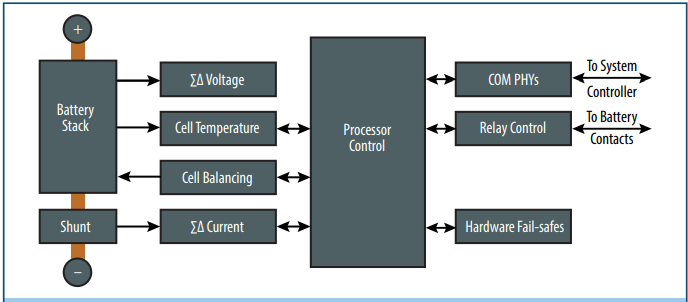
Fig 1. Block diagram of BMS system (image source: Bourns)0
Bourn’s Power Division: High-Voltage Isolation For BMS Communication And DC/DC Conversion
Isolation barriers serve to protect equipment and humans from harmful voltage surges. They also enable communication between a transmitter and a receiver. Bourns’ HCT and HVMA transformers deliver stable power and data communication across high-voltage EV battery systems with purpose-built DC/DC conversion and safety isolation.
Push-Pull Isolation Transformers (HCT Series): Isolation transformers are essential in BMS for separating HV battery domains from low-voltage control circuits, ensuring safety while enabling efficient isolated power delivery. Bourns’ HCT series features compact, surface-mount toroidal ferrite-core transformers designed for efficient isolated DC-DC conversion in push-pull topologies. The toroidal geometry minimizes leakage inductance and EMI, while low DCR (<0.5 Ω) supports high efficiency. With creepage distance >8 mm, 3 kV hi-pot capability, RoHS compliance, and AEC-Q200 options, the series suits demanding automotive and industrial isolation needs. Figure 2 illustrates how leakage inductance, distributed capacitance, and magnetizing inductance affect waveform integrity in a push-pull transformer. By optimizing these parameters, the Bourns HCT Series ensures clean energy transfer, reduced overshoot, and improved regulation—critical for accurate BMS sensing and reliable isolated power delivery.

Fig 2. Pulse Behavior in Push-Pull Isolation Transformers Showing Overshoot and Ringing Effects (image source: Bourns)
HVMA Series: Flyback and Gate-Drive Isolation: Flyback and gate-drive transformers enable isolated auxiliary power and precise switching control in BMS inverters, motor drives, and HV domain interfaces. The HVMA series delivers AEC-Q200 automotive-grade isolation for flyback and gate-drive power stages, built to IEC 61558-2 and IEC 60664-1 requirements. Flyback models HVMA01F35A-ST10S (1W) and HVMA03F40C-ST10S (3W) offer 900 Vdc working voltage, 4000 VAC hi-pot, 1:1:1 ratio, controlled inductance values, and leakage below 1 µH. The gate-drive model (2W) provides 800 Vdc working voltage, 2750 V hi-pot, 8 mm creepage, low DCR, and a precise 5:1:4 turns ratio. These transformers reliably support gate-drive power, inverters, BMS, motor drives, and industrial power delivery.
Bourns’ Protection Division: Multi-Layer Defence for Battery Safety
Modern BMS systems protect themselves with multiple security layers where different components work together to address threats throughout the entire system. Bourns' Protection Division offers a comprehensive range of passive components engineered specifically for the harsh electrical environment of battery systems. A few key components form this layered defence.
Precision current sense resistors for accurate BMS monitoring: Accurate current sensing is fundamental to BMS safety, as it enables precise SOC/SOH calculations and fast fault detection during charge-discharge cycles. The CSM2F and CSS metal-foil shunt resistors deliver ultra-low TCR (<50 ppm/°C), tight tolerances (±0.5%), and power ratings up to 50 W, enabling highly accurate pack and cell current measurements. Their stability under vibration makes them ideal for automotive-grade ADC interfacing and fast fault detection.

Fig 3. TCR curve illustrating the ±50 PPM/°C temperature coefficient of resistance for CSM2F-8518 shunt resistor material (image source)
Thick-Film power resistors: High-power resistors are essential in BMS for snubbing, current limiting, and dissipating transient energy to protect switching stages and measurement paths. Thick-film power resistors (PWR/PF series) offer compact DPAK, D2PAK, and TO-220 packages for space-constrained PCBs, delivering rated powers of 20–50 W at 25 °C case temperature when mounted on heatsinks. With resistance ranges from 0.02 Ω to 1 MΩ, tolerances of ±1% or ±5%, and temperature coefficients of ±100/±200/±600 ppm/°C, these are ideal for snubber, current-limiting, and load-dump energy dissipation in BMS power paths.
Wire-wound power resistors: Wire-wound resistors help ensure BMS robustness by offering stable current sensing, pulse handling, and controlled failure modes during high-energy fault events. The FW, WS, and surface-mount PWR wire-wound series deliver precise sensing and robust pulse performance from 0.5–10 W. Fusible versions support safe failure modes, while non-inductive windings reduce noise in charge/discharge monitoring. Their wide resistance range and operating capability of –55 °C to +275 °C ensure long-term reliability in automotive-grade environments.
Surge and overvoltage protectors: Battery systems face diverse transient threats, from lightning-induced surges in stationary storage to load dump events in automotive applications. IsoMOV hybrid protectors combine GDT and MOV technologies to provide low-leakage, high-energy surge suppression for EV/HEV inverters and BMS interfaces. For multichannel analog front-end protection, PTVS diodes offer fast clamping and surge capability up to 3 kA. ZV50S multilayer varistors extend compact high-speed protection up to 4500 A, while SMA6J TVS diodes offer 600 W peak power and sub-picosecond response for sensitive sensing and communication lines. The different overvoltage protection technologies can also be combined to ensure a comprehensive protection scheme. A high-energy MOV can be placed near a main power line for high energy transient dissipation while a TVS diode is placed on a signal line to ensure the voltage is clamped quickly to protect sensitive equipment effectively.
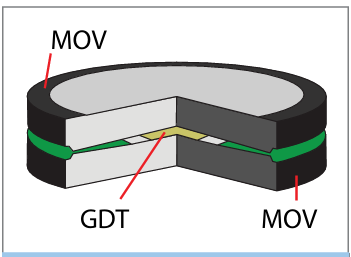
Fig 4. The construction of the IsoMOV protector (Image source: Bourns)
Fuses & Resettable PTCs for overcurrent protection: Fuses and resettable PTCs are indispensable for BMS because they isolate severe faults, prevent thermal runaway escalation, and protect low-voltage control electronics. POWrFuse PF-63R50H provides 10–40 A overcurrent protection with 20–30 kA interrupt ratings for HV battery packs and BDUs. MF-USHT resettable PTCs add AEC-Q200-compliant, space-saving protection up to 125 °C for BMS sensing, control, and thermal management subsystems.
Rectifier Diodes for efficient power conversion: Rectifier and Schottky diodes enable efficient, low-loss power conversion in BMS pre-charge, sensing, and protection circuits while maintaining reliable isolation at high voltages. AEC-Q101-qualified rectifier and Schottky diodes ensure efficient, low-loss power conversion. High-voltage series (up to 2000 V) support isolation in HV paths, while surge-rated and low-VF options improve efficiency and resilience in charge/discharge and protection circuitry.
|
Series |
Power Rating (W) |
Resistance Range (Ω) |
TCR (ppm/°C) |
BMS Application |
|
W/WS/FW |
1-7 |
0.01-15k |
±200-300 |
Overload in chargers, surge withstand |
|
PF/PWR (Thick Film) |
20-50 |
0.02-1M |
±50-250 |
Snubbers in BESS, low-inductance drives |
|
BR/BRT/BRS (Riedon) |
50-500 |
0.1-5k |
<±260 |
Energy dissipation in inverters, BESS |
|
UWP (Riedon) |
20-100 |
0.5-1k |
<±260 |
Pulse handling in battery chargers |
Table 1. Comparison of Riedon BR/BRS resistors for high-power BMS dissipation circuit
Precision Current Sensing With Riedon By Bourns
Riedon high-power thick film resistors (PF2203 and PFS35 series): They provide compact, low-inductance current-sensing solutions for high-power BMS. With 35 W ratings, resistance values ranging from 0.01 Ω to 51 kΩ, and tight tolerances (±1%/±5%), these ensure accurate measurements across –55 °C to +175 °C and offer strong pulse-handling capability for charge/discharge and capacitor-discharge events in BESS-integrated systems.
Riedon power resistors: With low resistances of 0.003–0.1 Ω across 1–10 W, these resistors enable precise sensing and stable overcurrent protection in EV/HEV BMS. Their excellent pulse performance also suits industrial power supplies, inverters, smart meters, solar inverters, telecom 5G units, and capacitor recharge/discharge circuits.
Riedon Industrial Shunt Resistors (RS/RSH/RSI/RSJ/RSK/RSN/RSW Series): They use Manganin elements to achieve 0.0083–100 mΩ resistance, ±0.1–0.25% tolerances, and ±15 ppm/°C TCR with current ratings up to 6000 A. RoHS-compliant and robust from –40 °C to +100 °C, they enable reliable measurements in BMS charge/discharge monitoring and ensure reliable overcurrent protection and thermal stability in space-constrained BMS setups. Their panel- and busbar-mount designs ensure accurate charge/discharge monitoring and are ideal for AC-DC converters, renewable energy systems, heavy industry, battery chargers, and mining applications.
Integrating Bourns Power And Protection In A Complete BMS Architecture
An optimized BMS architecture built on Bourns technologies offers end-to-end protection and isolation. A typical integration flow includes:
|
BMS Stage |
Bourns Component |
Function |
|
Input / HV Bus |
IsoMOV |
Surge suppression and DC bus overcurrent protection |
|
Power Conversion |
HCT / HVMA Transformers |
Isolated DC/DC conversion and communication |
|
Gate Drive & Control |
HVMA03F4A-LP8S Transformer, SMA6J TVS |
Safe switching and gate isolation |
|
Measurement & Balancing |
CSM2F / CSS / Riedon RS Series Shunts |
Accurate current and power monitoring |
|
Low-Voltage / Communication Rails |
MF-USHT PPTC, ZV50S MLV |
Resettable overcurrent and transient protection |
|
Rectification & Output Stage |
Bourns Rectifier Diodes |
Efficient current path management |
Fig 4. The construction of the IsoMOV protector (Image source: Bourns)
Conclusion
The future of energy storage and electric mobility depends on smarter, safer, and more efficient Battery Management Systems. To support this, a comprehensive component ecosystem that balances isolation performance, sensing precision, and protection robustness is needed. Bourns has developed an integrated portfolio spanning three key divisions: Power, Protection, and Riedon precision sensing. These divisions collectively enable engineers to build resilient, efficient BMS architectures capable of meeting the demanding requirements of next-generation battery systems.
ABOUT THE SPONSOR
Bourns, Inc., is a leading manufacturer and supplier of position and speed sensors, circuit protection solutions, magnetic components, microelectronic modules, panel controls and resistive products. Headquartered in Riverside, California, USA, Bourns serves a broad range of markets, including automotive, industrial, consumer, communications, non-critical life support medical (low/medium risk), audio and various other market segments. Learn more here.