

Have You Ever Wondered About the Networking Requirements of Industry 4.0 or the Industrial Internet of Things (IIOT)?
The world is becoming increasingly networked, and the rise of both industry 4.0 and the Industrial Internet of Things (IIoT) means networking is even more critical in an industrial setting.
Industrial applications present significant challenges for network solutions. On the actual production line, actuators and sensors require real time, low latency, deterministic communications to enable the manufacturing process. Higher level resource planning systems (e.g., Enterprise Resource Planning/ERP) do not require real time, deterministic communication, but they do require access to the external internet to interact with suppliers’ systems, etc.
These different requirements lead to deployments of different networks and networking technologies for the Information Technology (IT) network which supports the ERP system and for the Operational Technology (OT) network which supports the manufacturing actuators and sensors.
Typically, the IT network will be based on Ethernet while the OT network will use several different technologies (e.g., OPC UA, DDS, and EtherCat). In this legacy architecture, connection between the IT and OT networks is via gateways, access points, and protocol converters.
To achieve the integration and expansion required by Industry 4.0 and IIoT, separate networks present several issues which must be addressed:
• Strong network hierarchies are expensive and complicated to implement.
• Inflexible OT Network – Implementation requires pre-planning and complex cabling solutions, resulting in a solution which does not scale as needed with demand.
• Multiple communication protocol standards for OT networks, (e.g. EtherCAT, Profinet).
• OT network has limited bandwidth to support communication between network elements.
• Industry 4.0 will require increased communication to provide analytics which legacy protocols cannot provide, as they don't allow access to machine data freely for analytics and cloud computing.
To address these issues, there is a move towards deployment of a converged network which merges the IT and OT networks into a single network. This converged network still needs to be able to achieve the time critical, low latency, deterministic messaging required by the actuators and sensors. Enter Time Sensitive Networking (TSN).
Explaining Time Sensitive Networking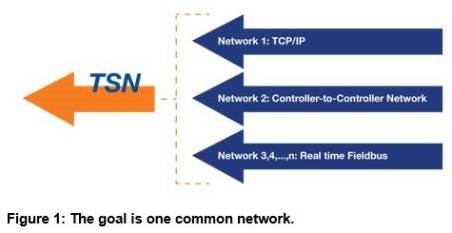
TSN enables different classes of network traffic to share the same transmission medium, providing both network management and a reserved path for scheduled traffic. This enables Time Sensitive Networking with deterministic communications and, therefore, enables one common network, which supports multiple communication standards.
When TSN operates over an Ethernet link, there are several modifications to standard Ethernet required. Standard Ethernet communications are not time aware; they distribute the data over the entire bandwidth of the link with packets queued for transmission. TSN implements a time awareness across the network with scheduled traffic in time-defined slots, and it supports cyclic data transmission while also providing pre-emption for higher priority packets.
TSN is defined by several IEEE 802.1 standards which specify the implementation. As of May 2019, seven of these standards have been adopted, while the remainder are still in the approval process.
These standards are implemented over Ethernet (IEEE 802.3 Physical layer) and support star, chain, ring, and mixed topologies, along with 100Mbit and 1Gbit data rates.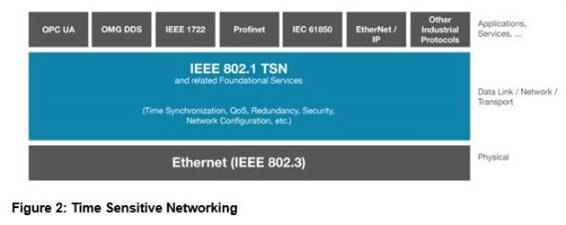
One of the key challenges of a TSN solution is the implementation of the scheduling, pre-emption, and queuing. TSN implementations can prioritize and pre-empt packets to ensure deadlines are achieved. This is achieved by pausing the transmission of lower priority packets. The time available for a TSN implementation to evaluate, pre-empt, queue, and schedule depends upon the network speed. When running at 100 Mbps, the controller has 82 microseconds to make and update queuing solutions. However, as the network speed increases to 1 Gbps, the time reduces to 8 microseconds. Achieving these timescale demands can be challenging.
Correctly implementing TSN requires a solution which can provide a low latency and deterministic response at both endpoints and switches. Many applications solve this challenge by the combination of a processor and a FPGA connected over a high-speed link such as PCIe. This two-chip solution not only increases board area, power consumption, development time and cost, but also prevents a holistic integrated solution from being developed. As the design is segmented between two devices, this also increases the complexity of verification.
Implementing TSN with heterogeneous System on Chips (SoC)
To address these challenges, heterogeneous System on Chips (SoC) are often used. These devices provide a combination of Processing System (PS) and Programmable Logic (PL), enabling the implementation of acquisition, control, and processing applications which require the use of TSN by optimal use of the PS and PL due to the following capabilities:
1. Ability to interface and control a wide range of sensors, actuators, motors, and other application-specific interfaces due to the flexibility of programmable logic.
2. Ability to implement complex processing at the edge, for example, machine learning, sensor fusion, image processing, and real-time analytics.
3. Communication support for a range of wired and wireless technologies.
4. Security and the ability for the device and system to be secure in terms of Information Assurance, Anti-Tamper, and Trust.
TSN within a heterogeneous SoC device utilizes both the Processing System (PS) and the Programmable Logic (PL) to implement the solution.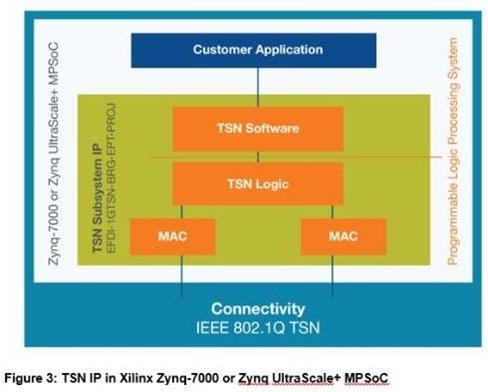
One example of a TSN Solution is Xilinx's TSN Endpoint Ethernet MAC LogiCORE IP. It consists of FPGA Logic for MAC, TSN Bridge and TSN Endpoint and software components for Network Synchronization, Initialization and for Interfacing with network configuration controllers for Stream Reservation as defined in P802.1Qcc. The software is designed to run in embedded Linux (e.g. Petalinux).
The LogiCORE IP provides deterministic behavior because it is built with dedicated resources from the device's PL. Synchronization (IEEE 802.1AS), Scheduled Traffic (IEEE 802.1Qbv), and Seamless Redundancy (P802.1CB) benefit from that and help offload the Processing Unit.
The LogiCORE IP also comes with an optional integrated time-aware L2 switch, which enables chain or tree topology required in many industrial applications without allocating another port at an external TSN switch.
Once instantiated internally, the TSN IP core provides individual interfaces for each traffic class which are used in conjunction with the PS: Processors, DDR Memory and interconnect. These interfaces support scheduled, reserved and best effort / legacy traffic over the network.
The majority of TSN networking is implemented within Programmable Logic because it provides not only the determinism and low latency that TSN requires, but also, due to its flexibility, the ability to update the IP core as the TSN standards progress and revisions are introduced.
Summary
To enable deployment of the IIoT and Industry 4.0, there needs to be convergence between IT and OT networks. TSN provides the ability to converge these networks, offering significant advantages in network connectivity, scalability, and cost of deployment and ownership. Implementing TSN within a heterogeneous SoC enables the acceleration capabilities of programmable logic to be used to achieve the demanding performance requires of TSN.
Glossary
- Enterprise Resource Planning: an integrated set of software applications used to manage the business processes of an entity. The applications typically include planning, purchasing, inventory, sales, marketing, finance, human resources, and more.
- EtherCat: a real-time, Industrial Ethernet technology developed by Beckhoff Automation. It is suitable for hard and soft real-time requirements in automation technology, in test and measurement, and other applications.
- Data Distribution Service (DDS): a middleware protocol and API standard for data-centric connectivity from the Object Management Group
 (OMG). It integrates system components to provide low-latency data connectivity, reliability, and a scalable architecture for IoT applications.
 - Determinism: a condition of a computing device where for every state, there is at most one state that can follow.
- Heterogeneous System on Chip: a device that provides a combination of Processing System (PS) and Programmable Logic (PL) to enable the implementation of acquisition, control, and processing applications.
- Industry 4.0: a term that describes smart factories which contain intelligent machines using wireless connectivity, sensors, automation controllers, and AI to manufacture products with independent decision making.
- Industrial Internet of Things (IIoT): synonymous to Industry 4.0.
- Latency: the amount of time it takes data to travel across a network.
- Operational Technology: the hardware and software technology used to control or monitor physical devices, processes and events typically in a factory or manufacturing facility.
- Profinet: a standard used for industrial networking in automation and manufacturing.
- Protocol Converters: a device used to convert standard or proprietary protocol of one device to the protocol suitable for the other device or tools to achieve the interoperability.
Top Comments