


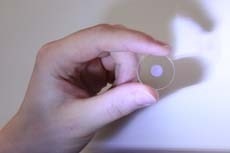
Nanostructure glass prototype (via University of Southampton)
A new type of light manipulated digital memory has come from research at the University of Southampton. A femtosecond laser (ultra short 10 − 15 second pulses) was used to create nanostructure glass that manipulates the way light then travels through it. The structure creates 'whirlpools' of light that can be read light data through an optical cable.
As a result the team talks of using the breakthrough to create more precise laser material processing, optical manipulation of particles, ultra high resolution imaging, and a lofty table-top accelerator. The team noticed that through the layers, light travels different depending on the polarization. This is the cornerstone of the discovery.
Barring the claims, information can be written into the glass structure, erased/wiped, and rewritten. Again, using the femtosecond laser, dots can be written into the glass into a 3D structure called 'voxels.' With fixed polarization, voxels can be written into planes on the glass 10 nanometers apart. Lead researcher Martynas Beresna talked about the storage potential, " No one has ever done this before... We have improved the quality and fabrication time and we have developed this five-dimensional memory, which means that data can be stored on the glass and last forever."
Team leader professor Peter Kazansky said, "Before this we had to use a spatial light modulator based on liquid crystal which cost about £20,000. Instead we have just put a tiny device into the optical beam and we get the same result." The result is microscopy at a 20th of the price. If this technology reaches the market, medical imaging will take a substantial leap.
Eavesdropper