


"No, sir. Robots are not programmed to love. I am simulating loving the baby.''
-Robot R781 from John McCarthy's short story "The Robot and the Baby."

A 1974 photo of John McCarthy at Stanford University. (via Stanford)
During his life, John McCarthy created a impressive body of work. From foundations of artificial intelligence to a concept for a space elevator, McCarthy never stopped creating. After his retirement in 2001, he continued to speculate on his website and Usenet forums. He even wrote an engaging short story, "The Robot and The Baby," quoted above. His potential was shown early on in his life. He taught himself college-level math while still a teenager, he skipped two years of mathematical study at the California Institute of Technology (CalTech). His early interest in math changed the world.
John McCarthy looked at artificial intelligence (A.I.), an expression he coined, as math with common sense. That simple thought paved the way for modern practices in A.I. In the 1958 paper "Program with Common Sense" elaborated on his idea. Put simply, logic is used to represent information in a computer system. In the paper he cited a hypothetical computer program called "advice taker" that demonstrated the use of logic based data.
"The main advantages we expect the advice taker to have is that its behavior will be improvable merely by making statements to it, telling it about its symbolic environment and what is wanted from it. To make these statements will require little if any knowledge of the program or the previous knowledge of the advice taker. One will be able to assume that the advice taker will have available to it a fairly wide class of immediate logical consequences of anything it is told and its previous knowledge. This property is expected to have much in common with what makes us describe certain humans as having common sense. We shall therefore say that a program has common sense if it automatically deduces for itself a sufficiently wide class of immediate consequences of anything it is told and what it already knows." - from the revised "Program with common sense" paper.

(Via John McCarthy, Stanford)
Later that same year, 1958, McCarthy took the idea into real-world practicality with the programming language LISP (LISt Processing). The language used some innovative concepts for the time, including tree data structures, dynamic typing (at runtime), automatic storage management, and self-hosting compiler. The data structure and source code of LISP are made up of Linked Lists. This allows for manipulation of the source code as a data structure. In other words, the code and the data are interchangeable, a program that can learn a new way of operating. LISP quickly became a leading language for A.I. development.
Taking the automatic storage management idea to another level, McCarthy created the "Garbage Collector" (GC) system. The collector attempts to free up memory occupied with objects no longer necessary for the running program. This feature is prevalent in other languages like C++. In most modern languages, a GC and a manual memory manager (allowing the programmer to handle memory stored objects) coexist.
Later in life McCarthy worked on non-monotonic reasoning 1978, the theory that adding a formula never produces a reduction of its set of consequences. He also came up with the idea of the "space fountain," or space elevator, in 1982. McCarthy's space fountain is an extremely tall structure that is held up by high speed particles from the ground that are redirected back to earth.
I believe John McCarthy desired an A.I. to exist in his lifetime, but resigned the accomplishment for another generation with the passage from his short story:
The actress asked, ``If you were programmed to have wants, what wants would you have?''
[The robot replied] ``I don't know much about human motivations, but they are varied. I'd have whatever wants Robot Central programmed me to have. For example, I could be programmed to have any of the wants robots have had in science fiction stories.''
Cabe
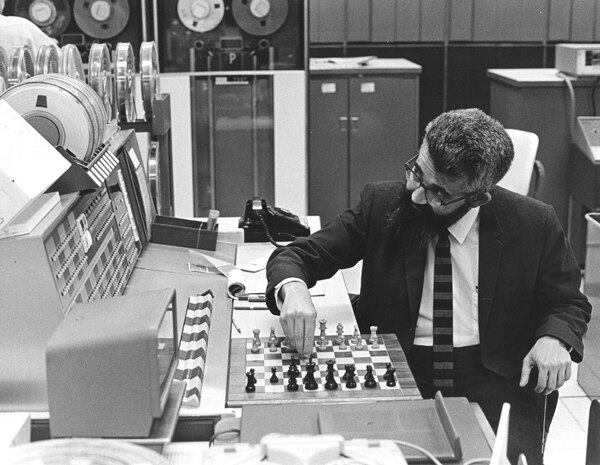
McCarthy playing chess via telegraph with rivals in Russia. 1966 (Via Chuck Painter)
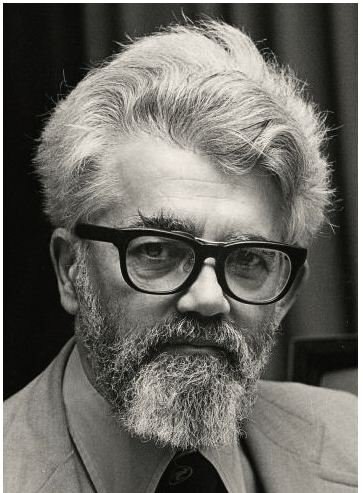
John McCarthy September 4, 1927 - October 23, 2011 (84) (Via John McCarthy collection)
John McCarthy facts:
Coined the term Artificial Intelligence.
Taught as a professor at MIT, Dartmouth College, Princeton University, and had the longest tenure at Stanford University.
Introduces the idea of Situation Calculus; changing scenarios as a set of first-order formulae.
1971, Won the Turing Award for the concept of commonsense data structures and LISP.
1988, Won the Kyoto Prize, Japan's version of the Nobel Prize.
1991, National Medal of Science .
1999, Inducted as a fellow of the COmputer History Museum.
2003, Received the Benjamin Franklin Medal in Computer science from the Franklin Institute.
2011, Inducted into the IEEE Intelligent Systems' Al's Hall of Fame for his contribution to A.I.
His wife passed away in a climbing accident in 1978 on Annapurna, Nepal. She was a computer programmer.
Co-founded the MIT Artificial Intelligence Project - Stanford Artificial Intelligence lab.

