


 A few weeks ago I checked out Ben Bova’s Able One from my library in the format of a preloaded digital audio player. The device is like a portable MP3 player dedicated to playing a single book.
I found the player did not work on a NiMH cell but worked fine on an alkaline. I mention this in an offhand tweet. The manufacturer, Playway, responded immediately offering to help in any way possible. I decided to test the unit on the bench first.
I powered the player on a bench supply and connected it to earphones with the volume set toward the higher end of the range. It worked reliably down to 1.1V and sometimes as low as 1.01V. When I started from zero and increased the voltage, the unit came up just above 1.1V, not much hysteresis. This is lower than a NiMH cell, so why wouldn’t it run on one?
I tried adding some series resistance. I repeated the test with series resistance and a capacitor across the battery terminals. The cap was a 470uF electrolytic with 0.62 ohms ESR.
| Resistor | Minimum Bench Supply Voltage | Minimum Voltage with 470uF Across Terminals |
|---|---|---|
| 0 ohm | 1.10 V | 1.10 V |
| 1 ohm | 1.15 V | 1.13 V |
| 2 ohms | 1.33 V | 1.29 V |
| 3 ohms | 1.49 V | 1.36 V |
The measured average current was around 50mA. I expected the current flow to have a high peak to average ratio. I did not, however, observe much variation in current on the scope at any point from powerup to play.
The unit would not run on the AAA NiMH cell even with the 470uF cap across the terminals. (Not surprising; BFC alone is rarely a solution to any problem.) The NiMH AAA I was using is advertised to have a resistance of 120 milliohms, at DC and 1Hz. I verified this by measuring the cell's voltage with a 10 ohm resistive load. The load only pulled it down to 1.26V.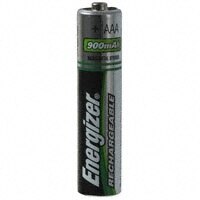
The unit would run on a D-size NiMH, corroborating the idea that internal cell resistance plays some role.
One idiosyncrasy in the player I discovered was if I ran the unit at a higher voltage, let the voltage fall to below 1.2V, and then let the voltage rise to 1.4V, the unit would shut off. I do not know if this is related to the trouble running off a NiMH cell.
Although I was very careful to limit my current and voltage, at some point unit stopped working and appeared to be broken. So I e-mailed Playaway again. I sent them all my test results, told them the player broke during bench testing, and audaciously asked if they would give me schematics and a new one to test. I thought some customer relations person would ignore my message or tell me to leave them alone. Surprisingly, they forwarded the message on to an engineer. They couldn’t provide schematics but said the unit does sometimes brownout in the 1.25V range. Although the player belonged to my library and it broke on my bench, they offered to replace it for me.
I would love to know why the unit works on a bench supply but not a NiMH battery. What stands out in my mind, though, is how quick Playaway was to respond to my offhand tweet and how they offered me a replacement after I apparently broke one testing it. People used to say manufacturers of amateur radio equipment had to have good service because if customers were dissatisfied a handful of people might hear them talking about it on the air. Social media have vastly increaesd this process.
Does anyone have any ideas why a player would work on a bench supply but not on a NiMH?
Top Comments