


(via Chris Harrison)
Innovative concepts are all right in front of our eyes, but few see them. Here is another "why didn't I think of that" concepts. Researchers from the HCI Institute at Carnegie Mellon have developed acoustic bar codes.
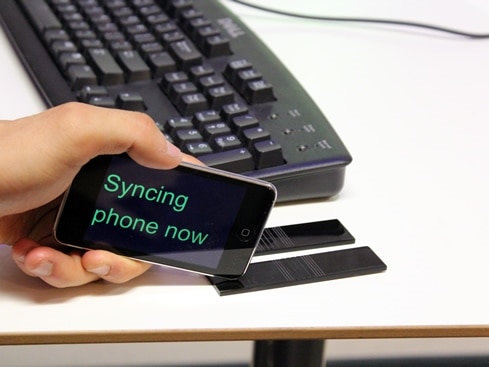
The method behind the acoustic bar code is straightforward. A specific etching of grooves onto some solid material will create a sequence of sounds when rubbed across by a hard material, like a fingernail, stylus or even your smart phone. The resulting sound sequence can be picked up by a microphone and decoded to perform a desired function.
More specifically, the Carnegie Mellon team tried etching these groves on wood, stone, glass and plastic. They developed two methods for encoding binary signals into these etches. One method keeps a constant number of grooves or notches and varies in length. The other keeps the total length constant and varies the number of notches. These grooves or notches, whatever you want to call them, are 0.25 to 0.5 mm thick and 0.1 to 0.3 mm deep and 7 mm wide to accommodate for fingernails and styluses. Both methods use base unit gap distances of either 1.6 or 3.2mm. Each bar code uses a standard guard sequence to alert the beginning and ending of a signal and provide reference for the gap distance. Attaching a simple and inexpensive piezo-contact microphone to the stylus, or on the etched material, picks up the sound which is then interpreted as a 1 or silence which corresponds to a 0. The binary can then be referenced to a databases to perform the desired output.
The team found that a smooth finish to the bar codes was necessary for their recognition. The team also said all their tests resulted in little wear between materials used (metals were not tested). A 24 bit bar code was the optimal length for accurate processing.
The group proposed using their device in four applications but surely more will be thought of. Carving these grooves on toys or models will allow for description of different parts of the object, for example, a toy boat used to learn the different parts of it like the hull or the starboard side. Acoustic bar codes on storefronts can be used to describe items and prices by passersby. Smart phones can use them to launch apps or perform specific functions, and different magnetic shapes (like refrigerator magnets) as in arrows can be used in classrooms or elsewhere to control robotics, camera positioning, picture taking etc. in whichever way the user wants.
This research was made possible with funds from the NSERC, The Center for the Future of Work, Heinz College, CMU and a Microsoft Ph.D. fellowship.
A extremely talented drummer could also mimic the bar code sounds. That might make for a fun promotional stunt.
Cabe