


The Technology First team at element14 is proud to bring you an excerpt from the latest issue XVII. Here's an Op-ed by wireless technologies expert David Niewolny from Freescale as part of our editorial retrospective.
Semiconductor technology is driving next generation medical devices to be smarter, more accurate, and better connected. What semiconductor technologies are paving the way for the medical devices of tomorrow? Freescale Semiconductor’s David Niewolny discusses the semiconductor advances that are making the biggest impact in medical device design.
The healthcare industry is in the middle of a technology revolution. A global aging population combined with rising health care costs is straining the world’s health care infrastructure. Baby boomers are now becoming our senior citizens, fueling the growth of the aged population. To accommodate this dramatic population shift, drastic changes in our health systems are necessary. Today, these changes include new therapies and early diagnostic tools only now made available by advanced hardware and software technologies that have long been avoided by the risk adverse medical device community. What technologies are paving the way for the medical devices of tomorrow?
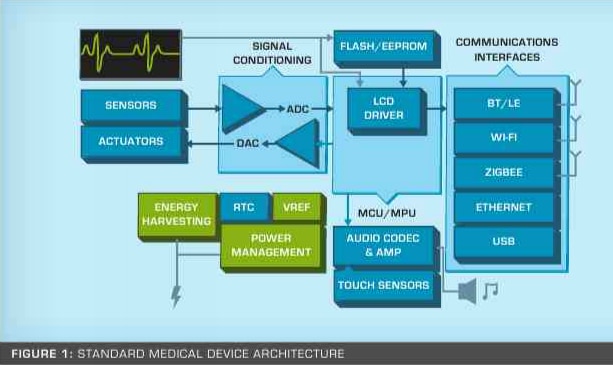
Figure 1: Standard medical device architecture
Figure 1 is an example of the standard hardware architecture of a typical medical device. The advances in silicon technology driving innovation in medical device design are listed below.
- Analog signal conditioning
- Low power embedded control
- Wireless connectivity
Silicon providers are delivering key advances in these strategic areas that are needed to enable healthcare device customers to optimize their products. One of the important and unique characteristics of a medical device is the ability to analyze a very small data signal captured by a wired or wireless sensor. Advances in precision analog components such as op amps, high resolution analog-to digital converters (ADC), digital-to-analog converters (DAC), analog comparators (ACMP), and voltage references (VREF) are a necessity to pave the way for increased accuracy on next generation medical devices.
Op amps are used to amplify and filter the signal and an analog comparator (ACMP) can be configured to trigger an interrupt once the peak has been reached. The next stage requires precisely timed analog–to–digital conversions of the sensors decaying output. Device designers should be looking for a feature–rich, very low power analog–to–digital converter (ADC) with greater than 16-bits of resolution. ADC’s that provide up to 24-bits of resolution are available for measurements requiring extremely accurate measurements. Many of the newer ADC’s have automatic compare and flexible conversion time settings, which ideal for this type of analysis. Finally, the data is sent to the CPU (8–bit or 32–bit) for the mathematical portion of the analysis.
Though analog circuits can be utilized on or off chip, on–chip integration of analog functionality provides many system cost benefits. The obvious benefit is that it decreases the need for external ICs, thus reducing the BOM and board space. But on–chip analog also features low–voltage detection and internal bandgap reference voltages, which further lowers overall cost.
Lowing power consumption is another area where advances in semiconductor design are making a significant impact in healthcare. This trend towards lower power consumption is enabling devices that were once tethered to be portable and turning once portable solutions into wireless sensors. For many medical devices, the microcontroller or microprocessor is a central component that performs most—if not all—of the application tasks. A microcontroller can be the main contributor to the device power consumption, so making use of the microcontroller’s features is essential to achieving battery life targets. Whether on the shelf, in a standby mode, or performing measurements, having certain capabilities can affect battery lifetime and thus determine the value of a product to the end customer.
Semiconductor manufacturers are taking steps to lower the power of the brains behind medical devices by implements some innovative design techniques. The first, is implementing additional modes of operation. Each low-power mode is tailored to a specific level of functionality to allow the most efficient performance/power consumption tradeoffs. The modes of operation support power consumption as low as 250 nA for some devices and enable medical applications to continuously operate with the highest energy efficiency. The modes of operation also enable many of the MCU’s peripherals to operate in a low–power run mode to provide the right mix of functionality and power consumption.
The second design technique is the use of clock gating, which reduces run–mode power consumption. Clock gating is a method of shutting down the clock signal that is routed to a peripheral. Though clock gating a single peripheral only reduces power consumption by tens of microamps, when reaching for the lowest power possible, it is essential to reduce every unneeded internal trace and clock signal. When disabling clocks to all peripherals, clock gating has been measured to reduce run mode power consumption by almost one third.
The third low power design technique is the creation of a separate power domain. Each memory bit cell and I/O driver has a leakage current. The greater the microcontroller memory size and I/O count, the greater the leakage will be. This separate power domain is used to power only a subset of the microcontroller features, specifically the crystal oscillator and real time clock registers needed to perform time keeping. Using the RTC power domain ensures that the medical device can be ready with time and date preset with little or no user interaction. For many devices, this is a critical requirement and utilizing this microcontroller feature not only conserves battery life, but also enriches the user experience.All the low power design techniques discussed have been implemented on the Freescale Kinetis line of microcontrollers and microprocessors. Utilized together, the features described in the previous section can optimize a medical design, for more energy–efficient operation.
Despite the fact that wireless technology is becoming more pervasive in many aspects of daily life, most medical devices are still wired today. A typical device has a data collection sensor that is wired to the medical device and the device can be connected to a PC, via another wired connection, likely USB. These wired solutions cause numerous issues for the patient, most importantly is ease of use. See the example below of a patient taking an electrocardiogram (ECG) reading.
Figure 1 shows a patient covered in wired sensors, which is typical for a 16-lead ECG. Figure 2 shows a next-generation, Band-Aid -sized ECG data gathering device. It is obvious which application is easier to use and thus most appropriate for patient home use.


Figure 2: ECG Data Collection Device (Today) Figure 3: ECG Data Collection Device (Future)
Medical device designers have a wide variety of options when it comes to choosing a wireless protocol. Wireless protocols that are commonly used in medical and healthcare devices are listed in Table 1 below.
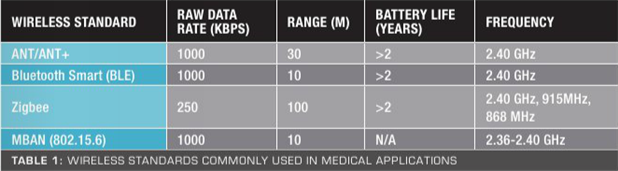
Table 1: Wireless standards commonly used in medical applications
As you can see there are a wide variety of low power technologies available for use in wireless medical devices and each has their place. ANT/ANT+ is a proprietary 2.4GHz protocol currently used mainly in health and fitness products, not clinical medical equipment. Total volume of ANT enabled products is rapidly growing, but only a handful of products have adopted the technology, potentially due to the low burst transfer rate of 20Kbps.
Similar to ANT, Zigbee operates in the 2.4GHz space and has gained some adoption in the medical device space, largely due to its specific healthcare profiles. One key difference is that Zigbee is built on an open standard protocol (IEEE 802.15.4) rather than a proprietary protocol like ANT. Zigbee success has been within clinical environments where hospital IT professional are able to take advantage of it’s mesh networking capability.
Bluetooth Smart (BLE) is a wireless technology specifically created for short-range, low-energy applications where only short bursts of data are required (i.e. non-streaming data). Low latency and numerous available sleep modes allow BLE to boast low power consumption characteristics. These characteristics combined with the fact that Bluetooth 4.0, containing Bluetooth Smart (BLE) has become a standard in smart mobile devices such as phones, tablets and PCs, make it a likely candidate for wide market adoption.
A new wireless protocol that is well positioned for rapid market adoption is the Medical Body Area Network or MBAN protocol. The MBAN spectrum was developed for use in low-power and short-range medical applications and has been driven by the “last meter” challenge of un-tethering the patient from the bedside monitoring and treatment equipment. It operates using the IEEE 802.15.6 standard and may be able to use the same radio hardware as Zigbee or Bluetooth Smart. Silicon providers focused on health and medical applications have already begun establishing solutions, some of which will launch in 2012.
Wireless applications in the medical market are on the cusp of a breakthrough. Imagine a system that uses a sensor embedded in your clothing to monitor your heart rate, then transmits the data to a telemonitoring gateway and alerts your physician, all wirelessly, without intervention. The vision is set, standards are being defined, and a technology revolution for the medical market is underway.
One last point to be considered is that unlike many other electronic products, medical devices face a heavy pre-market regulatory burden. Even in the best of circumstances the development of medical devices is expensive ($10M to $20M) and the time to market is long. This often necessitates a 10-15 year product life. Silicon providers have taken notice and some have introduced programs that guarantee a products life for 10, 15, or even 20 years. For specific Terms and Conditions of Freescale’s product longevity program and to obtain a list of available products please visit http://www.freescale.com/productlongevity.
The next 5 years are going to be exciting in the medical device world. New developments in analog, low power and wireless technology will help reshape the healthcare system as we know it today. In this new world everything will be wirelessly connected, extremely accurate, and powered for years. Soon after, devices -- not doctors -- will be helping us to make educated decisions regarding our health. This will help to lower the cost of healthcare and increase the level of patient care. The future is bright for both the developer and the user of next-generation medical devices. Working with a partner like Freescale, which has a long history of providing embedded solutions to the highly regulated automotive market should give medical device designers piece of mind. Freescale works hard to meet the needs of the medical device designer by not only providing a portfolio of highly integrated, ultra-low-power, microcontrollers offering flexible connectivity options, but also a wide variety of sensor, analog, and wireless solutions.
For more information on Freescale’s hardware and software solutions for the medical device market, visit www.farnell.com/medical or www.freescale.com/medical
David Niewolny, Medical Product Marketing Manager, Freescale, Inc.
