element14 Community
element14 Community
    Register Log In
  • Site
  • Search
  • Log In Register
  • Community Hub
    Community Hub
    • What's New on element14
    • Feedback and Support
    • Benefits of Membership
    • Personal Blogs
    • Members Area
    • Achievement Levels
  • Learn
    Learn
    • Ask an Expert
    • eBooks
    • element14 presents
    • Learning Center
    • Tech Spotlight
    • STEM Academy
    • Webinars, Training and Events
    • Learning Groups
  • Technologies
    Technologies
    • 3D Printing
    • FPGA
    • Industrial Automation
    • Internet of Things
    • Power & Energy
    • Sensors
    • Technology Groups
  • Challenges & Projects
    Challenges & Projects
    • Design Challenges
    • element14 presents Projects
    • Project14
    • Arduino Projects
    • Raspberry Pi Projects
    • Project Groups
  • Products
    Products
    • Arduino
    • Avnet & Tria Boards Community
    • Dev Tools
    • Manufacturers
    • Multicomp Pro
    • Product Groups
    • Raspberry Pi
    • RoadTests & Reviews
  • About Us
  • Store
    Store
    • Visit Your Store
    • Choose another store...
      • Europe
      •  Austria (German)
      •  Belgium (Dutch, French)
      •  Bulgaria (Bulgarian)
      •  Czech Republic (Czech)
      •  Denmark (Danish)
      •  Estonia (Estonian)
      •  Finland (Finnish)
      •  France (French)
      •  Germany (German)
      •  Hungary (Hungarian)
      •  Ireland
      •  Israel
      •  Italy (Italian)
      •  Latvia (Latvian)
      •  
      •  Lithuania (Lithuanian)
      •  Netherlands (Dutch)
      •  Norway (Norwegian)
      •  Poland (Polish)
      •  Portugal (Portuguese)
      •  Romania (Romanian)
      •  Russia (Russian)
      •  Slovakia (Slovak)
      •  Slovenia (Slovenian)
      •  Spain (Spanish)
      •  Sweden (Swedish)
      •  Switzerland(German, French)
      •  Turkey (Turkish)
      •  United Kingdom
      • Asia Pacific
      •  Australia
      •  China
      •  Hong Kong
      •  India
      • Japan
      •  Korea (Korean)
      •  Malaysia
      •  New Zealand
      •  Philippines
      •  Singapore
      •  Taiwan
      •  Thailand (Thai)
      • Vietnam
      • Americas
      •  Brazil (Portuguese)
      •  Canada
      •  Mexico (Spanish)
      •  United States
      Can't find the country/region you're looking for? Visit our export site or find a local distributor.
  • Translate
  • Profile
  • Settings
Publications
  • Learn
  • More
Publications
Blog AIST group develops method for measuring objects in 3D
  • Blog
  • Documents
  • Events
  • Files
  • Members
  • Mentions
  • Sub-Groups
  • Tags
  • More
  • Cancel
  • New
Join Publications to participate - click to join for free!
  • Share
  • More
  • Cancel
Group Actions
  • Group RSS
  • More
  • Cancel
Engagement
  • Author Author: Catwell
  • Date Created: 20 Aug 2012 7:10 PM Date Created
  • Views 612 views
  • Likes 2 likes
  • Comments 2 comments
  • object_tracking
  • research
  • test
  • 3d
  • industry
  • hmi
  • 3d_scan
  • robotics
  • robot
  • on_campus
  • cabeatwell
  • prototyping
  • measurement
  • university
  • kinect
  • sensor
  • innovation
  • communication
Related
Recommended

AIST group develops method for measuring objects in 3D

Catwell
Catwell
20 Aug 2012

image

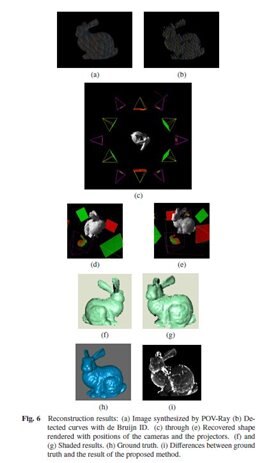
3D Scan of a rabbit statue (via Entire Shape Acquisition Technique Using Multiple Projectors and Cameras with Parallel Pattern Projection)


Scanning a 3D object is nothing new. Scanning while that object is moving is a task still in its infancy. Some first steps may have been taken. Researchers from AIST (Advanced Industrial Science and Technology) in Japan, with cooperation from researchers at Kagoshima and Hiroshima Universities, have developed a method of accurately measuring 3D objects using a series of projectors and a camera.


Sure there are systems capable of doing the same thing, such as Microsoft’s Kinect and the ASUS Xtion, but they have difficulty when the object being tracked moves rapidly or changes shape. The research team’s system uses a projector (or a series of LCD video projectors) to project a specially designed ‘wavy-light pattern’ onto an object. The resulting pattern images are then captured by a Point Grey Research Flea2 camera and processed using a computer to accurately measure the object using a single image. The team was also successful using 6 high-speed cameras along 6 projectors that can measure and track an object (triangulation) moving in real time. The projectors display a set of parallel lines only, in two different colors, to be able to easily analyze the image to gain accurate measurement all the way down to 1-2mm. This makes the system capable of identifying and measuring wrinkles in clothing and even the fine details (subtle curves) of human hands.


image

Concept and process (via Entire Shape Acquisition Technique Using Multiple Projectors and Cameras with Parallel Pattern Projection)


The researchers state that their system/method could be used in the same fashion as the Kinect or Xtion in relation to multimedia, VR and games but has the potential of moving beyond those in scenarios involving how athletes move on a playing field that could result in reduced injuries by analyzing the player’s movements. It could also be implemented for use with stereo microscopes to measure and map microscopic images, from bacteria or viruses, to garner a better understanding of how they work or evolve. Eventually the team hopes to replace the visible pattern from the projectors with infrared versions that do not interfere with the visible appearances of objects and also allow them to capture dynamic scenes (changing or moving) and visible textures at the same time.


Diginfo report:

You don't have permission to edit metadata of this video.
Edit media
x
image
Upload Preview
image


Cabe

http://twitter.com/Cabe_e14

  • Sign in to reply
  • Catwell
    Catwell over 13 years ago in reply to DAB

    The AIST might be reviewing their life's work once the Kinect 2.0 arrives. Supposedly, it will feature most of what AIST has accomplished in their tech. There always needs to be competition though.


    Cabe

    • Cancel
    • Vote Up 0 Vote Down
    • Sign in to reply
    • More
    • Cancel
  • DAB
    DAB over 13 years ago

    Using camera images to recreate a 3D space has been a staple of photgraphic interpretation for decades.

    Using the pattern projection helps to simplify the job in the near field by giving you callibration zones within the image.

    This extra verification lets current processing power work the images in realtime to create an approximation.


    These guys should go look at the latest Kinect work where they dither the IR projector to fill in the distance measurements to create a cleaner 3D measurement.


    I do like the idea about using the technique with the mircroscope.  Playing with that affect could be really interesting.


    Just a thought,

    DAB

    • Cancel
    • Vote Up 0 Vote Down
    • Sign in to reply
    • More
    • Cancel
element14 Community

element14 is the first online community specifically for engineers. Connect with your peers and get expert answers to your questions.

  • Members
  • Learn
  • Technologies
  • Challenges & Projects
  • Products
  • Store
  • About Us
  • Feedback & Support
  • FAQs
  • Terms of Use
  • Privacy Policy
  • Legal and Copyright Notices
  • Sitemap
  • Cookies

An Avnet Company © 2025 Premier Farnell Limited. All Rights Reserved.

Premier Farnell Ltd, registered in England and Wales (no 00876412), registered office: Farnell House, Forge Lane, Leeds LS12 2NE.

ICP 备案号 10220084.

Follow element14

  • X
  • Facebook
  • linkedin
  • YouTube