



Anonymous emblem. Symbolizing a leaderless organization and anonymity.
Boycotts and sit-ins were instrumental strategies in the civil rights movement mid 20th century. Not only were these actions effective but they were expressions of first amendment rights. Now, the group Anonymous is exercising another first amendment right by creating a digital petition to make distributed denial of service (DDoS) a legitimate form of protest. Unfortunately, neither Anonymous nor DDoS protests have created a good reputation for themselves in the eyes of the US gov, which will probably reflect in any decision made. Still, I’ll choose to be the tragic optimist.
Anonymous decided to make a petition on the White House’s website “We the People” (petitions.whitehouse.com). Over 25,000 signatures means it will get attention from the Obama Administration but does not guarantee a pass into the legislative or judicial branch.
In the past, people have been arrested for involvement in DDoS protests. A person was even arrested for an uploaded video that referred to a DDoS attack that never took place. Anonymous wants these individuals to be released and have their records wiped clean of any criminal wrongdoing. Anonymous says DDoS attacks are equivalent to “repeatedly clicking the refresh button on a website” so obviously, they are very different from hacking.
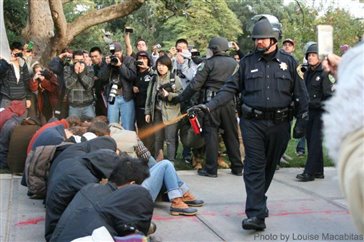
Civil disobedience is still disobedience. Infamous mace cop making history. (via LM)
Although the move seems to make sense from a constitutional standpoint, the various authorities were not very sentimental towards the occupy movement, which was itself, mostly composed of peaceful protests. A quick search for “mace cop” will show the establishments feelings about peaceful protest. (Also fun to see what people have done with the Mace Cop.) It is unlikely the DDoS petition will receive unbiased consideration.
Although certain DDoS attacks have been orchestrated against private companies like SONY, Anonymous has also targeted the FBI and other authorities. But perhaps the biggest reason why the US govt. will not grant this petition a passage to law is that DDoS poses a potential for foreign attack. Supposedly, the Iranian government was behind an attack that targeted bank websites, which would surely be a reason to deny the legitimization of DDoS attacks as protest. In 2012, DDoS attacks were conducted against almost every US bank. These attacks mainly flooded HTTP GET, UDP, ICMP and the SYN levels of networks. They lasted up to 32 hours and used about 5.9 Gbps.
The nature of this petition brings up a very important point. DDoS attacks disrupt services, and they could be abused (as with anything), but they also demonstrate that the online community has some of the same abilities in the virtual world, as human citizens have in the real world. By losing these forms of expression, we continue to see loss of rights in the government’s continued efforts to dictate our actions, this time, telling us we can’t refresh our web pages excessively.
The petition has until February 6th to gain official recognition. It has nearly 6,000 digital signatures as of Jan. 27. (I think people are scared to attach their names to this petition.)
Cabe


