


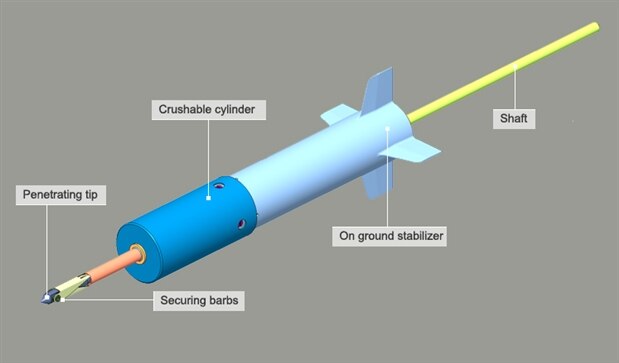
Harpoon concept (via Astrium UK)
Humans are messy. The city streets are littered, and we have done an equally superb job of dirtying up outer space around the planet. Like on earth, we tend to look the other way until something happens affects us. After satellite collisions, like that between the Iridum 33 and Cosmos 2251 satellites in 2009 that created an enormous amount of debris, space agencies around the world are thinking perhaps it's time to start cleaning it up. The European Space Agency launched its Clean Space Initiative, , Boeing thinks they can spray heavy gasses on them to cause them to fall towards Earth, Raytheon is currently tracking it all, and the Swiss Federal Institute of Technology wants to send new satellites to collect them and then burn themselves reentering the atmosphere.
The Astrium aerospace engineering company is in the developing phase of a few ideas of their own. Some using nets and others using grappling robots. One of the simplest ideas comes from their UK firm and involves a harpoon. At Astrium UK’s Stevenage base, tests are being conducted with a 60 cm harpoon composted of stabilizing fins, a penetrating tip with securing barbs and a crushable cylinder between them intended to absorb the impact. One of the dangers of harpooning space junk is that too much force could cause them to veer in some unwanted direction or worse break into pieces. This is why the team added the crushable cylinder, and why the space harpoon would only measure 30 cm (stabilizing fins are not needed in space).
The harpoon would be launched from “chaser satellites” that patrol space in search of decommissioned satellites. This satellite would take pictures from about 100 m away and send them to ground crews to verify the space garbage. Once confirmed, the chaser would get to 20 m away and harpoon it. Astrium UK is still figuring out if the chaser satellite should pull the space junk towards the atmosphere, or if the harpoon itself can be equipped with thrusters, to send it towards Earth.
This setup would only be productive and worthwhile if used on big space junk, but it is very important to clean these up as they pose the most destructive potential. Prof. Richard Crowther from the UK Space Agency wants to point out another destructive potential, which could result if these wrangler satellites are used against functioning satellites. As we all know, those involved in the military and those in love with science are not one in the same as much as military lusts for science would have you believe. So all space agencies must agree to do this peacefully and trust each other.
We’re still far off from having these types of satellites roaming space, but the necessity for a clean up means they will surely happen. The Astrium UK team is presenting their idea at the 63rd International Astronautical Congress in Naples, Italy. These efforts imply some valuable lessons about the need for more environmentally conscious practices in Earth and space while showing how these break down when there is a lack of trust, ahem military involvement.
A reminder why this is important. A fictitious commuter space flight in the near future...
Some interesting facts to consider before sending more stuff into space:
The ESA estimates 22,000 manmade objects bigger than a coffee cup are currently orbiting, and only 1,100 of those are working satellites.
NASA estimates at least 500,000 objects between one and ten centimeters orbiting the Earth, with more than 100 million objects up there that are smaller than one centimeter.
All of these are moving at the speed of bullets and posing potentially devastating threat to humans and machines in space.
Cabe

