


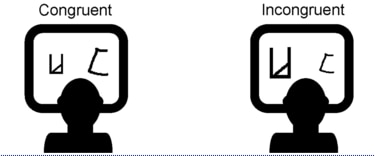
Stroop test concept setup (via University of Oxford)
Electroshock therapy was at one point used as treatment for all sorts of ailments, but research into its efficacy was inconclusive for the most part and now it is used as a last resort in depression, mania and catatonia. Studies that are much more recent have given electric currents a second chance to be the magic treatment. Transcranial Electrical Stimulation or TES is a noninvasive treatment that sends a direct current via electrodes to specific parts of the brain and changes neuronal excitability that leads to alterations in brain function.
At the University of Oxford, a preliminary study showed that TES could significantly improve the ability of subjects to associate unfamiliar symbols with numerical values when it was applied to the Posterior Parietal Cortex (PPC), an area crucial in numerical learning. Although these results were exciting, a new study performed at Stanford’s Cognitive and Systems Neuroscience Laboratory shows that this enhanced learning ability may come at the expense of decreased activity in other areas of the brain.
In the Stanford study, researchers Teresa Iucalano and Cohen Kadosh went a few steps further when replicating the Oxford study. At Oxford, they told volunteers to learn unfamiliar symbols and a numerical value they represented. While subjects learned the symbols, half of them received TES. Every week for six weeks, researchers would show subjects two symbols and ask them to choose, as fast as they could, which symbol represented the larger value. At Stanford, they replicated this portion of the test but while the subjects were learning the new symbols and their values, a third of the subjects were given TES at the Dorsolateral Prefrontal Cortex (DLPFC), an area in charge of performing tasks that do not need thinking like walking or talking i.e. automaticity. The other third of the volunteers were not given TES just perceived a tingly sensation to fool them.
Throughout the six-week study, subjects were presented with the same comparison test where they chose the symbol with the higher numerical value. In addition to this test, they were also submitted to another test that asked them to choose, as fast as possible, which symbol was physically smaller (as in the symbol of smaller font).
In the same fashion as a Stroop test, there were trials where both the numerical value and the font size were smaller. These are called congruent trials. Incongruent trials were also presented where the value of the number was bigger but its font was smaller. To measure automaticity, researchers subtracted the time from incongruent trials, which take a bit longer to process, from the congruent trials.

Stroop test symbols (via University of Oxford)
Those subjects that received TES at the PPC responded faster to the numerical value comparison test throughout the six weeks, meaning they learned them faster. However, this group showed a smaller difference between congruent and incongruent trials showing low automaticity.
On the contrary, the DLPFC group tested much faster during congruent trials. This resulted in a larger gap between congruent and incongruent trials, meaning that they were able to retrieve the information they learned much quicker and thus showed increased automaticity.
The non-treated group scored in between both other groups as expected and every group preformed the same in a Stroop test that used regular numbers.
Stanford researchers interpreted their results saying that TES may improve some brain functions at the expense of another, as was shown by the PPC group that learned faster but retrieved information slower during congruent trials in the Stroop test.
In response Cohen stated, “If there is a cost, we need to optimize stimulation to limit or eliminate side effects.” The Stanford group is now trying to find methods that may work around this cost to TES. They have suggested zapping both regions affected at different periods during learning. TES holds a lot of potential for both disabled and able-bodied people as it could eliminate the need for pharmaceuticals that have much more vicious side effects.
C
See more news at: