


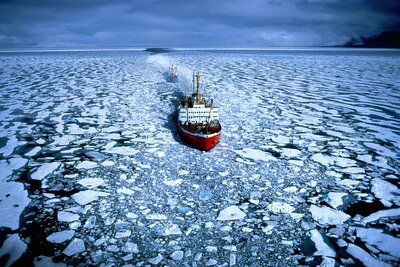
Ice breaker ship plowing through the Arctic Ocean (via stock photography)
Many projects, some which will start this year, will upgrade the current Internet connections of many regions of the northern hemisphere. Increased speed, connectivity, and reduced latency is the goal.
Starting this August, after the summer exposes the arctic sea, there are plans to lay fiber optic cable connecting Tokyo Japan and London UK across the Arctic Ocean. One of these projects is called the Russian Optical Trans-Arctic Submarine Cable System (ROTACS). This specific project will be composed of two cables through the North-West passage, while a third cable will be laid along the northern Russian coast. It will be comprised of 14,700 km of cable and will be responsible for installing the longest single stretch of fiber optic cable ever.
A second project, conducted by Toronto company Arctic Fiber, will lay cable beneath the Canadian Arctic. This project will lay 15,600 kilometers of cable and will include optical amplifiers ever 50 to 100 kilometers to ensure a strong signal throughout the massive fiber optic network. The Arctic Fiber project will reduce latency between Japan and the UK from 230 ms to 168 ms.
These projects will bring fiber optic Internet to communities along the arctic and surely will prove to be extremely useful to people accessing it. But, of course the project is not being done out of good will. So, no people in remote areas will piggy back on to this new Internet pipeline
Motive seems to never be without the assurance of monetary gain. Herein lies the reason for the excitement about the 62 ms latency reduction. High-frequency stock traders will gain an advantage over others in using these networks and automated trading.
These aforementioned projects will begin this year, but there is more in the works. A third project called the Arctic Link may begin in 2014 featuring 15,840 km of cable.
The remoteness of these oceans will provide protection to these lines. The plans side step politically unstable areas of the world. It is also rare to find much activity in the waters. So the laid lines will remain untouched by fishing boats or other activity. But, these projects will certainly put a dent in the wallets of those funding them, as their cost range from $600 million to $1.5 billion dollars. The price of expanding data communication.
Eavesdropper