element14 Community
element14 Community
    Register Log In
  • Site
  • Search
  • Log In Register
  • Community Hub
    Community Hub
    • What's New on element14
    • Feedback and Support
    • Benefits of Membership
    • Personal Blogs
    • Members Area
    • Achievement Levels
  • Learn
    Learn
    • Ask an Expert
    • eBooks
    • element14 presents
    • Learning Center
    • Tech Spotlight
    • STEM Academy
    • Webinars, Training and Events
    • Learning Groups
  • Technologies
    Technologies
    • 3D Printing
    • FPGA
    • Industrial Automation
    • Internet of Things
    • Power & Energy
    • Sensors
    • Technology Groups
  • Challenges & Projects
    Challenges & Projects
    • Design Challenges
    • element14 presents Projects
    • Project14
    • Arduino Projects
    • Raspberry Pi Projects
    • Project Groups
  • Products
    Products
    • Arduino
    • Avnet & Tria Boards Community
    • Dev Tools
    • Manufacturers
    • Multicomp Pro
    • Product Groups
    • Raspberry Pi
    • RoadTests & Reviews
  • About Us
  • Store
    Store
    • Visit Your Store
    • Choose another store...
      • Europe
      •  Austria (German)
      •  Belgium (Dutch, French)
      •  Bulgaria (Bulgarian)
      •  Czech Republic (Czech)
      •  Denmark (Danish)
      •  Estonia (Estonian)
      •  Finland (Finnish)
      •  France (French)
      •  Germany (German)
      •  Hungary (Hungarian)
      •  Ireland
      •  Israel
      •  Italy (Italian)
      •  Latvia (Latvian)
      •  
      •  Lithuania (Lithuanian)
      •  Netherlands (Dutch)
      •  Norway (Norwegian)
      •  Poland (Polish)
      •  Portugal (Portuguese)
      •  Romania (Romanian)
      •  Russia (Russian)
      •  Slovakia (Slovak)
      •  Slovenia (Slovenian)
      •  Spain (Spanish)
      •  Sweden (Swedish)
      •  Switzerland(German, French)
      •  Turkey (Turkish)
      •  United Kingdom
      • Asia Pacific
      •  Australia
      •  China
      •  Hong Kong
      •  India
      • Japan
      •  Korea (Korean)
      •  Malaysia
      •  New Zealand
      •  Philippines
      •  Singapore
      •  Taiwan
      •  Thailand (Thai)
      • Vietnam
      • Americas
      •  Brazil (Portuguese)
      •  Canada
      •  Mexico (Spanish)
      •  United States
      Can't find the country/region you're looking for? Visit our export site or find a local distributor.
  • Translate
  • Profile
  • Settings
Publications
  • Learn
  • More
Publications
Blog Automotive Oddities: French Propeller-driven Cars
  • Blog
  • Documents
  • Events
  • Files
  • Members
  • Mentions
  • Sub-Groups
  • Tags
  • More
  • Cancel
  • New
Join Publications to participate - click to join for free!
  • Share
  • More
  • Cancel
Group Actions
  • Group RSS
  • More
  • Cancel
Engagement
  • Author Author: GardenState
  • Date Created: 11 May 2015 1:11 PM Date Created
  • Views 1153 views
  • Likes 0 likes
  • Comments 0 comments
Related
Recommended

Automotive Oddities: French Propeller-driven Cars

GardenState
GardenState
11 May 2015

image

The Lane Motor Museum in Nashville TN was established by auto enthusiast Jeff Lane in 2002 based on his personal collection. The museum now has over 400 cars, 150 of which are on display at any time.


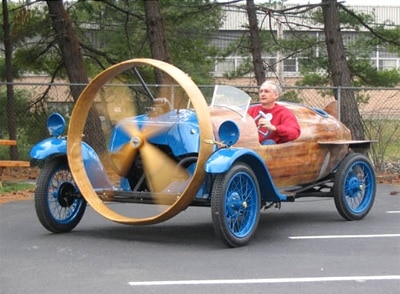
Of all the vehicles in the museum, perhaps the strangest is the Helicron (above), which receives its propulsion via an aircraft propeller and engine. It is not a car-and-plane hybrid as it cannot fly and was meant to be driven on public roads. Discovered in a French barn in 2000, having been placed there by the original owner in the late 1930s, the Helicron was constructed in 1932. It has been completely rebuilt but many of the mechanical components are original, such as the frame, wire wheels, dashboard, steering wheel, steering gear, brake pedal, light switch, headlights, and the type plate. The wood frame was sandblasted and treated, the steering gear was rebuilt, and the interior was upholstered. The current engine is a 4-cylinder, air cooled Citroën GS engine with the propeller coupled directly to the crankshaft. The original engine was lost but it is known to have been a horizontally-opposed, two cylinder, four stroke engine. The rear wheel assembly is used to steer the vehicle. The Helicron is reported to have passed a French safety inspection in 2000 and is approved for use on their roads. Speed is controlled by a throttle and top speed is said to be around 75 mph.

 

image

Perhaps more unusual is the fact that the Helicron isn’t the only propeller-driven car in the Lane Museum’s collection; it’s joined by several Marcel Leyat creations.  The image above shows the 1919 Leyat Helico. Marcel Leyat believed that propeller-driven cars were the wave of the future. He thought they would be popular because they were simpler – they contained no rear axle and no transmission, differential or clutch were required. Steering was handled via the rear wheels. In the front the giant propeller was powered by an 8 horsepower Scorpion engine that provided movement for the vehicle.

  • Sign in to reply
element14 Community

element14 is the first online community specifically for engineers. Connect with your peers and get expert answers to your questions.

  • Members
  • Learn
  • Technologies
  • Challenges & Projects
  • Products
  • Store
  • About Us
  • Feedback & Support
  • FAQs
  • Terms of Use
  • Privacy Policy
  • Legal and Copyright Notices
  • Sitemap
  • Cookies

An Avnet Company © 2025 Premier Farnell Limited. All Rights Reserved.

Premier Farnell Ltd, registered in England and Wales (no 00876412), registered office: Farnell House, Forge Lane, Leeds LS12 2NE.

ICP 备案号 10220084.

Follow element14

  • X
  • Facebook
  • linkedin
  • YouTube