element14 Community
element14 Community
    Register Log In
  • Site
  • Search
  • Log In Register
  • Community Hub
    Community Hub
    • What's New on element14
    • Feedback and Support
    • Benefits of Membership
    • Personal Blogs
    • Members Area
    • Achievement Levels
  • Learn
    Learn
    • Ask an Expert
    • eBooks
    • element14 presents
    • Learning Center
    • Tech Spotlight
    • STEM Academy
    • Webinars, Training and Events
    • Learning Groups
  • Technologies
    Technologies
    • 3D Printing
    • FPGA
    • Industrial Automation
    • Internet of Things
    • Power & Energy
    • Sensors
    • Technology Groups
  • Challenges & Projects
    Challenges & Projects
    • Design Challenges
    • element14 presents Projects
    • Project14
    • Arduino Projects
    • Raspberry Pi Projects
    • Project Groups
  • Products
    Products
    • Arduino
    • Avnet & Tria Boards Community
    • Dev Tools
    • Manufacturers
    • Multicomp Pro
    • Product Groups
    • Raspberry Pi
    • RoadTests & Reviews
  • About Us
  • Store
    Store
    • Visit Your Store
    • Choose another store...
      • Europe
      •  Austria (German)
      •  Belgium (Dutch, French)
      •  Bulgaria (Bulgarian)
      •  Czech Republic (Czech)
      •  Denmark (Danish)
      •  Estonia (Estonian)
      •  Finland (Finnish)
      •  France (French)
      •  Germany (German)
      •  Hungary (Hungarian)
      •  Ireland
      •  Israel
      •  Italy (Italian)
      •  Latvia (Latvian)
      •  
      •  Lithuania (Lithuanian)
      •  Netherlands (Dutch)
      •  Norway (Norwegian)
      •  Poland (Polish)
      •  Portugal (Portuguese)
      •  Romania (Romanian)
      •  Russia (Russian)
      •  Slovakia (Slovak)
      •  Slovenia (Slovenian)
      •  Spain (Spanish)
      •  Sweden (Swedish)
      •  Switzerland(German, French)
      •  Turkey (Turkish)
      •  United Kingdom
      • Asia Pacific
      •  Australia
      •  China
      •  Hong Kong
      •  India
      • Japan
      •  Korea (Korean)
      •  Malaysia
      •  New Zealand
      •  Philippines
      •  Singapore
      •  Taiwan
      •  Thailand (Thai)
      • Vietnam
      • Americas
      •  Brazil (Portuguese)
      •  Canada
      •  Mexico (Spanish)
      •  United States
      Can't find the country/region you're looking for? Visit our export site or find a local distributor.
  • Translate
  • Profile
  • Settings
Publications
  • Learn
  • More
Publications
Blog Battery lost all power? Replace it using a chemical-based aerosol spray!
  • Blog
  • Documents
  • Events
  • Files
  • Members
  • Mentions
  • Sub-Groups
  • Tags
  • More
  • Cancel
  • New
Join Publications to participate - click to join for free!
  • Share
  • More
  • Cancel
Group Actions
  • Group RSS
  • More
  • Cancel
Engagement
  • Author Author: Catwell
  • Date Created: 3 Jul 2012 5:52 PM Date Created
  • Views 453 views
  • Likes 1 like
  • Comments 3 comments
  • research
  • alternative_energy
  • industry
  • hmi
  • on_campus
  • battery
  • cabeatwell
  • prototyping
  • university
  • energy
  • solar
  • sensor
  • innovation
Related
Recommended

Battery lost all power? Replace it using a chemical-based aerosol spray!

Catwell
Catwell
3 Jul 2012

image

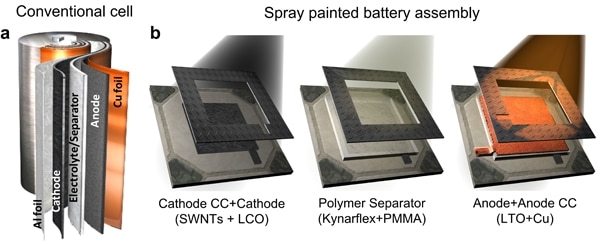
Sprayable battery concept showing each layer vs traditional cell (via Rice University)


Rice University researchers bring us a novel way of creating a lithium-ion rechargeable battery that can be ‘sprayed’ onto almost any surface. Actually the ‘paint’ is sprayed in layers with each effectively representing the traditional make-up of their solidified counterpart. The research team, led by graduate student Neelam Singh, designed the spray-on battery using five key layers that consist of a pair of current collectors, a cathode layer, anode layer and a polymer separator sandwiched in the middle. Each layer is made of a chemical make-up that includes the positive current collector which is refined single walled carbon nano-tubes mixed with black carbon particles diffused in N-methylpyrrolidone (chemical compound used to recover hydrocarbons in petrochemicals).


The cathode layer is a mixture of lithium cobalt oxide, carbon combined with ultra-fine graphite powder in an adhesive solution (unknown solution, most likely a solvent). In comes the polymer separator layer (that divides the anode and cathode layers preventing short circuits) that is made using Kynar Flex resin with PMMA (polymethyl-methacrylate) otherwise known as thermoplastic) and silicon dioxide that is dissipated in a solvent. Next comes the anode layer that is comprised of a lithium-titanium oxide along with ultra-fine graphite powder diffused in a solvent binder. Finally, rounding out the five layers is the anode portion which is comprised of a simple copper paint diluted in ethanol. Combine them in a layered application and presto; instant rechargeable battery! However, you might not want to use your tongue to see if it still has a charge.
 

image

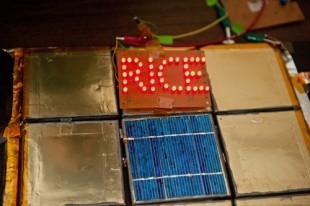
Solar and battery tile proof of concept (via Rice University)


The researchers tested the spray-on battery application using a series of surfaces that included ceramic bathroom tiles, flexible polymers (plastic), stainless steel, glass and even a beer stein (talk about getting lit-up). Each surface was coated in each layer using an airbrush, and each was found to be an adequate medium that could hold the chemical layers and maintain a steady charge. One particular experiment the team successfully demonstrated was using 9 ceramic tiles that were individually coated with the spay-on battery and then connected in parallel to each other. The center tile was outfitted with a solar-cell that collected power from a white laboratory light and charged each ‘tile-battery’ which was then able to power a series of LED’s for 6 hours with a stable current of 2.4 volts. The tiles were then tested for reliability by charging/discharging the batteries over a 60 cycle period after which the team found only a slight loss in charge capacity for each battery.


It is the team’s hope that the spray-on batteries could be integrated with paintable solar-cells such as MIT’s bio-photovoltaic cells which are made from plants. Who knows, maybe ‘tag’ artists could use the paintable batteries in their artwork that covers most every train car in America which could then be used to provide a sort of ‘green-power’ fuel for the train itself.


Cabe

http://twitter.com/Cabe_e14

  • Sign in to reply
  • DAB
    DAB over 13 years ago in reply to Catwell

    Yes


    I could see some really neat phospher activated street art that you could make with this technology and a few others.  It could make the streets a more interesting place.  Especially if it is mostly invisible during the day.


    Just a thought,

    DAB

    • Cancel
    • Vote Up 0 Vote Down
    • Sign in to reply
    • More
    • Cancel
  • Catwell
    Catwell over 13 years ago in reply to DAB

    That is true. Doubling battery size is the brute force way at extending operation time. Efficiency is key.


    However, this tech would take graffiti artists to a whole new level, don't you think?


    Cabe

    • Cancel
    • Vote Up 0 Vote Down
    • Sign in to reply
    • More
    • Cancel
  • DAB
    DAB over 13 years ago

    More likely just another step in the long road to better energy management.

    If you sit down and calculate the efficiencies of our current power generation and transmission systems, we are only running about 10%.

    So if we can just double our efficiency, we can double our power available with no increase in fuel use.


    Something to think about.


    DAB

    • Cancel
    • Vote Up 0 Vote Down
    • Sign in to reply
    • More
    • Cancel
element14 Community

element14 is the first online community specifically for engineers. Connect with your peers and get expert answers to your questions.

  • Members
  • Learn
  • Technologies
  • Challenges & Projects
  • Products
  • Store
  • About Us
  • Feedback & Support
  • FAQs
  • Terms of Use
  • Privacy Policy
  • Legal and Copyright Notices
  • Sitemap
  • Cookies

An Avnet Company © 2025 Premier Farnell Limited. All Rights Reserved.

Premier Farnell Ltd, registered in England and Wales (no 00876412), registered office: Farnell House, Forge Lane, Leeds LS12 2NE.

ICP 备案号 10220084.

Follow element14

  • X
  • Facebook
  • linkedin
  • YouTube