element14 Community
element14 Community
    Register Log In
  • Site
  • Search
  • Log In Register
  • Community Hub
    Community Hub
    • What's New on element14
    • Feedback and Support
    • Benefits of Membership
    • Personal Blogs
    • Members Area
    • Achievement Levels
  • Learn
    Learn
    • Ask an Expert
    • eBooks
    • element14 presents
    • Learning Center
    • Tech Spotlight
    • STEM Academy
    • Webinars, Training and Events
    • Learning Groups
  • Technologies
    Technologies
    • 3D Printing
    • FPGA
    • Industrial Automation
    • Internet of Things
    • Power & Energy
    • Sensors
    • Technology Groups
  • Challenges & Projects
    Challenges & Projects
    • Design Challenges
    • element14 presents Projects
    • Project14
    • Arduino Projects
    • Raspberry Pi Projects
    • Project Groups
  • Products
    Products
    • Arduino
    • Avnet & Tria Boards Community
    • Dev Tools
    • Manufacturers
    • Multicomp Pro
    • Product Groups
    • Raspberry Pi
    • RoadTests & Reviews
  • About Us
    About the element14 Community
  • Store
    Store
    • Visit Your Store
    • Choose another store...
      • Europe
      •  Austria (German)
      •  Belgium (Dutch, French)
      •  Bulgaria (Bulgarian)
      •  Czech Republic (Czech)
      •  Denmark (Danish)
      •  Estonia (Estonian)
      •  Finland (Finnish)
      •  France (French)
      •  Germany (German)
      •  Hungary (Hungarian)
      •  Ireland
      •  Israel
      •  Italy (Italian)
      •  Latvia (Latvian)
      •  
      •  Lithuania (Lithuanian)
      •  Netherlands (Dutch)
      •  Norway (Norwegian)
      •  Poland (Polish)
      •  Portugal (Portuguese)
      •  Romania (Romanian)
      •  Russia (Russian)
      •  Slovakia (Slovak)
      •  Slovenia (Slovenian)
      •  Spain (Spanish)
      •  Sweden (Swedish)
      •  Switzerland(German, French)
      •  Turkey (Turkish)
      •  United Kingdom
      • Asia Pacific
      •  Australia
      •  China
      •  Hong Kong
      •  India
      •  Japan
      •  Korea (Korean)
      •  Malaysia
      •  New Zealand
      •  Philippines
      •  Singapore
      •  Taiwan
      •  Thailand (Thai)
      •  Vietnam
      • Americas
      •  Brazil (Portuguese)
      •  Canada
      •  Mexico (Spanish)
      •  United States
      Can't find the country/region you're looking for? Visit our export site or find a local distributor.
  • Translate
  • Profile
  • Settings
Publications
  • Learn
  • More
Publications
Blog Bicarbonate of soda, stores hydrogen efficiently
  • Blog
  • Documents
  • Events
  • Files
  • Members
  • Mentions
  • Sub-Groups
  • Tags
  • More
  • Cancel
  • New
Join Publications to participate - click to join for free!
  • Share
  • More
  • Cancel
Group Actions
  • Group RSS
  • More
  • Cancel
Engagement
  • Author Author: Eavesdropper
  • Date Created: 15 Jun 2011 8:51 PM Date Created
  • Views 607 views
  • Likes 1 like
  • Comments 2 comments
  • research
  • alternative_energy
  • dit
  • eavesdropper:dit
  • on_campus
  • fuel_cell
  • university
  • energy
  • innovation
Related
Recommended

Bicarbonate of soda, stores hydrogen efficiently

Eavesdropper
Eavesdropper
15 Jun 2011

image


Fuel cells may be the energy source of the future, but hydrogen storage is a major issue. Low pressure metal hydride canisters are currently the most popular storage option for fuel cells. There are a plethora of options available, each with their pros and cons. However, the formic acid storage option offers a stable way to hold hydrogen for long periods of time in the chemical HCOOH. A ruthenium catalyst can separate the bonds to form H2 and CO2. Release of carbon dioxide is not an attractive thing to do for an green alternative energy source.


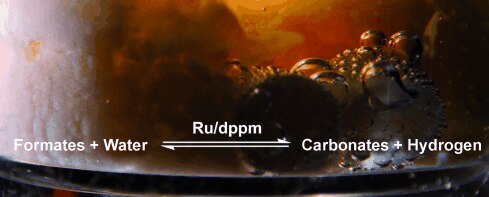
A team from the Leibnitz Institute for Catalysis, Germany, lead by Matthais Beller have created a CO2 free hydrogen storage option based on the formic acid solution. In their solution a ruthenium catalyst is still used as the hydrogen is released CO2. is captured in the form of a bicarbonates, aka baking powder, baking soda, sherbet, or NaHCO3. After the hydrogen is removed at room temperature, the leftover bicarbonate can be reloaded with hydrogen. The solid is portable and safe. Not mentioned is the energy density per gram of the solid, but it is a solid step in a new direction.


Eavesdropper


Picture via Leibniz Institute for Organic Catalysis at the University of Rostock (IfOK)

  • Sign in to reply
  • Eavesdropper
    Eavesdropper over 15 years ago in reply to DAB

    Dab,


    Finally a good use for the partially hydrogenated oils in trans-fats. I looked it up, and hydrogenated oils have about the same hydrogen density as the formic acid option above.


    E

    • Cancel
    • Vote Up 0 Vote Down
    • Sign in to reply
    • More
    • Cancel
  • DAB
    DAB over 15 years ago

    An interesting concept.  I wonder if they could do something similar to hydrogenating oils to build up a two component chemical reaction to get the Hydrogen to remain in suspension until needed?


    Thanks,

    DAB

    • Cancel
    • Vote Up 0 Vote Down
    • Sign in to reply
    • More
    • Cancel
element14 Community

element14 is the first online community specifically for engineers. Connect with your peers and get expert answers to your questions.

  • Members
  • Learn
  • Technologies
  • Challenges & Projects
  • Products
  • Store
  • About Us
  • Feedback & Support
  • FAQs
  • Terms of Use
  • Privacy Policy
  • Legal and Copyright Notices
  • Sitemap
  • Cookies

An Avnet Company © 2026 Premier Farnell Limited. All Rights Reserved.

Premier Farnell Ltd, registered in England and Wales (no 00876412), registered office: Farnell House, Forge Lane, Leeds LS12 2NE.

Follow element14

  • X
  • Facebook
  • linkedin
  • YouTube