element14 Community
element14 Community
    Register Log In
  • Site
  • Search
  • Log In Register
  • Community Hub
    Community Hub
    • What's New on element14
    • Feedback and Support
    • Benefits of Membership
    • Personal Blogs
    • Members Area
    • Achievement Levels
  • Learn
    Learn
    • Ask an Expert
    • eBooks
    • element14 presents
    • Learning Center
    • Tech Spotlight
    • STEM Academy
    • Webinars, Training and Events
    • Learning Groups
  • Technologies
    Technologies
    • 3D Printing
    • FPGA
    • Industrial Automation
    • Internet of Things
    • Power & Energy
    • Sensors
    • Technology Groups
  • Challenges & Projects
    Challenges & Projects
    • Design Challenges
    • element14 presents Projects
    • Project14
    • Arduino Projects
    • Raspberry Pi Projects
    • Project Groups
  • Products
    Products
    • Arduino
    • Avnet & Tria Boards Community
    • Dev Tools
    • Manufacturers
    • Multicomp Pro
    • Product Groups
    • Raspberry Pi
    • RoadTests & Reviews
  • About Us
  • Store
    Store
    • Visit Your Store
    • Choose another store...
      • Europe
      •  Austria (German)
      •  Belgium (Dutch, French)
      •  Bulgaria (Bulgarian)
      •  Czech Republic (Czech)
      •  Denmark (Danish)
      •  Estonia (Estonian)
      •  Finland (Finnish)
      •  France (French)
      •  Germany (German)
      •  Hungary (Hungarian)
      •  Ireland
      •  Israel
      •  Italy (Italian)
      •  Latvia (Latvian)
      •  
      •  Lithuania (Lithuanian)
      •  Netherlands (Dutch)
      •  Norway (Norwegian)
      •  Poland (Polish)
      •  Portugal (Portuguese)
      •  Romania (Romanian)
      •  Russia (Russian)
      •  Slovakia (Slovak)
      •  Slovenia (Slovenian)
      •  Spain (Spanish)
      •  Sweden (Swedish)
      •  Switzerland(German, French)
      •  Turkey (Turkish)
      •  United Kingdom
      • Asia Pacific
      •  Australia
      •  China
      •  Hong Kong
      •  India
      •  Korea (Korean)
      •  Malaysia
      •  New Zealand
      •  Philippines
      •  Singapore
      •  Taiwan
      •  Thailand (Thai)
      • Americas
      •  Brazil (Portuguese)
      •  Canada
      •  Mexico (Spanish)
      •  United States
      Can't find the country/region you're looking for? Visit our export site or find a local distributor.
  • Translate
  • Profile
  • Settings
Publications
  • Learn
  • More
Publications
Blog Bioengineers create ‘Franken-Jellyfish’ using silicon and rat muscle cells
  • Blog
  • Documents
  • Events
  • Files
  • Members
  • Mentions
  • Sub-Groups
  • Tags
  • More
  • Cancel
  • New
Join Publications to participate - click to join for free!
  • Share
  • More
  • Cancel
Group Actions
  • Group RSS
  • More
  • Cancel
Engagement
  • Author Author: Catwell
  • Date Created: 2 Aug 2012 5:03 AM Date Created
  • Views 366 views
  • Likes 0 likes
  • Comments 0 comments
  • research
  • test
  • industry
  • hmi
  • robotics
  • robot
  • cabeatwell
  • prototyping
  • measurement
  • biohacking
  • university
  • medical
  • biology
  • technology_for_the_disabled
  • sensor
  • innovation
  • communication
Related
Recommended

Bioengineers create ‘Franken-Jellyfish’ using silicon and rat muscle cells

Catwell
Catwell
2 Aug 2012

image

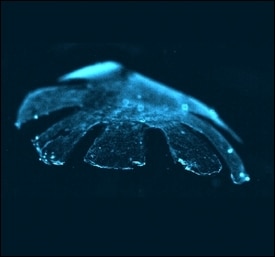
Medusoid - artificial "jellyfish" (via California Insititue of Technology)


Silicon finds a use beyond the circuit board.


Scientists from the California Institute of Technology and Harvard’s Wyss Institute have succeeded in a collaboration to create a bio-synthetic jellyfish to gain a foot-hold on repairing or replacing damaged heart-valves in humans. The team of scientists designed their synthetic jellyfish, known as ‘Medusoid’ (shape resembling a jellyfish), to function in much the same manner as its real multi-organ counterpart which uses muscles to pump water below its bell-shaped body to maneuver through the sea (almost the same morphology as the beating of a human heart).


In order to gain a better understanding on how to reverse-engineer these gelatinous invertebrates, the team used specialized analysis (biometrics and crystallography) tools used by law enforcement agencies to map out sub-cellular protein networks found in muscle cells. This was followed by studying how electrical impulses contracted the muscles themselves, including timing, for the creature’s propulsion. The team’s findings led them to create the bio-replica by forming their jellyfish bell using a pliable sheet of silicon that features eight arm-like appendages for mobility.


Later the team found they could use strips of heart muscles made from rat cells grown in their respective labs to use as the jellyfishes ‘motor.' These strips were then affixed to the silicon bell using a flexible silicon-based elastomer which was then placed in a tank of sea water. They then sent an electrical current through the water and found that they could make their artificial jellyfish swim with a synchronization of electrical shocks. They even found that the muscles would contract on their own even before electrical current was introduced to the water (almost as if the muscles knew the shock was premeditated). It’s the hope of the scientists that the findings could lead to a better understanding of how to better bio-engineer replacement tissue for use in valve replacement in human hearts.


Cabe

http://twitter.com/Cabe_e14

  • Sign in to reply
element14 Community

element14 is the first online community specifically for engineers. Connect with your peers and get expert answers to your questions.

  • Members
  • Learn
  • Technologies
  • Challenges & Projects
  • Products
  • Store
  • About Us
  • Feedback & Support
  • FAQs
  • Terms of Use
  • Privacy Policy
  • Legal and Copyright Notices
  • Sitemap
  • Cookies

An Avnet Company © 2025 Premier Farnell Limited. All Rights Reserved.

Premier Farnell Ltd, registered in England and Wales (no 00876412), registered office: Farnell House, Forge Lane, Leeds LS12 2NE.

ICP 备案号 10220084.

Follow element14

  • X
  • Facebook
  • linkedin
  • YouTube