


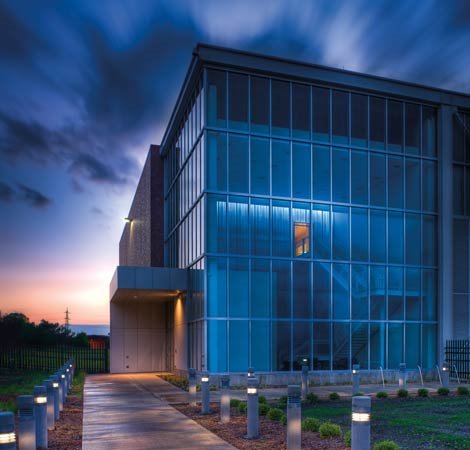
The National Petascale Computing Facility, the new home of the Blue Waters supercomputer. (via University of Illinois)
Blue Waters supercomputer is a project that was almost never finished. IBM, the original company with the contract to build the computer, backed out after realizing that they would not be making any profit on the project. From there the National Science Foundation (NSF) and University had to search for another contractor to work with, or abort the project all together. This is when Cray stepped in to save the project. Having to replace the IBM installation with their own mix of cores and processors, Cray took a few chances searching and ordering parts needed.
“I could name probably 10 things we had to juggle because they were late. We ran into those over and over again, and each time we had to fix it and move on...We took huge risks that individual pieces might not be delivered on time,” commented Barry Bolding, Cray's vice president of corporate marketing. Nevertheless, the computer was built successfully and is now among the world's fastest machines ranking third in the world and the fastest at any University campus.


ECOPhlex (PHase0change Liquid Exchange) cooling system. Two loops, on with R-134a refriderant and one with chilled water keeps the 300 cabinets of Blue Waters cool. (via University of Illinois)
The massive machine is now going to be helping scientist and engineers solve problems that require immense calculations. Blue Waters is built to operate at a sustained performance of one quadrillion calculations per second. Furthermore, when running at its peak power it is capable of reaching 11.61 quadrillion calculations per second, or 11.6 petaflops. This is accomplished through a Cray XE/XK hybrid machine with a total of 276 cabinets. 237 of those are XE compute cabinets while the others are the XK blend of cabinets. Together, the system has a total of 1.476 petabytes of total memory! The computational ability of the machine is powered by AMD 6276 “Interlagos” processors, each with a clock speed of at least 2.3 GHz, and NVIDIA GK110 “Kepler” GPU accelerators.
Researchers and scientist using Blue Waters will be studying topics such as nanoelectronics, biology, climate, and astronomy. The supercomputer also has a remote system which allows users to access their work on the machine from anywhere with an internet connection. So far, ten research projects have been awarded the clearance to work on the machine which can fuel innovation and benefit society. For instance, Blue Waters has the power to help us learn more about how viruses interact with the body and mutate or it may help us better understand and predict when tornadoes or hurricanes may occur. One of the first uses of the computer was to simulate earthquakes on California's fault lines. With the massive computational power now available for use, we may have the opportunity to save lives and better understand the way our world works.
C
See more news at:
