


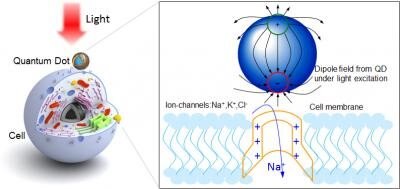
Quantum Dot concept image (via the Optical Society Journal "Remote switching of cellular activity and cell signaling using light in conjunction with quantum dots"
Lih Lin and her research team at the University of Washington have been working with Quantum Dot based stimulation of cells within the brain with surprising results. Quantum Dots (QD) are small crystal shaped particles only a few nanometers wide that behave similarly to semiconductors. They are readily excited by light. When exposed to a light source, the QDs become negatively charged. The small size and composition give them extraordinary fluorescent optical properties, and are easily adjusted by changing the size or physical composition.
Lih Lin explained where the QDs are used, "Many brain disorders are caused by imbalanced neural activity... Manipulation of specific neurons could permit the restoration of normal activity levels."
The teams succeeded in creating action potentials within the neurons by exciting quantum dots nearby. The stimulation of the QD created a negative charged surrounding it and opened up the ion channels in the neurons. The ion channels are vital to stimulating the brain cells by allowing positive charges to flow into the cell and create an action potential. Additionally, the action potential in neurons is what sends messages to other neurons or nerve cells within the body allowing a form of communication to occur. The goal is to use quantum dots to control the abnormal signal firing within the brain cause by Parkinson's, for example.
QDs can be used to treat a wide variety of brain disorders from dementia to depression. Furthermore, they may be able to treat problems within the eye and possibly blindness. The only drawback right now is creating a way to shine a light on the quantum dots while they are in the brain.
The first use of QDs will likely happen in the eye, where light is constantly absorbed. However, QDs could be delivered to the brain through the veins where they could help balance out the neural activity. Quantum Dots have a bright future in the medical field treating disorders and can possibly do so without any dangerous or unwanted side effects that come along with current brain disorder treatments.
Cabe
