


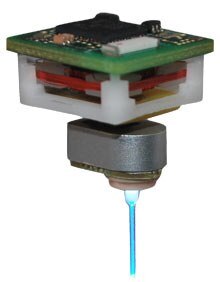
Brain Router (via Kendall Research)
The budding field of optogenetics consists of controlling cells, especially neurons, by use of light. Different parts of the brain control certain behaviors, and manipulating a trait is as simple as turning these regions on and off. This is an alternative to taking months of genetically engineering a specimen, which would only have a single gene on or off. Optogenetics hopes to give a real-time switching of particular genes.
With this tech, the genes of the specimen in question must first be altered to respond to light, usually achieved by introducing a virus to the creature. Laser systems are then used to affect the areas of interest. The issue up to the present, was how oversized, heavy, and/or expensive equipment.
Researchers from the startup company Kendall Research are breaking some barriers by designing innovative lightweight equipment to be used in optogenetic experiments. Their scientists have engineered, optogenetic “routers” that can deliver stimuli while also returning feedback wirelessly in real time. (Simultaneous datafeeds in this area was not conquered, until now.) These “routers” weigh three grams and can be strapped to the head of mice and other test subjects. Experiments can be done instantly and also on a scheduled basis. The Kendal researchers also replaced lasers with LEDs and laser diodes to save on power and space. The router then interfaces with an implant in the animal's brain, similar to a network connection plug.
An equally important jump in technology comes in how the system in powered. A Supercapacitors(ultracapacitor) bank underneath the testing area delivers bursts of energy via some wireless transfer circuit. (Details on the design of the power system and non-existent. I believe a super/ultra-cap battery hybrid is the next evolution in powering mobile gadgets. I do wish they explained this part.)
With these new optogenetic devices, experiments on living specimen can be conducted without a person being present, as all power and data transfer in wireless. The research team hopes with will provide a more natural environment and thus more accurate, reliable results. As an bonus, these devices can be manufactured at a competitive cost versus current technology, and there is room to drive the price down even further.
This type of technology is far from being applied to humans, but it is leading the path towards computerized learning and behavior modification that could be accessed by logging into a network or computer. Undoubtedly, this type of control could equally be used for harm as it is for understanding. Even though many believe optogenetics could cure many diseases, like Parkinson's, human testing is some time away.
Cabe

