


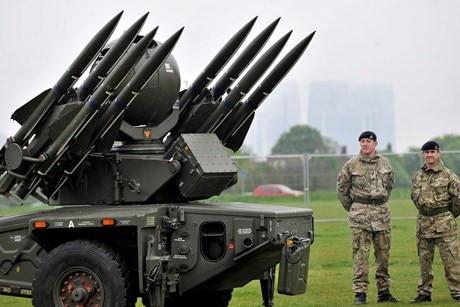
Missle defense (via AAP)
The British Parliament is going ‘all-out’ with security at this year’s (2012) Olympic Games being held in London. The government recently stated that they are set to deploy 13,500 military personnel, more than are stationed in all of Afghanistan, as back-up for the 10,000+ police and private security contractors (unknown as to the total number). To give an idea of what security measures are being put in place for this year’s summer games, Parliament is placing surface-to-air missiles on various roof-tops around the city in order to combat any airborne threat that might incur. Even the river Thames will serve as a staging platform for troops stationed the country’s largest amphibious assault ship the HMS Ocean, which can provide sea, ground and air support whenever and wherever needed. Sprinkled among the conventional forces will be the UK’s elite SAS (Special Air Service) and SBS (Special Boat Service) units. Their recent exploits had them reaching out to their US counterparts loaning a few UH-6 ‘Little Bird’ (or ‘Killer Egg’) attack helicopters for a QRF (Quick Reaction Force), an anti-terror rapid response team.
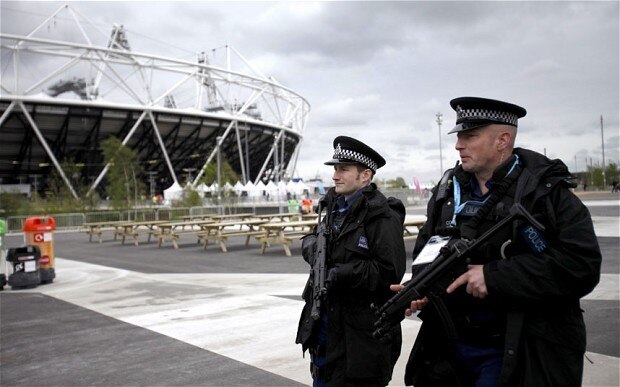
Security forces outside the Olympic stadium (Via EPA)
Security for the Olympic Park’s 1.24 square mile area includes 20 foot-high fencing with the top 4 feet of it electrified encompassing the park itself. Of course, there are checkpoints, known as ‘tunnels of truth’, that employ sensors to detect a wide range of weapons, explosives and biohazards located through-out the venue along with CCTV cameras just about everywhere you can imagine. Think of them like TSA (Transportation Security Administration) screening areas in the US only without the nudity.
A concerned employee from the Sun tabloid newspaper recently decided to test the Park’s security measure and was successful in smuggling a fake bomb through 2 checkpoints, that featured both iris and hand scanners, where he then posed for a photograph he took himself and the bomb directly outside of the stadium. However, I’m sure that the security ‘loop-hole’ he used has been addressed by the appropriate personnel at this point so there’s no need to worry. The price tag for all these measures tops out at roughly 1 billion Euros (~1.25 billion USD), but can that justified when it comes to personal safety? Yes and no. If we look back to the Munich Olympic Games in 1972 where athletes of the Israeli Olympic team were taken hostage (and killed) by the Palestinian group known as Black September or the pipe-bombs that killed two people and wounding 111 at the Olympic Games held in Atlanta Georgia in 1996, then the cost is certainly justified. You can’t put a price on people’s safety, especially when it comes to high-profiled events such as the Olympics.
On the other hand, fear is an extremely lucrative emotion that can easily be ‘cashed’ in on. How much security is enough? Why stop at surface-to-air missiles, when we could easily wear biohazard suits inside of bomb-proof concrete bunkers with windows made of ballistic glass while using high-powered optics to watch the events from a few hundred yards away. If we let fear control us, then, haven’t the ne'er-do-wells won? If we can learn to live without fear, we can accomplish the same goals (security-wise) without the added extra cost that falls on the taxpayer shoulder's, which is what we should fear.
For a comparison:
The 2008 Beijing Olympic games cost approximately 40.9 -56 Billion USD, and only returned a profit of $146M
2004 Athens ended in a loss
2000 Sydney - US $1.765 billion profit
1996 Atlanta US $10 million profit
1992 Barcelona US $5 million profit
1988 Seoul US $300 million profit (record high, not in adjusted dollars)
1984 Los Angeles US $250 million profit
Cabe