


With television content delivered largely via cable, satellite or the Internet (streaming media), it is easy to forget that the over-the-air television broadcast model is still a very efficient method of reaching large numbers of people, not only with entertainment programming but also, in times of emergencies, when you need a reliable means of disseminating critical information.
As broadcasters look to develop new services and evolve to accommodate the shifting viewing habits of the public--which increasingly involves “second screen” devices such as smartphones and tablets-- the first step in the process is to develop new standards. One of these standards, ATSC 3.0, aims to send hybrid content services to fixed (such as traditional large-screen living room and bedroom TV sets), mobile (vehicular screens), and portable handheld receivers seamlessly and simultaneously, combining both over-the-air transmission and broadband delivery.
Last week I had an opportunity to join a group of journalists, analysts and broadcast professionals touring several Cleveland locations to witness how this next-generation broadcast TV system could reach mobile viewers, connect viewers with Internet content and provide 4K Ultra High-Definition TV content delivered over-the-air using the soon to be ratified ATSC 3.0 physical layer standard.
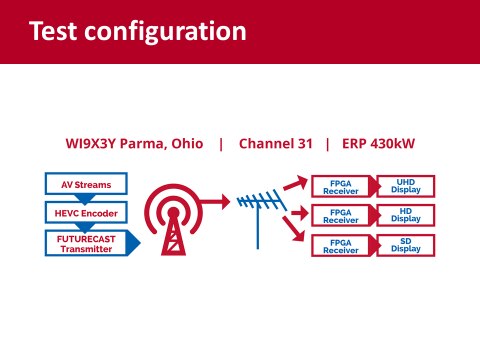
The system, dubbed “Futurecast” by proponents GatesAir, LG and Zenith and being tested in Cleveland on a rainy, nasty Thursday is designed to demonstrate how ATSC 3.0 will be able to deliver 4K Ultra HD content and two robust mobile TV streams in a single 6-Megahertz channel, while optimizing indoor reception and providing broadcast spectrum efficiency.
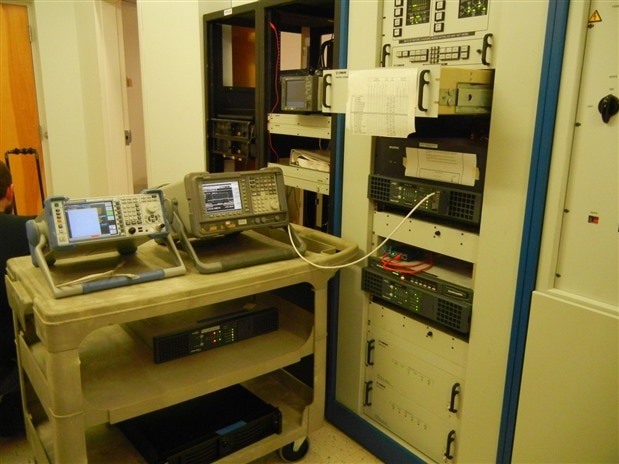
Under an experimental broadcast license from the FCC, Tribune Broadcasting’s WJW-TV provided a TV transmitter, tower and 6-MHz channel for the ATSC 3.0-related field testing, the first conducted since a similar effort in Madison, WI in mid-May.
The demonstrations involved simultaneous transmission of three data pipe configurations, ranging from a high bit rate lower robustness stream (14.2 dB Threshold of Visibility [ToV]) carrying 15.7 Mbps 4K UHD signals to a fixed receiver to more robust, lower bit rate signals such as a 3.3 db ToV, 720p HD pipe aimed at reception by a mobile device (in this case a bus traveling around downtown Cleveland) to a 480p standard definition data pipe with -1.3 db ToV (the negative number indicates that the noise level is actually higher than the signal level) designed for reception by handheld devices.
The LG/GatesAir/Zenith ATSC 3.0 technologies that were field tested in Cleveland demonstrated:
- Data throughput increases of 30 percent and improved multipath performance (compared with the current DTV standard) for fixed and portable TV reception;
- Enhanced indoor TV signal penetration for mobile reception thanks to flexible system parameter choices;
- State-of-the-art error correction coding and signal constellations.
Another demonstration hosted by local CBS affiliate WOIO-TV, a Raycom Media station, utilized AWARN (the Advanced Warning and Response Network) to deliver broadcast emergency announcements to TV sets along with rich media, maps, graphics, video, text, and audio.
Overall the tests in Cleveland were said to be even more encouraging than the previous tests, with improved signal acquisition for mobile TV reception in fast-moving vehicles (the bus reached 50mph) at locations ranging from downtown’s concrete canyons to areas several miles from the transmitter.