


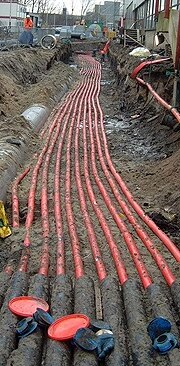
Laying a section of underground power cables (via VSMC)
As we make moves towards stabilizing the east coast power woes, many say the federal government has not done enough to promote U.S. infrastructure projects. After hurricane Sandy struck the east coast, millions of people were left without power leading many, including Maryland senator Nathaniel McFadden, to suggest a long-term project that could significantly improve the electrical grid: burying it.
Of course the project sounds simpler than it is. The landscape, especially in the northeastern coast, which is full of forest, would need to be considered before taking on this task. Communities in the U.S. are more spread out than in denser countries like Germany, where the vast majority of power lines are already buried. But after hurricane Irene, the “Derecho” storm and now Sandy caused major power outages in the east coast, many believe this is a project worth tackling.
Burying the lines will not make power outages a thing of the past. Floods, earthquakes, heat waves and mistakes in construction could also lead to outages. Unburied sections of the grid, especially high voltage transmission lines would still lead to cuts in service if damaged.
The is one reason underground power is not standard practice, price. The cost of insulated underground wires is much greater than those overhead and discovering faulty parts can take longer underground, especially if there is no redundant way to test sections frequently. Apart from their higher costs, underground wires have a higher capacitance, which may hinder long-distance power transmission.
Setting up the 300,000 km of lines that make up the U.S. power grid took decades, and likewise, it would take decades to bury it all. The risks of lives being lost to outages and risks faced by businesses like tech giant Amazon, who had to resort to gas generators to keep its servers running (and businesses reliant on those servers like Reddit, Quora, Hootsuit, Pintrest and Foursquare), make this project one that should at least be debated.
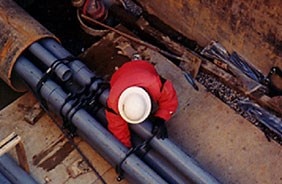
Underground cable bundle (via Power Engineers)
Of course as with any big infrastructure project, people ask about costs first. Journalist David Frum says the rule of thumb for the electrical industry is that underground wires cost 10 times more than overhead. Studies done in the UK say burying costs could be as low as 4.5 times higher than over head, but of course these estimates would vary with landscape like the woody areas mentioned above etc. Another study estimated that burying the lines of only Washington D.C. would cost $5.8 billion and could prevent 60% of outages. Washington D.C. occupies 61 sq miles, New York City spans 302 sq miles, Chicago 227 sq miles and Los Angeles 469 sq miles. A rough calculation, using the Washington D.C. estimate, would put the total cost of burying the 3 cities’ power lines at $94 billion. Of course, these prices would vary as New York is much denser than L.A. so costs would be greater in L.A. To put this in perspective next to current spending, just last year, in 2011, the U.S. military spend $695 billion…. It certainly seems doable spread over a few decades.
Better estimations could result from information released by the U.S. Energy Information Administration (http://www.eia.gov/todayinenergy/detail.cfm?id=7250) that put the average overhead-to-underground conversion cost around $750,000 dollars per mile in suburban and urban areas and about $300,000 per mile in rural areas.
Certainly, sections would need to be buried strategically, perhaps in areas at high risk of sever weather outages like parts of the east coast, all the while testing strategies for fault detection. The Energy Information Administration also stated that utilities will study burying a few key circuits. They also suggest using protective equipment at vulnerable points, more aggressive approach to vegetation management, improving the system design and implementing new technology that could pinpoint problems, divert power through other circuits to minimize outages and optimize crew deployment a.k.a making a smart grid.
Maybe we should simply figure out how Tesla was going to provide free wireless electricity, only now, we should disregard the objection of our capitalist overlords.
Cabe