


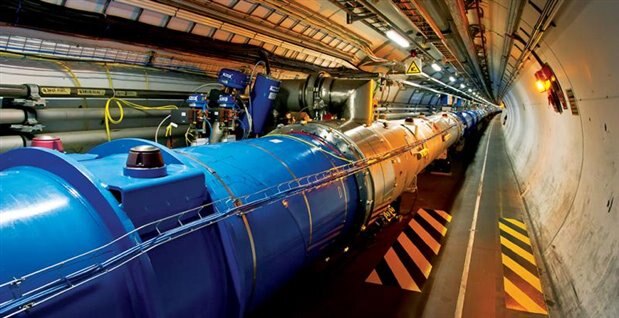
CERN’s Large Hadron Collider (LHC) is the world’s largest and most powerful particle accelerator. It consists of a 27-km ring of superconducting magnets with a number of accelerating structures to boost the energy of the particles along the way. It first started up on September 10, 2008.
In its last series of runs in 2012-13 the ATLAS and CMS experiments at the LHC observed and confirmed the existence of a new particle in the mass region around 126 gigaelectronvolts (GeV). This particle is consistent with the Higgs boson, predicted by what physicists refer to as the Standard Model, which explains how the basic building blocks of matter interact, governed by four fundamental forces. On October 8, 2013 the Nobel Prize in physics was awarded jointly to François Englert and Peter Higgs "for the theoretical discovery of a mechanism that contributes to our understanding of the origin of mass of subatomic particles”.
Now, after a period of maintenance and upgrades to the machine, proton beams have circulated in the LHC for the first time in two years.
LHC operators and systems experts kept the beams at their injection energy of 450 GeV, far below the target energy of 6.5 teraelectronvolts (TeV) per beam. The operators will now test the accelerator's subsystems and key beam parameters in preparation for increasing the beam intensity and ramping up the energy.
Only when the machine is sufficiently tuned – and the team declares "Stable Beams" with the beams in collision at the new energy of 6.5 TeV per beam – will the physics data taking begin. This work will take many weeks.
Researchers and maintenance crews will spend a great deal of this time checking and rechecking subsystems on the LHC. For example, the Machine Protection subsystem ensures that the LHC is protected from its own beams. It includes the beam dump, beam interlock system, collimators, and beam-energy tracking devices. 'Loss maps' tell the team where the beam is losing particles along the ring. Similarly, Beam Instrumentation systems includes position monitors, beam-loss monitors and synchrotron-light monitors among other devices. There are also radiofrequency, vacuum, beam-optics and injection systems, which all need to be tested and double-checked.
Despite the LHC's complexity, increasing the beam energy is a simple enough process: ramp up the current in the magnets and allow the radio frequency system to increase the energy of the beams. The current in all the magnets (and hence the magnetic field seen by the beam) is carefully increased as the beam energy rises. The main dipoles provide the necessary centripetal force to bend the beams around the ring. Other magnets such as quadrupoles have to carefully track along with the increasing dipole field.
Particle collisions at an energy of 13 TeV could start as early as June.