


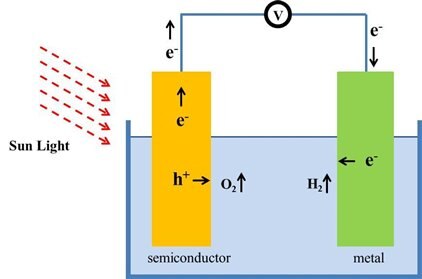
(System concept via University of Kentucky)
Hydrogen is not the abundant, free-energy, source everyone thinks it is. It has to be extracted from other compounds, like water. It takes a large amount of electricity to extract that hydrogen from other compounds. Right now, most of the hydrogen produced/collected in the word comes from non-renewable sources like natural gas and coal. However, this is about to change.
A new semiconductor alloy developed by the University of Kentucky and the University of Louisville that can generate hydrogen from water using only sunlight. Using state-of-the-art simulation software, the team found that an alloy formed by a 2% substitution of antimony (Sb) in gallium nitride (GaN) has the right electrical properties to allow for the photoelectrochemical splitting of water.
Project lead, Professor Madhu Menon, explained the development processes, "Previous research on PEC has focused on complex materials. We decided to go against the conventional wisdom and start with some easy-to-produce materials, even if they lacked the right arrangement of electrons to meet PEC criteria. Our goal was to see if a minimal 'tweaking' of the electronic arrangement in these materials would accomplish the desired results."
The efficiency and hydrogen volume that can be produced was not stated. Over time, a piece of the Sb-GaN alloy could quietly produce carbon-free hydrogen somewhere. Even in small volume, it is a solid step towards cleaner energy.
The research is funded by the U.S. Department of Energy. The team is led by Professors Madhu Menon and R. Michael Sheetz at the UK Center for Computational Sciences, and Professor Mahendra Sunkara and graduate student Chandrashekhar Pendyala at the UofL Conn Center for Renewable Energy Research. Their most recent findings were published Aug. 1 in the Physical Review Journal.
Eavesdropper

