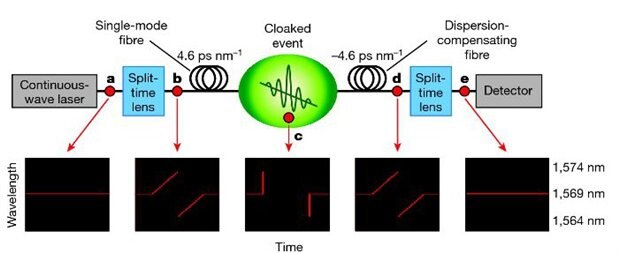
Another batch of articles about “cloaking” research has appeared following the publication of a letter in the January 5th journal of Nature entitled “Demonstration of Temporal Cloaking”. It seems that every few months something is published related to invisibility and we get a batch of questionable articles likening the research to science fiction.
The Nature article describes a DARPA-funded experiment at Cornell involving transmitting laser light through a fiberopic cable. The laser light is monochromatic with a wavelength of 1569nm. They pass the light through a process called a split-time lens (STL), which causes the wavelenth to ramp upward by 5nm over 25ps period. It then causes the wavelength to drop 10nm and ramp back up to 1569nm during the following 25ps.
The Nature article describes a DARPA-funded experiment at Cornell involving transmitting laser light through a fiberopic cable. The laser light is monochromatic with a wavelength of 1569nm. They pass the light through a process called a split-time lens (STL), which causes the wavelenth to ramp upward by 5nm over 25ps period. It then causes the wavelength to drop 10nm and ramp back up to 1569nm during the following 25ps.
The light is then passed through a dispersive element in which shorter wavelengths propagate faster than long wavelengths. Light of different wavelengths propagating at different frequencies is a common phenomon. It’s why prisms bend different wavelengths different amounts. It’s also why blue and violent lights appear blurrier than red lights to people who are nearsighted and clearer to people who are farsighted.
At the receiving side of the experiment the light passes through the reverse process: reversing the dispersive process and reversing the ramp in wavelength. The result is a 50ps gap period during which events between the two processes cannot be observed. The observer sees the time-shifted light and nothing of any interruptions that happen during the gap.
The researchers tested this by introducing a signal on the fiber optic cable between the transmitter and receiver that would interact with the 1569nm transmitted signal to produce a 1539nm signal. When the interfering signal was introduced during the gap period, its received strength was less than a 10th of its strength without the cloak. The signal was not completely attenuated because of non-idealities in the relationship between propagation speed to wavelength in the dispersive element.
The next step is to increase the duration of the 50ps gap. This could be increased to a few nanoseconds, limited by the propagation time of the longest stretch of fiber the laser beem can be transmitted on.
The first potential application of this could be an encryption method requiring an STL and dispersive element to decode the signal. I cannot see how it will ever lead to technology to hide objects outside of a fiber optic cable for a significant period of time.
You can read the article in Nature for $4 at Deepdyve.