element14 Community
element14 Community
    Register Log In
  • Site
  • Search
  • Log In Register
  • Community Hub
    Community Hub
    • What's New on element14
    • Feedback and Support
    • Benefits of Membership
    • Personal Blogs
    • Members Area
    • Achievement Levels
  • Learn
    Learn
    • Ask an Expert
    • eBooks
    • element14 presents
    • Learning Center
    • Tech Spotlight
    • STEM Academy
    • Webinars, Training and Events
    • Learning Groups
  • Technologies
    Technologies
    • 3D Printing
    • FPGA
    • Industrial Automation
    • Internet of Things
    • Power & Energy
    • Sensors
    • Technology Groups
  • Challenges & Projects
    Challenges & Projects
    • Design Challenges
    • element14 presents Projects
    • Project14
    • Arduino Projects
    • Raspberry Pi Projects
    • Project Groups
  • Products
    Products
    • Arduino
    • Avnet & Tria Boards Community
    • Dev Tools
    • Manufacturers
    • Multicomp Pro
    • Product Groups
    • Raspberry Pi
    • RoadTests & Reviews
  • About Us
  • Store
    Store
    • Visit Your Store
    • Choose another store...
      • Europe
      •  Austria (German)
      •  Belgium (Dutch, French)
      •  Bulgaria (Bulgarian)
      •  Czech Republic (Czech)
      •  Denmark (Danish)
      •  Estonia (Estonian)
      •  Finland (Finnish)
      •  France (French)
      •  Germany (German)
      •  Hungary (Hungarian)
      •  Ireland
      •  Israel
      •  Italy (Italian)
      •  Latvia (Latvian)
      •  
      •  Lithuania (Lithuanian)
      •  Netherlands (Dutch)
      •  Norway (Norwegian)
      •  Poland (Polish)
      •  Portugal (Portuguese)
      •  Romania (Romanian)
      •  Russia (Russian)
      •  Slovakia (Slovak)
      •  Slovenia (Slovenian)
      •  Spain (Spanish)
      •  Sweden (Swedish)
      •  Switzerland(German, French)
      •  Turkey (Turkish)
      •  United Kingdom
      • Asia Pacific
      •  Australia
      •  China
      •  Hong Kong
      •  India
      • Japan
      •  Korea (Korean)
      •  Malaysia
      •  New Zealand
      •  Philippines
      •  Singapore
      •  Taiwan
      •  Thailand (Thai)
      • Vietnam
      • Americas
      •  Brazil (Portuguese)
      •  Canada
      •  Mexico (Spanish)
      •  United States
      Can't find the country/region you're looking for? Visit our export site or find a local distributor.
  • Translate
  • Profile
  • Settings
Publications
  • Learn
  • More
Publications
Blog Controlling Electron Spin on the Surface of Topological Insulators
  • Blog
  • Documents
  • Events
  • Files
  • Members
  • Mentions
  • Sub-Groups
  • Tags
  • More
  • Cancel
  • New
Join Publications to participate - click to join for free!
  • Share
  • More
  • Cancel
Group Actions
  • Group RSS
  • More
  • Cancel
Engagement
  • Author Author: Eavesdropper
  • Date Created: 22 Dec 2011 6:55 PM Date Created
  • Views 506 views
  • Likes 1 like
  • Comments 1 comment
  • alternative_energy
  • mit
  • spintronics
  • on_campus
  • eavesdropper
  • university
  • laser
  • innovation
Related
Recommended

Controlling Electron Spin on the Surface of Topological Insulators

Eavesdropper
Eavesdropper
22 Dec 2011
image
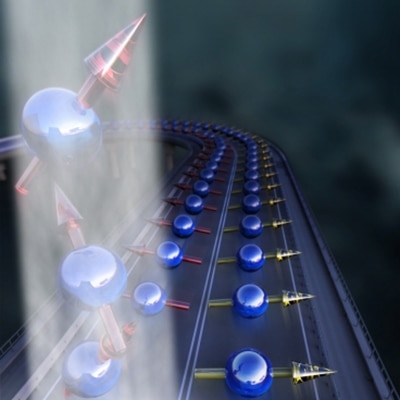
Electrons (blue) with their axis of spin (arrows.) A laser (white) removing electrons from the stream, leaving a net flow going in the opposite direction. (via MIT & Gedik Group)
 
Material science opens the doors to previously unforeseen possibilities. They set the stage for new scientific breakthroughs in studying a material’s fundamental building blocks.  For example, a groundbreaking material comes from MIT, dubbed topological insulators. This new material, discovered in recent years, has a peculiar property; it is an insulator with the unique ability of conducting electricity only through its outermost surface.
 
MIT assistant professor Nuh Gedik explained that the most critical information needed to define the characteristics of any material lies in understanding a material's electrons. The combination of energy, momentum and spin of the material’s electrons constitute the three pieces of information needed to understand a material’s properties.
 
Previously, the method for finding these pieces of information involved shining a laser at a chuck of a material in a certain orientation. The material would then have to be oriented in a slightly different position, and the laser is used again. This was a time-consuming, iterative process, so to study the properties of topological insulators, Gedik and his team devised a new method that obtains all of the needed data in one shot. This method was inspired by these new materials but can be applied to any material.
 
Appling a similar process, the team at MIT discovered that using polarized light (lasers) to key in on electrons with specific spins and “knock out” a continuous stream of these electrons. This also creates an electric current along the materials exterior surface. Identifying electrons with specific spins opens the door to further development in the field of spintronics. (Where devices utilize electron’s spin rather that than the electron’s charge to transfer information.)
 
Not only did researchers at MIT find many possibilities for new exciting applications for topological insulators, but they also observed unexpected behavior from the ejected electrons. Gedik explained that the spin of the electrons was thought to be perpendicular to the direction the electron is moving. However, this was not the case with these electrons. Unfortunately, electron path and spin is not always perpendicular, Gedik admitted after experimentation. Electron spin based devices will have to wait a few more years.
 
While being materialistic can make someone narrow minded, material science can open up worlds of possabilities.
 
Eavesdropper
  • Sign in to reply
  • DAB
    DAB over 14 years ago

    Hi E,


    A very interesting post.  It could be that the spin creates a weak, but repulsive magnetic field.  That would explain why the free electrons would flow along the outside of the material without penetrating.  There might also be a difference in electron energy levels that influence the repeled electrons.  It will be interesting to see if they can find the true cause of this measured discontenuity of the materials.


    Let us know if you find more information on this technology.


    Thanks

    DAB

    • Cancel
    • Vote Up 0 Vote Down
    • Sign in to reply
    • More
    • Cancel
element14 Community

element14 is the first online community specifically for engineers. Connect with your peers and get expert answers to your questions.

  • Members
  • Learn
  • Technologies
  • Challenges & Projects
  • Products
  • Store
  • About Us
  • Feedback & Support
  • FAQs
  • Terms of Use
  • Privacy Policy
  • Legal and Copyright Notices
  • Sitemap
  • Cookies

An Avnet Company © 2026 Premier Farnell Limited. All Rights Reserved.

Premier Farnell Ltd, registered in England and Wales (no 00876412), registered office: Farnell House, Forge Lane, Leeds LS12 2NE.

ICP 备案号 10220084.

Follow element14

  • X
  • Facebook
  • linkedin
  • YouTube