element14 Community
element14 Community
    Register Log In
  • Site
  • Search
  • Log In Register
  • Community Hub
    Community Hub
    • What's New on element14
    • Feedback and Support
    • Benefits of Membership
    • Personal Blogs
    • Members Area
    • Achievement Levels
  • Learn
    Learn
    • Ask an Expert
    • eBooks
    • element14 presents
    • Learning Center
    • Tech Spotlight
    • STEM Academy
    • Webinars, Training and Events
    • Learning Groups
  • Technologies
    Technologies
    • 3D Printing
    • FPGA
    • Industrial Automation
    • Internet of Things
    • Power & Energy
    • Sensors
    • Technology Groups
  • Challenges & Projects
    Challenges & Projects
    • Design Challenges
    • element14 presents Projects
    • Project14
    • Arduino Projects
    • Raspberry Pi Projects
    • Project Groups
  • Products
    Products
    • Arduino
    • Avnet & Tria Boards Community
    • Dev Tools
    • Manufacturers
    • Multicomp Pro
    • Product Groups
    • Raspberry Pi
    • RoadTests & Reviews
  • About Us
  • Store
    Store
    • Visit Your Store
    • Choose another store...
      • Europe
      •  Austria (German)
      •  Belgium (Dutch, French)
      •  Bulgaria (Bulgarian)
      •  Czech Republic (Czech)
      •  Denmark (Danish)
      •  Estonia (Estonian)
      •  Finland (Finnish)
      •  France (French)
      •  Germany (German)
      •  Hungary (Hungarian)
      •  Ireland
      •  Israel
      •  Italy (Italian)
      •  Latvia (Latvian)
      •  
      •  Lithuania (Lithuanian)
      •  Netherlands (Dutch)
      •  Norway (Norwegian)
      •  Poland (Polish)
      •  Portugal (Portuguese)
      •  Romania (Romanian)
      •  Russia (Russian)
      •  Slovakia (Slovak)
      •  Slovenia (Slovenian)
      •  Spain (Spanish)
      •  Sweden (Swedish)
      •  Switzerland(German, French)
      •  Turkey (Turkish)
      •  United Kingdom
      • Asia Pacific
      •  Australia
      •  China
      •  Hong Kong
      •  India
      •  Korea (Korean)
      •  Malaysia
      •  New Zealand
      •  Philippines
      •  Singapore
      •  Taiwan
      •  Thailand (Thai)
      • Americas
      •  Brazil (Portuguese)
      •  Canada
      •  Mexico (Spanish)
      •  United States
      Can't find the country/region you're looking for? Visit our export site or find a local distributor.
  • Translate
  • Profile
  • Settings
Publications
  • Learn
  • More
Publications
Blog Copper Nano-Wire Breakthrough
  • Blog
  • Documents
  • Events
  • Files
  • Members
  • Mentions
  • Sub-Groups
  • Tags
  • More
  • Cancel
  • New
Join Publications to participate - click to join for free!
  • Share
  • More
  • Cancel
Group Actions
  • Group RSS
  • More
  • Cancel
Engagement
  • Author Author: Catwell
  • Date Created: 6 Jun 2012 3:38 PM Date Created
  • Views 509 views
  • Likes 1 like
  • Comments 1 comment
  • research
  • test
  • industry
  • hmi
  • on_campus
  • Design
  • cabeatwell
  • prototyping
  • conductivity
  • measurement
  • university
  • sensor
  • nano-wire
  • innovation
  • communication
Related
Recommended

Copper Nano-Wire Breakthrough

Catwell
Catwell
6 Jun 2012

image

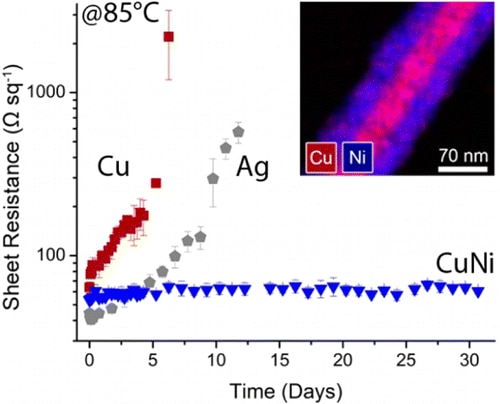
(via Duke University & ACS Publications)


The uses of digital screens on hand held devices are rapidly expanding. An elemental part of this industry is its use of indium tin oxide (ITO), which is part of the transparent coating to create the displays we use on our cell phones, iPads and devices alike. But there is a draw back to using ITO in millions of devices. ITO is obtained from a slow expensive process which gives it a cost of $600-$800 per kilogram.


However, the tide may soon be changing for a big part of this industry. In a paper published May 29 by Duke University’s assistant chemistry professor Benjamin Wiley, titled NanoLetters, he explains a new method for synthesizing a nano wire material made of copper and nickel. He also tells of its properties that could very well be used to replace the expensive ITO found in everyday  devices. The cupronickel wires could also be used as a new medium for printed circuit boards. It could be used in electronic paper displays, flexible clothing, packaging, solar cells and LEDs as well.


Copper nanowires alone were undesirable because of their natural orange tint and corrosiveness. The team hypothesized that coating the copper nanowires with nickel solve the issue of the orange tint and also protect the copper from corrosion. After experimentation, their hypothesis was confirmed.


The thin film of conductive cupronickel nanowires is composed of a 2:1 ratio of copper to nickel and has a grayish tint which works fine in displays and electrochromic windows. The nanowires themselves are only about 70 nm wide. In the paper published, the Duke team speaks of the method for synthesizing and new information about the properties of the material like higher strength and flexibility. It is projected that a cupronickel film containing 20-mol % nickel will lose half of its conductivity in 400 years at room temperature. By comparison, nano films of pure copper or silver lose half their conductivity in only 3 and 36 months, respectively, at room temperature.


Of course, there are limitations this new material. This cupronickel material cannot be used in LCD screens the way it is because it is not as conductive as ITO, and high electrical conductivity is needed when viewing films with a high level of transparency.


Still, this is only the beginning and researchers at Duke are excited about their results because it means that many products can use this new material and use elements that are much more abundant and easily obtained. Whether the decrease in manufacturing cost will transfer to a price drop of devices, will be left to the capitalists.


Cabe

http://twitter.com/Cabe_e14

  • Sign in to reply
  • DAB
    DAB over 13 years ago

    I wonder how well these wires would work at high frequencies.  When you get physical sizes down to that level, you sometimes can setup transmission lines with resonent frequencies or parasitic oscillations.


    It will be interesting to watch how this technique evolves.


    DAB

    • Cancel
    • Vote Up 0 Vote Down
    • Sign in to reply
    • More
    • Cancel
element14 Community

element14 is the first online community specifically for engineers. Connect with your peers and get expert answers to your questions.

  • Members
  • Learn
  • Technologies
  • Challenges & Projects
  • Products
  • Store
  • About Us
  • Feedback & Support
  • FAQs
  • Terms of Use
  • Privacy Policy
  • Legal and Copyright Notices
  • Sitemap
  • Cookies

An Avnet Company © 2025 Premier Farnell Limited. All Rights Reserved.

Premier Farnell Ltd, registered in England and Wales (no 00876412), registered office: Farnell House, Forge Lane, Leeds LS12 2NE.

ICP 备案号 10220084.

Follow element14

  • X
  • Facebook
  • linkedin
  • YouTube