element14 Community
element14 Community
    Register Log In
  • Site
  • Search
  • Log In Register
  • Community Hub
    Community Hub
    • What's New on element14
    • Feedback and Support
    • Benefits of Membership
    • Personal Blogs
    • Members Area
    • Achievement Levels
  • Learn
    Learn
    • Ask an Expert
    • eBooks
    • element14 presents
    • Learning Center
    • Tech Spotlight
    • STEM Academy
    • Webinars, Training and Events
    • Learning Groups
  • Technologies
    Technologies
    • 3D Printing
    • FPGA
    • Industrial Automation
    • Internet of Things
    • Power & Energy
    • Sensors
    • Technology Groups
  • Challenges & Projects
    Challenges & Projects
    • Design Challenges
    • element14 presents Projects
    • Project14
    • Arduino Projects
    • Raspberry Pi Projects
    • Project Groups
  • Products
    Products
    • Arduino
    • Avnet & Tria Boards Community
    • Dev Tools
    • Manufacturers
    • Multicomp Pro
    • Product Groups
    • Raspberry Pi
    • RoadTests & Reviews
  • About Us
  • Store
    Store
    • Visit Your Store
    • Choose another store...
      • Europe
      •  Austria (German)
      •  Belgium (Dutch, French)
      •  Bulgaria (Bulgarian)
      •  Czech Republic (Czech)
      •  Denmark (Danish)
      •  Estonia (Estonian)
      •  Finland (Finnish)
      •  France (French)
      •  Germany (German)
      •  Hungary (Hungarian)
      •  Ireland
      •  Israel
      •  Italy (Italian)
      •  Latvia (Latvian)
      •  
      •  Lithuania (Lithuanian)
      •  Netherlands (Dutch)
      •  Norway (Norwegian)
      •  Poland (Polish)
      •  Portugal (Portuguese)
      •  Romania (Romanian)
      •  Russia (Russian)
      •  Slovakia (Slovak)
      •  Slovenia (Slovenian)
      •  Spain (Spanish)
      •  Sweden (Swedish)
      •  Switzerland(German, French)
      •  Turkey (Turkish)
      •  United Kingdom
      • Asia Pacific
      •  Australia
      •  China
      •  Hong Kong
      •  India
      • Japan
      •  Korea (Korean)
      •  Malaysia
      •  New Zealand
      •  Philippines
      •  Singapore
      •  Taiwan
      •  Thailand (Thai)
      • Vietnam
      • Americas
      •  Brazil (Portuguese)
      •  Canada
      •  Mexico (Spanish)
      •  United States
      Can't find the country/region you're looking for? Visit our export site or find a local distributor.
  • Translate
  • Profile
  • Settings
Publications
  • Learn
  • More
Publications
Blog CPU disguises itself as a wall clock to confuse interior decorators
  • Blog
  • Documents
  • Events
  • Files
  • Members
  • Mentions
  • Sub-Groups
  • Tags
  • More
  • Cancel
  • New
Join Publications to participate - click to join for free!
  • Share
  • More
  • Cancel
Group Actions
  • Group RSS
  • More
  • Cancel
Engagement
  • Author Author: Eavesdropper
  • Date Created: 20 Apr 2012 6:54 PM Date Created
  • Views 555 views
  • Likes 2 likes
  • Comments 1 comment
  • electo-mechanical
  • research
  • Mechanical
  • industry
  • hmi
  • Design
  • prototyping
  • eavesdropper
  • innovation
Related
Recommended

CPU disguises itself as a wall clock to confuse interior decorators

Eavesdropper
Eavesdropper
20 Apr 2012

You don't have permission to edit metadata of this video.
Edit media
x
image
Upload Preview
image


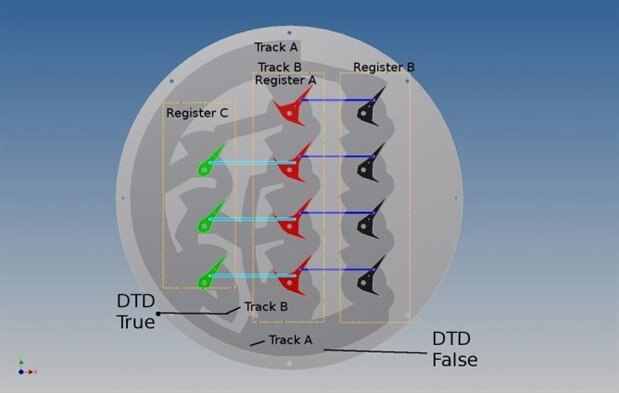
Have you ever wanted to understand how a CPU works but are unsure of how much time that might take? Kill two birds with the 'Mechanical CPU Clock.' Lior Elazary designed the clock to teach his children how a central processing unit works as well as "justifying the cost of a new laser-cutter." His clock represents all the pieces of a working CPU complete with ALU (arithmetic logic unit), Buses, ram, registers and control unit, all of which functions mechanically.


Time is displayed by a series of registers that are 'switched' over by a ball bearing when time progresses. Shown in binary form, register 'A' represents what hour it currently is while the outer-edge of HEX numerals represents the clocks minutes. The ball-bearing moves from the bottom of the inner track (presumably by some magnetic-conveyor system) and then drops through register A to progress the hour. Once the hour reaches a count greater than 11, the ball travels through register B which works in conjunction with register C to display the correct time. This, of course, means there is no 'second-hand' displayed so only the hour and minutes are shown at any given time. It's an interesting concept at learning, but it's far more fun to watch the Mechanical CPU Clock change time. See more about the clock after this link.
 

image

(via liorelazary.com)


Though, after hearing the ball drop enough times, I would have to destroy it or at least take it down.


Eavesdropper

  • Sign in to reply
  • DAB
    DAB over 13 years ago

    Hi E,


    I suspect that this clock is quieter than some of those old Grandfather clocks.  You could hear some of them tick while sitting outside.

    But I agree, if you want to have a computer drive someone crazy, this approach would probably fit the bill.


    DAB

    • Cancel
    • Vote Up 0 Vote Down
    • Sign in to reply
    • More
    • Cancel
element14 Community

element14 is the first online community specifically for engineers. Connect with your peers and get expert answers to your questions.

  • Members
  • Learn
  • Technologies
  • Challenges & Projects
  • Products
  • Store
  • About Us
  • Feedback & Support
  • FAQs
  • Terms of Use
  • Privacy Policy
  • Legal and Copyright Notices
  • Sitemap
  • Cookies

An Avnet Company © 2025 Premier Farnell Limited. All Rights Reserved.

Premier Farnell Ltd, registered in England and Wales (no 00876412), registered office: Farnell House, Forge Lane, Leeds LS12 2NE.

ICP 备案号 10220084.

Follow element14

  • X
  • Facebook
  • linkedin
  • YouTube