


The nagging pain in my abdomen had reached the point where I finally reached for my phone. It was time to see a doctor and put an end to whatever was causing so much pain and discomfort. What followed was a diagnosis, a cure, and some thoughts on the need for engineering troubleshooting in the area of healthcare purchases.
As I scheduled an appointment I inquired about the cost of an office visit. I was met with uncertainty. The billing department guessed it would be $220 to see the doctor, not counting any lab work. The clinic where my doctor worked until this year charged $120 for an office visit. The pain allowed me to overlook this issue; I kept the appointment.
It was a typical Wednesday morning at the clinic. They checked vital signs, similar to troubleshooting a board: first make sure the supplies are up and the clocks are oscillating.
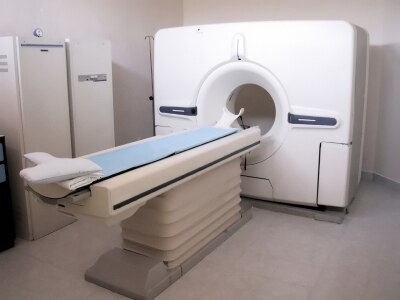
Probing my abdomen the doctor said “it’s either the kidney or the colon, I’ll need a CT scan to know for sure”. This brought to mind how a CT scan uses a Discrete Fourier Transform (DFT) of projections through the body at various angles to arrive at a 3-D model. I've never seen a CT machine in action. I started wondering, though, if I really needed to have a CT scan to diagnose this problem. What would doctors have done before CT?
“We've narrowed it down to two organs. Is there any other way to rule out one or the other?” I asked the doctor. He said, “There a lab test that would rule out kidney problems. It takes about an hour for the results. If that's negative, it's probably diverticulitis. There is a course of antibiotics that diverticulitis responds to quickly.” So the lab tests came back negative for kidney problems, I took the antibiotics as a "test" for diverticulitis.
Once I started the antibiotics the pain dropped exponentially with a time constant of about 10 hours, such that the pain was at about a third after 10 hours and undetectable after 50 hours. For $100 office visit (the billing department's original guess turned out to be way high), $100 in lab tests, and $25 in prescription drugs, I had a diagnosis and a cure. Before going down this path, I had told my doctor I could easily afford the CT test and I wanted it if it was medically necessary. He approved of the antibiotic test approach, which implied to me that the CT scan was not completely necessary. I do not suspect any conflict of interest on the part of my doctor or the clinic. I suspect doctors and patients typically select a CT scan because it's straightforward and many of the patients are either wealthy or have very-low-deductible insurance policies that pay for most of the cost of the test.
By coincidence four days after my office visit, a local newspaper ran a story on charity care at Madison hospitals that related the case of a woman diagnosed with diverticulitis. She received a CT scan and a bill of $4,500, a bill she could not pay at the time. The hospital forgave the bill, but she would like to pay it anyway when she is able. I do not know the details of her case, but I wonder if she could have avoided the large bill using the lab test and antibiotic approach.
There will be extensive debate at the national level over the next few years as healthcare overhaul measures are phased in. Engineers, regardless of their view the role of government in healthcare, should weigh in on this important issue. An engineering approach would be helpful in heathcare issues, at the point of service and to the broader policy debate.


