


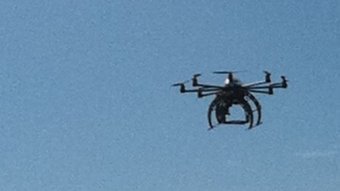
Eyedroid 8 caught flying over Queensland beach (via Kim Powell)
While it may not look all that impressive running in slow-motion to save drowning victims, the octocopter drone is looking to become the latest addition in the life-guard tool-box to help save lives in Queensland, Australia. Adopted by Surf Life Saving Australia, the octocopters are set to undergo test trials at North Stradbroke Island (about 20 miles southwest of Brisbane) before they’re deployed for beach monitoring. While Australia’s beaches are some of the most beautiful on the planet, they parallel to looked in danger. Varied wildlife found in the area such as crocodiles (yes they have them), sharks, stingrays and box jellyfish add to the risk. Actually it’s more probable that you get hit by a vehicle crossing the street than becoming injured by the wildlife, but accidents do happen (with 550 rescues and 2408 receiving first-aid already this year). Life-guards need to be able to respond quickly to be effective in their job. This is where the octocopters come in as there is simply too much ground to monitor and too few personnel to cover it all. According to the SLSA, the drones will be outfitted with flotation buoys so they can be dropped onto the ocean as an ‘on-station’ option for delivery. They will also be outfitted with a siren that can alert people in the area if there is dangerous marine life, or somebody is in need of assistance.
Eye Droid 8
So, what drone model will the SLSA be using for beach monitorization? Very little is known, however a local (Kim Powell) was able to grab a picture of the drone as it flew by her window and looks to be an Eye Droid 8 Rotor Octocopter (purely speculative but the design is strikingly similar) from Infinite Jib. The Eye Droid 8 would be perfect for the life-guard job and features a Droidworx AD-8 air-frame capable of lifting DSLR and Large HD cameras, HoverFlyPro flight controller and a HoverFlyGPS navigation system capable of autonomous flight using GPS waypoints (including ‘return to home’). The total diameter of the octocopter is 35.7 inches and each rotor measures in at a foot (3 spin clockwise on one side, while another 3 spin counterclockwise while 2 are used as back-up) which provides a stable flight platform. The best feature of the Eye Droid 8 is the inclusion of Fat Shark Goggles (used in conjunction with the on-board Fat Shark FPV equipment), which the pilot uses to navigate through a live continuous video feed from the drone. There are a few drawbacks at using this system, as the drone itself costs about $13,000 US for the basic model (no extra equipment such as HD cameras) which is pretty expensive but the most important drawback is the drones flight-time. The Eye Droid 8 only has enough power (LiPo Flight Battery with 5450mah) to remain airborne for 8 minutes and 30 seconds with no payload and only 6 min when the drone is fully loaded which limits the area these drones can cover. Still, accidents usually occur in less time and when every second counts an extra pair of eyes in the sky would be welcomed.
Cabe
-

DAB
-
Cancel
-
Vote Up
0
Vote Down
-
-
Sign in to reply
-
More
-
Cancel
-

Catwell
in reply to DAB
-
Cancel
-
Vote Up
0
Vote Down
-
-
Sign in to reply
-
More
-
Cancel
Comment-

Catwell
in reply to DAB
-
Cancel
-
Vote Up
0
Vote Down
-
-
Sign in to reply
-
More
-
Cancel
Children