


(Left) Giovanni Aldini (Right) Depiction of stimulating an animals limbs by current conducted through the demonstrators
Electricity was believed to be a "magical wonder" for many years of its early known existence. It was first produced by electrostatic machines and later by early batteries such as Volta's voltaic pile. However, very little was actually known about the phenomena and little to none of its qualities were used in practical applications until the late 1800s.
The earliest demonstrations of electricity included electrocuting dead and live animals and eventually people. Luigi Aldini, Bologna, was one of the first to find a correlation between muscular movements and electricity. He found that by "applying sparks to a dead frogs legs" he could make it twitch. Luigi's nephew, Giovanni Aldini, took this concept further by performing public demonstrations of electrocuting human body parts and large animals. Observers were amazed and frightened by the sight of severed limbs and dead animals suddenly jerking frantically as if they were alive and in some frenzied state. As a result of scientist and physicists ability to create such an unknown force, they were often regarded as magicians or wizards.
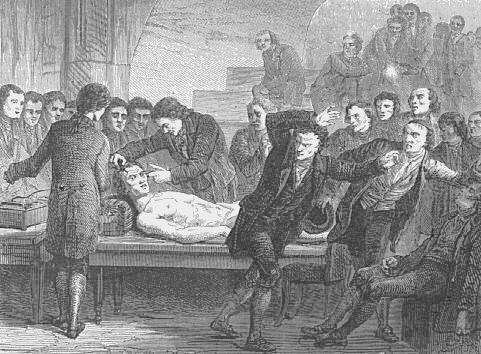
Louis Figuier, of the depects how experiments conducted on humans created both a sense of wonder and horror in “Le docteur Ure galvanisant le corps de l’assassin Clydsdale” (1867)
The demonstrations grew more shocking and grotesque over time. Giovanni eventually was given the body of a recently executed convict for use in one demonstration. Given the unique opportunity he applied as much electrical energy as possible to the body. The body twisted and jerked wildly, the face created exhilarating and frightening expressions, and the legs and arms moved so much that spectators insisted he must be executed again. This event undoubtedly inspired the Mary Shelley's novel of Frankenstein. The event was disturbing and inhumane, yet worse was to come.
During the war, of the currents in the late 1800s Edison was trying to find ways to popularize his direct current system. On the other hand, George Westinghouse was trying to commercialize Nikola Tesla's AC distribution system. As a result, Edison decided to demonstrate the dangers of alternating current to the press and public by killing animals such as cats, dogs, and unwanted cattle. Additionally, he tried to popularize a phrase for being electrocuted by AC as being “Westinghoused.”
The worst of the battle came when a prisoner, William Kemmler, was sentenced to be the first put to death by electricity. Edison's company built the first electric chair and using AC electricity planned to put the prisoner to death painlessly. However, The first attempt only caused unconsciousness and did not stop the heart. After the generators recharged, they tried a second time with a higher voltage, this time still not killing the man but burning his skin where the electrodes were attached and slowly burning his insides. It took over eight minutes for the man to be executed. After the event, Westinghouse declared they would have been better off with an ax.
Cabe

