element14 Community
element14 Community
    Register Log In
  • Site
  • Search
  • Log In Register
  • Community Hub
    Community Hub
    • What's New on element14
    • Feedback and Support
    • Benefits of Membership
    • Personal Blogs
    • Members Area
    • Achievement Levels
  • Learn
    Learn
    • Ask an Expert
    • eBooks
    • element14 presents
    • Learning Center
    • Tech Spotlight
    • STEM Academy
    • Webinars, Training and Events
    • Learning Groups
  • Technologies
    Technologies
    • 3D Printing
    • FPGA
    • Industrial Automation
    • Internet of Things
    • Power & Energy
    • Sensors
    • Technology Groups
  • Challenges & Projects
    Challenges & Projects
    • Design Challenges
    • element14 presents Projects
    • Project14
    • Arduino Projects
    • Raspberry Pi Projects
    • Project Groups
  • Products
    Products
    • Arduino
    • Avnet & Tria Boards Community
    • Dev Tools
    • Manufacturers
    • Multicomp Pro
    • Product Groups
    • Raspberry Pi
    • RoadTests & Reviews
  • About Us
    About the element14 Community
  • Store
    Store
    • Visit Your Store
    • Choose another store...
      • Europe
      •  Austria (German)
      •  Belgium (Dutch, French)
      •  Bulgaria (Bulgarian)
      •  Czech Republic (Czech)
      •  Denmark (Danish)
      •  Estonia (Estonian)
      •  Finland (Finnish)
      •  France (French)
      •  Germany (German)
      •  Hungary (Hungarian)
      •  Ireland
      •  Israel
      •  Italy (Italian)
      •  Latvia (Latvian)
      •  
      •  Lithuania (Lithuanian)
      •  Netherlands (Dutch)
      •  Norway (Norwegian)
      •  Poland (Polish)
      •  Portugal (Portuguese)
      •  Romania (Romanian)
      •  Russia (Russian)
      •  Slovakia (Slovak)
      •  Slovenia (Slovenian)
      •  Spain (Spanish)
      •  Sweden (Swedish)
      •  Switzerland(German, French)
      •  Turkey (Turkish)
      •  United Kingdom
      • Asia Pacific
      •  Australia
      •  China
      •  Hong Kong
      •  India
      •  Japan
      •  Korea (Korean)
      •  Malaysia
      •  New Zealand
      •  Philippines
      •  Singapore
      •  Taiwan
      •  Thailand (Thai)
      •  Vietnam
      • Americas
      •  Brazil (Portuguese)
      •  Canada
      •  Mexico (Spanish)
      •  United States
      Can't find the country/region you're looking for? Visit our export site or find a local distributor.
  • Translate
  • Profile
  • Settings
Publications
  • Learn
  • More
Publications
Blog Electron shower radiation turns larvae into Superfly equipped with its very own “nano-suit”
  • Blog
  • Documents
  • Events
  • Files
  • Members
  • Mentions
  • Sub-Groups
  • Tags
  • More
  • Cancel
  • New
Join Publications to participate - click to join for free!
  • Share
  • More
  • Cancel
Group Actions
  • Group RSS
  • More
  • Cancel
Engagement
  • Author Author: Catwell
  • Date Created: 16 Jul 2013 7:07 PM Date Created
  • Views 676 views
  • Likes 2 likes
  • Comments 1 comment
  • research
  • mit
  • industry
  • hmi
  • on_campus
  • cabeatwell
  • prototyping
  • university
  • medical
  • biology
  • sensor
  • innovation
  • communication
Related
Recommended

Electron shower radiation turns larvae into Superfly equipped with its very own “nano-suit”

Catwell
Catwell
16 Jul 2013

image

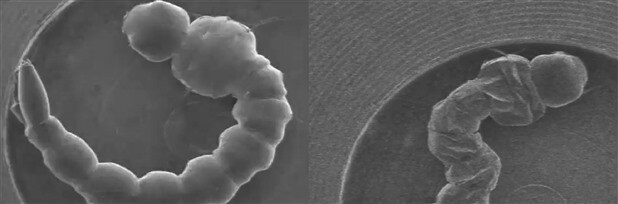
Left: Mosquito larva develops its own nano-suit for protection under the radiation and space-like environment of an electron microscope

Right: Mosquito larva with no protection quickly dehydrates under an electron microscope (via MIT)


What does it take to survive space travel? A tough, durable suit that can withstand the radiation and vacuum pressures of the environment is clearly necessary, as we’ve seen - but these suits are not the most flexible attire for moving around very much. Though MIT has been working on a BioSuit that scientists hope changes that, a team of researchers at the Hamamatsu University School of Medicine in Japan have made a discovery that allows larvae to survive space-like environments under an electron microscope via a “nano-suit” layer of protection around their bodies.


Takahiko Hariyama and colleagues made the discovery while observing mosquito larvae under an electron microscope. Electron microscopes require a vacuumed environment to avoid the absorption of the electrons used to take pictures by air molecules. The tiny organisms were placed under the microscope and bombarded with electrons, wiggling around unharmed for an hour. Typically, tiny insects placed in this environment quickly suffer from dehydration, facing close to immediate death - however, those that were immediately struck by electron showers survived.


After taking a closer look at the larvae skin, the scientists observed that the surface of their skin had changed. Energy from the electrons caused a thin layer of the insect’s skin (50-100 nm thick) to link together and forms a tough, flexible exterior shell through a process called polymerization. To further test this “nano-suit” theory, the scientists used a non-toxic chemical called Tween 20 to polymerize the skin of other larvae  and, sure enough, those larvae were also able to survive the electron microscope environment unscathed.


Though far from the development of actual space nano-suit technology, the researchers’ findings has some notable and exciting implications. The findings can be used to explain how tiny creatures can survive actual space travel atop the surface of meteorites by the development of nano-suits. A human-equivalent suit, however, would require “sunbathing naked on top of Everest under a hole in the ozone,” says microscopist Jeremy Skepper of the University of Cambridge - so, it looks like we’ll have to wait for MIT’s BioSuit to be finished before we move on to upgrading our own skin for outer space travel. Still, the Japanese scientists hope this discovery will at least aid in studying the insides of tiny organisms at high resolutions.


C

See more news at:

http://twitter.com/Cabe_e14

  • Sign in to reply
  • DAB
    DAB over 12 years ago

    Makes you wonder if Mosquitos are actually from outer space.


    Who knows, they may be colonizing the planet and using us as food.


    Think about it.


    DAB

    • Cancel
    • Vote Up 0 Vote Down
    • Sign in to reply
    • More
    • Cancel
element14 Community

element14 is the first online community specifically for engineers. Connect with your peers and get expert answers to your questions.

  • Members
  • Learn
  • Technologies
  • Challenges & Projects
  • Products
  • Store
  • About Us
  • Feedback & Support
  • FAQs
  • Terms of Use
  • Privacy Policy
  • Legal and Copyright Notices
  • Sitemap
  • Cookies

An Avnet Company © 2026 Premier Farnell Limited. All Rights Reserved.

Premier Farnell Ltd, registered in England and Wales (no 00876412), registered office: Farnell House, Forge Lane, Leeds LS12 2NE.

ICP 备案号 10220084.

Follow element14

  • X
  • Facebook
  • linkedin
  • YouTube