


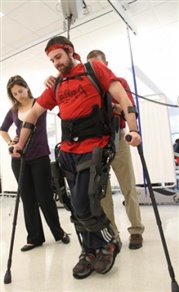
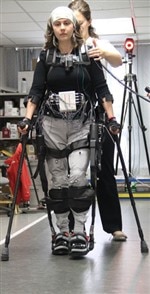
People trying out the Ekso (right) (via kesslerfoundation.org)
As magnificent as the human body is, it has many delicate structures that are vital for a regular life; one of these is the spinal cord. Until now, people who suffer spinal cord injuries must face the rest of their lives dependent on a wheelchair for mobility. Engineers at the Ekso Bionics are developing an exoskeleton machine they hope will allow paraplegic or quadriplegic patients the chance to stand upright and walk again.
This past October, Ekso Bionics demonstrated their apparatus and detailed a plan for making the device available to the public in coming years. Currently the device requires another person to control all the components of the exoskeleton. The components include four electric motors, 15 sensors and an onboard computer to control the motion of the robotic legs via remote control. In a few months, Ekso will have the controls put on a set of crutches so users themselves can control their movements. (Update: Ekso lasts 4 hours on a single battery charge).
Ekso Bionics is working alongside the Kessler Foundation and the Kessler Institute for Rehabilitation to conduct research into the long-term use of such devices. Repetitive walking motion, in some cases, can reprogram the nervous system as well as prevent other side-effects of continual wheel chair use. (Cardiac and lung weakness, pressure ulcers and poor bone density, to name a few.)
Ekso has also teamed up with the IDEO design company in an effort to understand the needs of patients around their home to improve their design.
Currently the mechanism is beyond expensive for most, but Ekso hopes to reduce the cost to between the 30 to 50 thousand dollar range by 2014.
A recent TED MED talk covered the exoskeleton:
Eavesdropper
See more devices like this in the Technology For The Disabled group.
-

e14 Contributor
-
Cancel
-
Vote Up
0
Vote Down
-
-
Sign in to reply
-
More
-
Cancel
Comment-

e14 Contributor
-
Cancel
-
Vote Up
0
Vote Down
-
-
Sign in to reply
-
More
-
Cancel
Children