


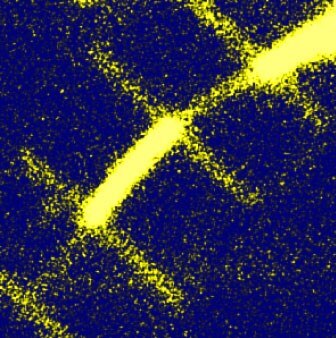
In yellow, scattering light from the silicon nano-wire. The dimmer areas are coated with gold, reducing the scattering of light - hence cloaking.
There has been so many developments involving ‘cloaking devices’ over the past few years that I’m starting to wonder if the invisibility devices found on sci-fi shows like Star Trek are close to becoming a reality. With this in mind, an engineering teams from Stanford University and the University of Pennsylvania have recently announced their development of a ‘plasmonic cloaking’ device. The invisible machine detects light and is capable of ‘seeing without being seen.' Plasmons, in basic terms, are plasma-quasiparticles with the oscillation of free-electron density relative to the stationary positions of ions in metals (metal being the key word here) at different frequencies that scatter light. This plays a huge role in the optical properties in metals when it concerns light-waves. The engineers picked up on this principle and used it to develop their device using silicon-based nano-wires encased in a thin sheet of gold which dissipate light-waves by adjusting the ‘metal to silicon ratio’ (tuning the geometries). This makes the device invisible to the naked eye, and since there is no known picture of the ‘device’ (as it’s invisible) we’ll just have to take Stanford’s word for it (joking of course).
The engineering teams found that it was by precisely fine-tuning, the gold-plated nanowires that the scattered light cancelled each other out through the metal and semiconductor (destructive interference). They found that much of the visible light spectrum could be dissipated no matter what angle you viewed the device from and that using other metals, like copper and aluminum, work just as well as gold at making the device invisible. The only mitigating factor is making the ‘dipoles’ (separation of positive and negative ion charges) are lined-up precisely. Otherwise, the desired effect is lessened or even cancelled outright.
The teams state that this new technology could be applied to solar-cells (generating a tremendous amount of electricity through light dissipation), solid-state lighting and even digital cameras (improving image quality by reducing motion-blur associated with light). Those seem so mundane compared to ‘cloaking’ my vehicle while parked in a no-parking zone or making my home invisible to uninvited guests.
Cabe
