


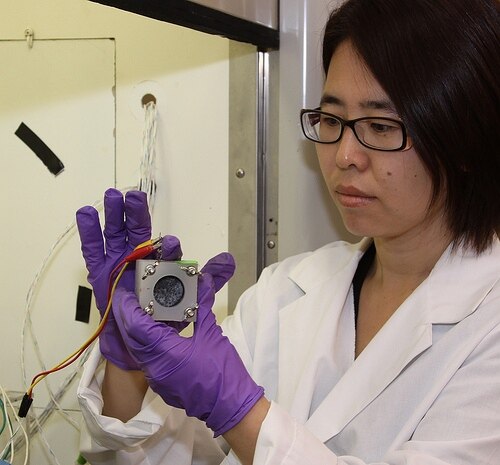
Associate professor Hong Liu holding the waste-water fuel cell (via OSU Departement of Biological and Ecological Engineering)
The world produces a tremendous amount of waste in the form of waste-water. Every time we go to the bathroom, take a shower, wash dishes or drive vehicles, what’s known as waste-water or ‘grey-water’ is the outcome. It takes a sizable amount of energy and resources to reclaim and treat. A team of engineers from Oregon State University have been developing a solution that can produce energy through the treatment of waste-water using microbial fuel cells.
The current method of treating waste-water is by using ‘activated sludge’ which is a combination of air and biological floc (flake of precipitate) of bacteria and protozoans to break down the waste. Although this process is efficient, it does release methane gas, which is a green-house gas. The waste-water itself contains an enormous amount of energy in the form of organic molecules, which is tough isolate. However, the OSU engineering team has developed their microbial fuel cell to replace the activated sludge and not only gain the energy from the organic molecules but the methane as well. The team’s fuel cell has been in development for a few years now, but earlier revisions produced less power. Their current iteration which has reduced spacing between the anode and cathode, allowing the team to incorporate an increased amount of the terminals in their new design.
The new cell also features re-engineered microbes that are placed on the cathode and anode terminal which create electricity (2.87 watts per liter of waste-water) during the digestion process. The methane release generated during the process is also converted to energy within the cell which eliminates another unwanted by-product in the form of hydrogen sulfide (poisonous gas that smells like rotten eggs). The team states that their microbial fuel cell system has been proven ‘to scale’ in the lab, and they are now looking to introduce a pilot study on a full-scale test plant. If their study succeeds, the system could be incorporated into all waste-water treatment plants, which at the very least would pay for itself in terms of energy use but does have the potential to generate more energy than was consumed in the digestion process.
Cabe

