


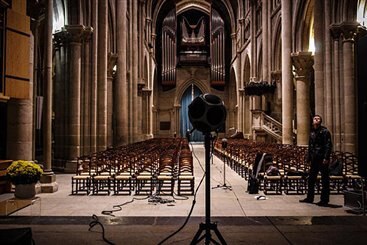
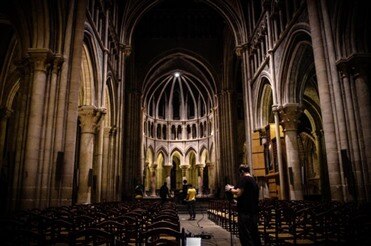
EPFL setting up for the sound scan of the Lausanne Cathedral (via EPFL)
It's like EPFL researchers watched the "Dark Knight" film a few times. Mapping an environment with sound was the only way the hero could find the badguy.
Nature has a ton of experience working out echolocation for navigation and spatial awareness. A group of researchers at the world-renowned Swiss Federal Institute of Technology (EPFL) are now trying to recreate the abilities of echolocation to put them into app form by next year.
Researcher Ivan Dokmanic is leading the way by experimenting with microphone setups and a loudspeaker to map out a 3D space. The first true test of his technique was completed at the Lausanne Cathedral and used five microphones and a loudspeaker located inside that produced tones between 200 Hz and 10 kHz.

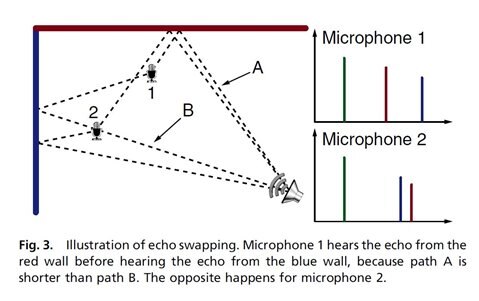
Microphone set up in the Lausanne Cathedral and the basic concept of how the system works (via EPFL)
From this trial, Dokmanic and his team found they need at least four microphones (5 in the case of the field test) to pick up a robust signal of echoes reflecting from complex geometries to reconstruct them. The EPFL team is refining an echo-sorting algorithm that can distinguish between the echoes quickest to return (first order echoes) and the combination of residual echoes that becomes useless noise. The team uses the fact that the residual, higher order echoes result from superposition of first order echoes to filter them out.
The reflected sound can be analyzed using this algorithm to accurately depict the shape of the environment as well as the location of the sound emission source. The technique uses sine sweeps and Fourier transforms to extract the waveform reflecting from the surrounding structure.
For the next test, the team wants to use ultrasound and microphones connected via wifi or bluetooth to do the echo analysis. Eventually, a mobile app could use voices to do the echolocation but this brings additional challenges in distinguishing between voices in a crowded space. The aim is to have entire stores or indoor spaces offer the app to visitors, granting anyone an instant map of the current arrangements in their environment.
Dokmanic has experience working with Microsoft Research in Redmond, Washington. He says the echolocation app will be ready in about one year.
C
See more news at:
