


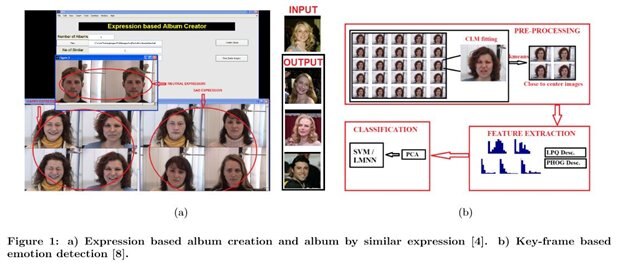
(via ANU)
Wouldn’t it be nice to make sure all the pictures from that special night are ones that captured the mood perfectly? A team from the Australian National University in Canberra is developing software that could sort pictures of people using face recognition and their expression analysis algorithms. This approach could also be used to analyze crowds in real time and tell whether people are having a good time or if people are getting upset.
The software determines a person’s expression by extracting faces using Constrained Local Model software commonly used in face recognition. Then the program assigns nine fiducial points to faces in key areas like the corners of the mouth and eyes used to compute a geometric shape called an Expression Image. By tracking these points, the team can interpret an entire expression from beginning to end. Next, the software uses a database of previously ranked pictures to come up with its own rating, which deviates no more than 7% from the human ranking. Finally, the setting and other environmental factors are taken into account before the program can rank the pictures from happiest, to not so enthusiastic.
Abhinav Dhall, lead researcher, and his colleagues envision a feature on a website like flickr or an app for your phone that can classify pictures by the moods they portray. This app would give pictures “mood scores” by using the algorithm that compare to how humans have scored similar pictures. This could lead to “search by expression” options, or sort them so that happy ones are seen first.
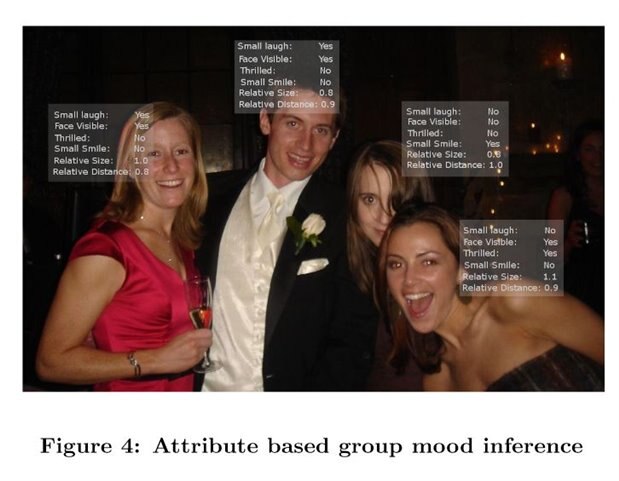
Flash to the future... The camera says you are not happy enough! (via ANU)
To obtain a large sample of mood ratings needed by the program for comparison, the team surveyed 150 people to determine the relevant criteria for detecting the mood of a picture. Here they realized opinions for determining the mood of a picture could be categorized by local and global factors. Local factors were those regarding a single face and global factors refer to setting, and the expressions of adjacent people.
The expressions of the people in each picture are weighted to attain more accurate results. For example, the expression on the face of the person in the middle of the picture counts more towards the mood score than does a person off to the side. The software also scores the clarity of an expression higher than one that is partially obscured.
This software is also being adapted to analyze moods in videos by looking at snapshots of clear expressions with the hope of one day being able to analyze a live crowd. The software was described at the ACM International Conference on Multimedia Retrieval in Dallas, on April 20th. I wonder if it will pick up on silly faces.
C
See more news at:

