


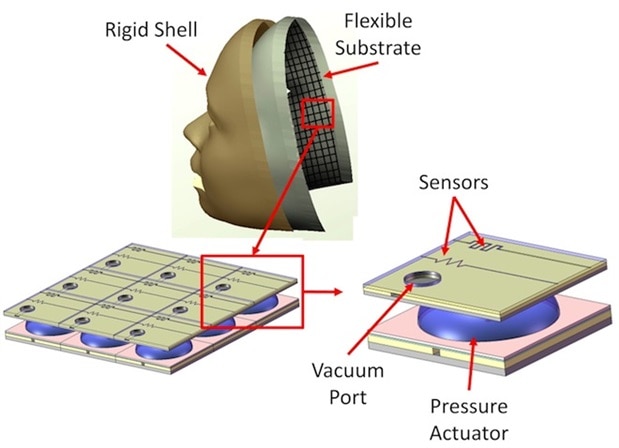
Biomask concept (via UT Arlington)
Being enlisted into the armed forces signs everyone up to a high risk of injury. Face damage is one of the most debilitating injury, and special care has to be taken. Soldiers that are injured in the face now may have the option to bypasses surgery and use a Biomask to repair their wounds.
Currently, the procedure to repair the face involves removing the damaged areas and grafting in new skin. With this procedure, you run the risk of having deformities, speech problems and scarring. The Biomask does not involve going under the knife but by just wearing a mask. The mask speeds up the healing process of disfiguring facial burns and helps rebuild the face.
It is a polymer mask that has electrical, mechanical and biological components built right in that allows the magic to happen. Actuators press the mask to the patient's face. Onboard arrays of sensors give feedback on the healing process as well as a guideline on how to handle certain areas. "Localized activation of treatment" can be administered as the system decides. A network of "micro-tubing" administers antibiotics, pain killers, and stem cells (for rapid re-growth) onto specific areas of the face. Although the mask gives 24/7 healing, no specific time-table was set for the average repair time.
The criticality of developing a medical device runs deeper than any other. There were many heads being joined together to make sure it is not only effective but safe as well. The head commander of this project is Eileen Moss who is an electrical engineer and research scientist at UT Arlington Automation & Robotics Research Institute. Her partners consist of the Army Institute of Surgical Research at the Brooke Army Medical Center and Northwestern University.
The Biomask was funded by a research grant from the U.S. Army Medical Research & Materiel Command of $700,000. Not a lot to ask for just a revolutionary healing system.
Northwestern University is hard at work studying the wound healing while UT Arlington team is focused on the developing the Biomask prototypes. The prototypes are going to be tested on other collaborators first so that Moss can use the results to the best of its abilities to improve the mask before being fully released. The goal is to get the Biomask assessable to our soldiers within 5 years.
Cabe