


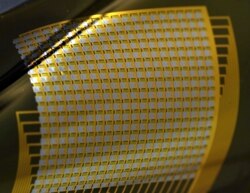
Flexible electrode array. (Via Travis Ross and Yun Soung Kim, University of Illinois Urbana-Champaign)
Better than a bolt in the head, a flexible brain implant allows for the monitoring of brain activity much finer than alternatives today. In an effort to monitor and eventually control the effect of seizures, the membrane circuit was constructed to gather the most information possible on a wider area of the brain. The project's lead author Jonathan Viventi Ph.D., explained, "This technology allows us to see patterns of activity before and during a seizure at a very fine scale, with broad coverage of the brain."
The membrane the team created housed 720 silicon nanomembrane transistors in a 360-channel multiplexed array. The key feature of the patch is that is can conform to the complex surface shape of the brain due to its thickness, four millionths of a meter. Researchers claim that the membrane can reach areas of the brain that were never before reached. They also claim that the membrane can be inserted through a small home in the skull into the brain itself, without opening up the cranium.
Project member Dr. Brian Litt elaborates on the projects purpose, "If our findings are borne out in human studies, they open up the possibility of treating seizures with therapies like those used for cardiac arrhythmias. Epilepsy surgery could become more analogous to ablation procedures for cardiac arrhythmias. In these procedures, electrodes are used to detect aberrant electrical circuits in the heart muscle, which are then interrupted by making tiny lesions in the muscle. A stimulating electrode array might one day be designed to suppress seizure activity, working like a pacemaker for the brain."
The flexible circuit comes from a multi-university, multi-disciplinary, collaboration funded by the National Institutes of Health. Epilepsy will soon be a problem of the past, thanks to the team's efforts. I hope to hear more news on their progress.
Cabe