element14 Community
element14 Community
    Register Log In
  • Site
  • Search
  • Log In Register
  • Community Hub
    Community Hub
    • What's New on element14
    • Feedback and Support
    • Benefits of Membership
    • Personal Blogs
    • Members Area
    • Achievement Levels
  • Learn
    Learn
    • Ask an Expert
    • eBooks
    • element14 presents
    • Learning Center
    • Tech Spotlight
    • STEM Academy
    • Webinars, Training and Events
    • Learning Groups
  • Technologies
    Technologies
    • 3D Printing
    • FPGA
    • Industrial Automation
    • Internet of Things
    • Power & Energy
    • Sensors
    • Technology Groups
  • Challenges & Projects
    Challenges & Projects
    • Design Challenges
    • element14 presents Projects
    • Project14
    • Arduino Projects
    • Raspberry Pi Projects
    • Project Groups
  • Products
    Products
    • Arduino
    • Avnet & Tria Boards Community
    • Dev Tools
    • Manufacturers
    • Multicomp Pro
    • Product Groups
    • Raspberry Pi
    • RoadTests & Reviews
  • About Us
  • Store
    Store
    • Visit Your Store
    • Choose another store...
      • Europe
      •  Austria (German)
      •  Belgium (Dutch, French)
      •  Bulgaria (Bulgarian)
      •  Czech Republic (Czech)
      •  Denmark (Danish)
      •  Estonia (Estonian)
      •  Finland (Finnish)
      •  France (French)
      •  Germany (German)
      •  Hungary (Hungarian)
      •  Ireland
      •  Israel
      •  Italy (Italian)
      •  Latvia (Latvian)
      •  
      •  Lithuania (Lithuanian)
      •  Netherlands (Dutch)
      •  Norway (Norwegian)
      •  Poland (Polish)
      •  Portugal (Portuguese)
      •  Romania (Romanian)
      •  Russia (Russian)
      •  Slovakia (Slovak)
      •  Slovenia (Slovenian)
      •  Spain (Spanish)
      •  Sweden (Swedish)
      •  Switzerland(German, French)
      •  Turkey (Turkish)
      •  United Kingdom
      • Asia Pacific
      •  Australia
      •  China
      •  Hong Kong
      •  India
      • Japan
      •  Korea (Korean)
      •  Malaysia
      •  New Zealand
      •  Philippines
      •  Singapore
      •  Taiwan
      •  Thailand (Thai)
      • Vietnam
      • Americas
      •  Brazil (Portuguese)
      •  Canada
      •  Mexico (Spanish)
      •  United States
      Can't find the country/region you're looking for? Visit our export site or find a local distributor.
  • Translate
  • Profile
  • Settings
Publications
  • Learn
  • More
Publications
Blog Flexible memory breaks through flex limitations
  • Blog
  • Documents
  • Events
  • Files
  • Members
  • Mentions
  • Sub-Groups
  • Tags
  • More
  • Cancel
  • New
Join Publications to participate - click to join for free!
  • Share
  • More
  • Cancel
Group Actions
  • Group RSS
  • More
  • Cancel
Engagement
  • Author Author: Catwell
  • Date Created: 8 Nov 2011 9:52 PM Date Created
  • Views 484 views
  • Likes 0 likes
  • Comments 0 comments
  • flextronics
  • mobile_phone
  • element14
  • flexible_memory
  • rram
  • on_campus
  • memory
  • embedded
  • cabeatwell
  • prototyping
  • memristor
  • university
  • news
  • innovation
Related
Recommended

Flexible memory breaks through flex limitations

Catwell
Catwell
8 Nov 2011
Flexible electronics (flex circuits) is science fiction becoming reality. Traditionally, just electrical components attached to a flexible substrate, and not quite the paper thin electronic newspaper many dream of. Recent research is attempting to push towards that concept and make the circuitry flex with the substrate. The main issue that has held back progress in this area comes from how the integrated components effect each other as the substrate bends. As the circuit flexes the components get close to each other and cause electromagnetic interference, short circuit, and generally degrade the overall device.
 

image

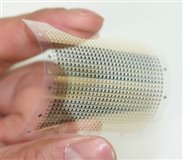
University of Tokyo's PEN Flash (via University of Tokyo)

 
Back in 2009, a research team from the University of Tokyo (UT) made flexible organic flash memory in a polyethylene naphthalate (PEN) resin substrate. Geared towards e-paper devices or large-area sensors, the non-volatile memory could be curved until it reached a radius of 6mm before the onboard transistors started to interfere with each other's operation. The group, led by Takeo Someya and Tsuyoshi Sekitani stated that they would attempt to fix this issue by adjusting the layers. No new developments have come from the school.
 
imageimage
KAIST Flexible RRAM around a 1cm quartz rod (left) and the memory layer cross section (right) (Via KAIST)

However, the Korea Advanced Institute of Science and Technology (KAIST) has just overcome past issues with flexible memory by simply adding a newer technology into the mix, memristors. The research team, led by Professor Keon Lee of the Department of Materials Science and Engineering at KAIST, overcame all issues by placing single-crystal silicon transistors alongside the memristor elements, which are unaffected by "cell-to-cell" interference. The result, KAIST's flexible non-volatile resistive random-access memory (RRAM).

Professor Lee commented on the achievement, "This result represents an exciting technology with the strong potential to realize all flexible electronic systems for the development of a freely bendable and attachable computer in the near future."

The memristor, conceived by Leon Chua in 1971, was first commercially produced at HP Labs in 2008 and is being considered as a replacement for Flash, SSD, SRAM, and DRAM within the next few years. The KAIST team has demonstrated that their RRAM flexible memory can write/read/erase perfectly and could bring the budding technology into whole new markets. Consider memory embedded into clothes or shoes, a necessary component for the much lauded flexible display and batteries on the way.

Cabe
http://twitter.com/Cabe_e14
 
What is the symbol for a memristor?
For future reference:image
 
 
Other flexible circuit news:
Flexible circuit reaches new areas on the human brain
Pen & ink for drawing conductive circuits
Cotton transistor and wearable electronics
Transparent graphene transistor material stretches beyond all others
Tattoo electronics and possibility
First flexible carbon nanotube logic circuit printed
Researchers showing off flexible transistor
  • Sign in to reply
element14 Community

element14 is the first online community specifically for engineers. Connect with your peers and get expert answers to your questions.

  • Members
  • Learn
  • Technologies
  • Challenges & Projects
  • Products
  • Store
  • About Us
  • Feedback & Support
  • FAQs
  • Terms of Use
  • Privacy Policy
  • Legal and Copyright Notices
  • Sitemap
  • Cookies

An Avnet Company © 2025 Premier Farnell Limited. All Rights Reserved.

Premier Farnell Ltd, registered in England and Wales (no 00876412), registered office: Farnell House, Forge Lane, Leeds LS12 2NE.

ICP 备案号 10220084.

Follow element14

  • X
  • Facebook
  • linkedin
  • YouTube