


The flow of electricity on the grid and the energy market, in the USA, is controlled by Independent System Operators and the Regional Transmission Organization, ISOs and RTO. The ISO-RTOs predict the amount of electricity needed approximately one day in advance. Then various companies make bids to meet that demand. Once the demand is met, the providers are paid what the highest bidder is paid on the scale. When the prediction is wrong, there is often not enough power to provide. Much like power outages on sudden hot days, or extremely cold ones. The predictions often do not account for freak changes in the climate. However, a new system by Beacon POWER may smooth out those demands.
In the past, frequency regulation on grid based power production works by either increasing or decreasing the speeds of generators in power plants. Since the demand and available power is often mismatched, this process happens frequently. Generators last the longest when operated at a constant speed, and the adjusting of speed has several negative results. Higher wear on the generators is experience, more fuel is needed to get the generators up to speed, and higher global warming pollutants are expelled as a result, to name a few of the problems. The few options to store excess power from running generators constantly, which deters companies from operating at full capacity. With Beacon POWER's frequency regulation, emergency energy can be tapped and excess power can be stored.
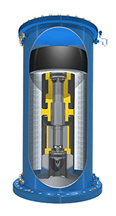
After receiving a $43 million dollar load from the Department of Energy, Beacon POWER has built the first 20 Megawatt flywheel energy storage plant in Stephentown, New York. The flywheel complex stores energy in a kinetic, or mechanical battery. Excess power is sent to the location and turns motors that spins a weight on an axis, a moment of inertia device. When the grid needs more power, the flywheels are slowed down, and energy is collected from the same motor, then acting as a generator.
The flywheel tube has a complete vacuum inside, reducing friction on the magnetically elevated flywheels. The flywheel typically will spin at 8,000 to 16,000 rpm. (The outer edge of the flywheel can approach mach 2, or 1,500 mph.) Each tube is capable of delivering 25 kWh of energy. At the New York installation, 100 of these flywheel tubes will be installed. Full 20 megawatt operation has already begun.
Many more plants are being planned for the other free energy markets in the USA. Future outages and brown outs may soon be a thing of the past.
Eavesdropper
Pictures via Beacon POWER


