


(Left) Back To The Future time machine settings (Right) Ford Traffic Jam Assist sensor diagram
So, Marty McFly arrived to the future just a couple of days ago. And although I have not seen any hovercrafts of flying cars around, it is assuring to know that the Ford Motor Company, along with others, is striving to produce a car that will drive itself during the worst time of any drivers life: traffic.
Automation of the car has happened in steps, from the automatic transmission to self parking cars. Now, Ford Motor Company is developing a system called Traffic Jam Assist (TJA) which is an automated semi-autonomous system that takes over during slow bumper-to-bumper traffic.
TJA uses battery sensors, cameras, laser-range finders, 2.4 GHz microwave radar and ultrasonic transducers to make the car’s computer aware of its changing surroundings.
The system is engaged by simply pressing a button on the dashboard after coming to a stop during slow traffic. The car then calls on its sensors to see lane markings, and gage distances and velocities of surrounding cars so that when traffic moves again, the driver does not need to touch any controls. The car even recognizes cars changing lanes and sudden large objects in front of the vehicle. Once a specific traffic speed increases the system will notify the driver to take over once again. The cut-off speeds are still being researched by Ford.
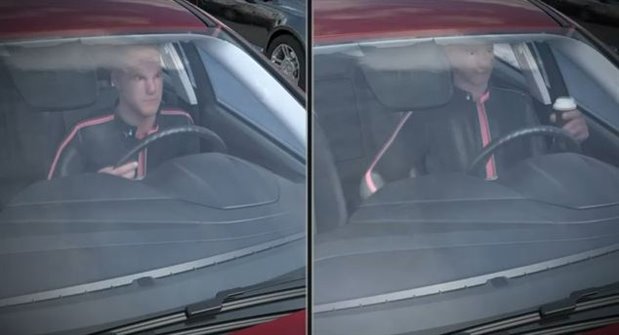
Ford concept video pic. Angry driver on the left. TJA using driver on the right enjoying coffee. (Via Ford)
Hands-off traffic driving technology give drivers a bit of free time during tedious driving conditions. Users could make use of all sorts of gadgets included in the car like the Ford-Sync Bluetooth software or simply enjoy some extra time to relax and catch up on some reading. It is estimated that commuters spend 30% of their time in heavy-traffic, so this possible free time is not something to sneeze about. However, it is hard to imagine giving up control of the car and reading a book while sipping coffee. Simulations predict that if only 1 out 4 cars have TJA, car rides could be reduced by 37% and might also reduce the number of delays by 20%. Recent tests have shown the system to be fully functional, but Ford and other car manufacturers must be assured that their critically thinking software is as safe as it could possibly be. It currently does not take into account animals, pedestrians or cyclist.
TJA technology will launch commercially between 2015 and 2020. For those readers who are not Ford fans, BMW, GM, Audi and Mercedes are also working on similar tech to be released around the same time.
This technology will put us a step closer to fully automated cars that communicate with each other, allowing them to drive at fuel efficient speeds, safely in groups. In this situation, safety means developing software that is protected against (illegal) hackers.
All of these efforts by car manufacturers are being encouraged by government agencies like the National Highway Traffic Safety Administration. Ford has that going for them. Lower emission, stress-free traffic and a bit of extra free time are very well within our near foreseeable future.
Cabe
