element14 Community
element14 Community
    Register Log In
  • Site
  • Search
  • Log In Register
  • Community Hub
    Community Hub
    • What's New on element14
    • Feedback and Support
    • Benefits of Membership
    • Personal Blogs
    • Members Area
    • Achievement Levels
  • Learn
    Learn
    • Ask an Expert
    • eBooks
    • element14 presents
    • Learning Center
    • Tech Spotlight
    • STEM Academy
    • Webinars, Training and Events
    • Learning Groups
  • Technologies
    Technologies
    • 3D Printing
    • FPGA
    • Industrial Automation
    • Internet of Things
    • Power & Energy
    • Sensors
    • Technology Groups
  • Challenges & Projects
    Challenges & Projects
    • Design Challenges
    • element14 presents Projects
    • Project14
    • Arduino Projects
    • Raspberry Pi Projects
    • Project Groups
  • Products
    Products
    • Arduino
    • Avnet & Tria Boards Community
    • Dev Tools
    • Manufacturers
    • Multicomp Pro
    • Product Groups
    • Raspberry Pi
    • RoadTests & Reviews
  • About Us
  • Store
    Store
    • Visit Your Store
    • Choose another store...
      • Europe
      •  Austria (German)
      •  Belgium (Dutch, French)
      •  Bulgaria (Bulgarian)
      •  Czech Republic (Czech)
      •  Denmark (Danish)
      •  Estonia (Estonian)
      •  Finland (Finnish)
      •  France (French)
      •  Germany (German)
      •  Hungary (Hungarian)
      •  Ireland
      •  Israel
      •  Italy (Italian)
      •  Latvia (Latvian)
      •  
      •  Lithuania (Lithuanian)
      •  Netherlands (Dutch)
      •  Norway (Norwegian)
      •  Poland (Polish)
      •  Portugal (Portuguese)
      •  Romania (Romanian)
      •  Russia (Russian)
      •  Slovakia (Slovak)
      •  Slovenia (Slovenian)
      •  Spain (Spanish)
      •  Sweden (Swedish)
      •  Switzerland(German, French)
      •  Turkey (Turkish)
      •  United Kingdom
      • Asia Pacific
      •  Australia
      •  China
      •  Hong Kong
      •  India
      •  Korea (Korean)
      •  Malaysia
      •  New Zealand
      •  Philippines
      •  Singapore
      •  Taiwan
      •  Thailand (Thai)
      • Americas
      •  Brazil (Portuguese)
      •  Canada
      •  Mexico (Spanish)
      •  United States
      Can't find the country/region you're looking for? Visit our export site or find a local distributor.
  • Translate
  • Profile
  • Settings
Publications
  • Learn
  • More
Publications
Blog Form follows function with MIT’s 3D solar array
  • Blog
  • Documents
  • Events
  • Files
  • Members
  • Mentions
  • Sub-Groups
  • Tags
  • More
  • Cancel
  • New
Join Publications to participate - click to join for free!
  • Share
  • More
  • Cancel
Group Actions
  • Group RSS
  • More
  • Cancel
Engagement
  • Author Author: Catwell
  • Date Created: 30 Mar 2012 5:35 PM Date Created
  • Views 573 views
  • Likes 1 like
  • Comments 1 comment
  • research
  • alternative_energy
  • test
  • solar_panel
  • industry
  • hmi
  • on_campus
  • Design
  • cabeatwell
  • prototyping
  • measurement
  • university
  • energy
  • solar
  • sensor
  • innovation
  • photovoltaic
Related
Recommended

Form follows function with MIT’s 3D solar array

Catwell
Catwell
30 Mar 2012

image

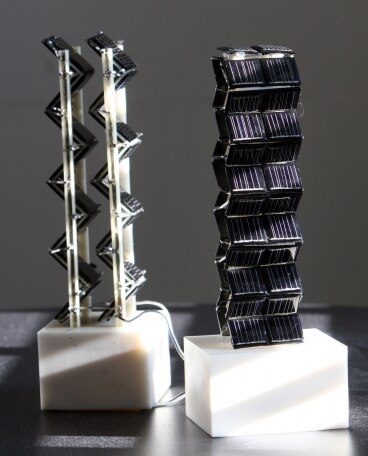
3D Solar Array (via MIT)


Sure, MIT’s 3D solar array may look like art, but its looks are pure function. Unlike sun-tracking solar arrays that follow the fiery sphere along its ecliptic path to maximize its power gathering potential, MIT's 3D solar array is designed to efficiently gather energy by positioning its photovoltaic cells upward. Conceived by Associate Professor Jeffrey Grossman and his team at MIT, the 3D solar array provides more than double (and in some cases 20 times more) the power output than fixed emplacements.


Special computer algorithms were used to test different configurations of cell placement as well as a host of different seasons, weather and locations. The team then went on to build three different configured models based on the algorithmic findings which were then put through a week long testing process. The chosen 3D design was able to beat out current panels even in adverse conditions including overcast skies. According to the propeller-heads, the reason the 3D configuration is better at grabbing energy when the sun is positioned closer to the horizon such as mornings and evenings. The design does have one downside over current set-ups: Money. It costs more to build the 3D array. According to MIT, the energy collected over existing arrays is worth the additional cost to build them. I’ll go one step further in saying that they look more interesting and appealing, as well.


Cabe

http://twitter.com/Cabe_e14

  • Sign in to reply
  • DAB
    DAB over 13 years ago

    There was a post last year on 3D solar cell devices on the MEMS scale.


    Since then I have been wanting to experiment in 3D solar array configurations to see if you could increase the energy harvested per square foot.

    It looks like MIT has looked at the problem from an new angle.  I also like the artistic effect.  Even my wife would approve of a solar collector that doubles as a sculpture.


    Neat post.

    DAB

    • Cancel
    • Vote Up 0 Vote Down
    • Sign in to reply
    • More
    • Cancel
element14 Community

element14 is the first online community specifically for engineers. Connect with your peers and get expert answers to your questions.

  • Members
  • Learn
  • Technologies
  • Challenges & Projects
  • Products
  • Store
  • About Us
  • Feedback & Support
  • FAQs
  • Terms of Use
  • Privacy Policy
  • Legal and Copyright Notices
  • Sitemap
  • Cookies

An Avnet Company © 2025 Premier Farnell Limited. All Rights Reserved.

Premier Farnell Ltd, registered in England and Wales (no 00876412), registered office: Farnell House, Forge Lane, Leeds LS12 2NE.

ICP 备案号 10220084.

Follow element14

  • X
  • Facebook
  • linkedin
  • YouTube